 Key Therapy Practice Success Strategies
Are you a social worker or other mental health provider wondering how to succeed in private practice? Or are you looking for strategies to boost your existing private practice business?
Lynn Grodzki, LCSW, MCC, provided some valuable guidance on on private practice success in her talk “Navigating the New Psychotherapy Marketplace” at the 2014 Psychotherapy Networker Symposium.
As per Grodzki, the [private practice] mental health marketplace has become very competitive vs. 15 or so years ago. In addition to there being a large number of therapists out there, you face:
- Lower insurance reimbursements for providing therapy (since 2000, insurance companies have reduced their mental health outlays from 15% to 1%)
- A reduction in both the number and frequency of sessions per client
- A preference for medication over talk therapy (despite evidence showing that over the long-run, talk therapy either equals or supersedes medication alone)
- Clients/insurance companies/employers have a utilitarian perception of therapy
Note: While Lynn Grodzki shared these insights at the 2014 Psychotherapy Networker Symposium, the challenges she identified have only intensified. The competitive marketplace, insurance complications, and need for strong business strategies remain critically relevant – if anything, even more so with the rise of online therapy platforms, AI mental health apps, and continued healthcare system changes. The core strategies Grodzki outlines for private practice success are timeless fundamentals that apply regardless of when you’re reading this.
Changes in the healthcare/insurance arena, developments in technology/internet, as well as the ways in which many individuals are now viewing and seeking therapy are all playing a role in the field of psychotherapy.
To run a successful practice in today’s competitive environment, Grodzki recommends that you adapt some business strategies that work especially well with educated consumer shoppers.
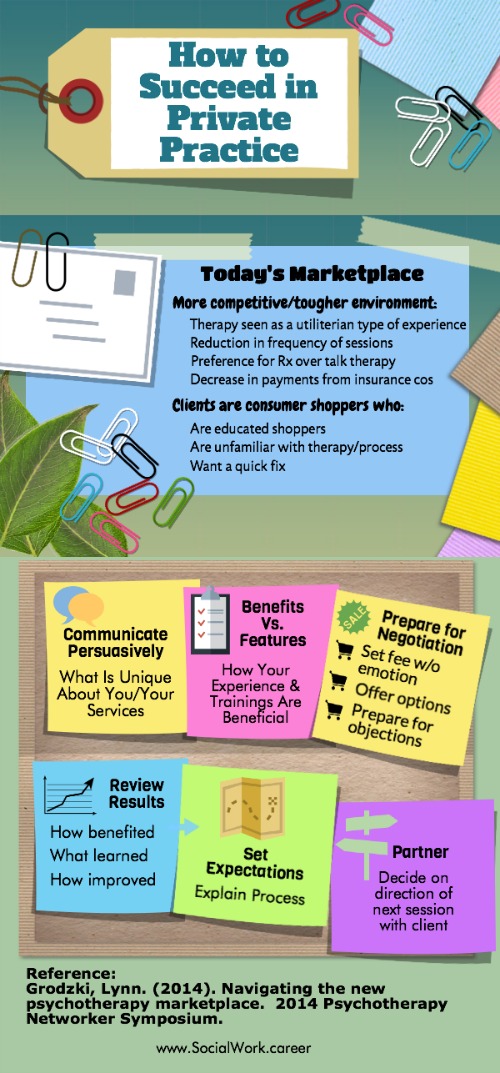
Below is an infographic summarizing the main take-aways that you need to know.
Key Strategies to Succeed in Private Practice
To succeed in private practice in today’s competitive environment, Grodzki recommends adapting business strategies that work especially well with educated consumer shoppers.
Three Pillars of Private Practice Success
Marketing Is Critical
Communicate Persuasively
- Your Unique Selling Proposition – Indicate on your website what is unique about you/your services.
- Your Benefits vs. Features – Translate your experience and training into a benefit that is meaningful to consumers who are are likely to be new to therapy.
- Prepare for Negotiation – This includes thinking about your vision for your practice, setting your fee(s) without emotion, providing a variety of options or packages, and preparing for objections.
- Prepare for First Contact –
- Do not accept a phone or email inquiry the second it arrives or even during your 5 or 10 minute break. This automatically places you at a disadvantage.
- Email/call when you have lots of time and then schedule a 15, 20 or 30 minute time to speak with prospective client. In this manner, the prospective client gets a brief introduction to what therapy feels like (there are boundaries, appointments are scheduled in advance, and he/she will get a little experience of you as a therapist).
- Think through your intentions for this call
- First Half: Are We a Good Fit?
- What things do you want to learn about the client?
- Can you establish a little rapport?
- Are there some disqualifiers ? People who have X problem are not right for me…
- Do you want to try out an intervention? (to see if your styles are compatible)
- Second Half: Closing the Call
- Summarize main issues raised
- Share what you think you can offer
- Talk about logistics (what you charge and how you work)
- Objections may arise at this point…
- First Half: Are We a Good Fit?
“I need someone who takes my insurance.” – Think through in advance of how you want to respond to such statements and then stick with your decision.
Implementing Private Practice Success Strategies
The final key to succeed in private practice is adapting your working style.
- Review Results in Every Session – track goals and progress
- You want to be able to tell your clients how they are changing, improving and/or achieving their goals.
- Set Expectations – provide a metaphor to your clients of what therapy is like and how it may feel to them
- This will help them understand the therapy process and be able to understand that setbacks are part of the process (vs. an excuse for stopping therapy).
- Partner with Client – over the direction of the next session; have an agreement with client session by session.
Your Path to Private Practice Success
Implementing these strategies from Lynn Grodzki can help you succeed in private practice despite today’s competitive marketplace. By focusing on clear marketing, persuasive communication, and adapting your working style to meet clients’ needs, you’ll build a sustainable, thriving practice. Ready to succeed in private practice? Start by implementing one strategy this week, perhaps preparing your response to “I need someone who takes my insurance” or structuring your consultation call template.
Grodzki provides valuable guidance that every mental health professional may benefit from. It is also very much in line with what Taibbi advises in 4 First Session Strategies Every Therapist Should Know.
What are your thoughts/reactions to these ideas? Which of Grodzki’s suggestions are you ready to start putting into action?
Like this post? Please share it!
You May Also Enjoy:
Grodzki, L. (2013). Shopping for therapy. Psychotherapy Networker.
Reference: Grodzki, L. (2014). Navigating the new psychotherapy marketplace. 2014 Psychotherapy Networker Symposium.
Related Resources to Help You Succeed in Private Practice
Building your therapy practice? Explore these essential guides:
Complete Guide to Starting Your Private Practice
In-depth interviews with Tamara G. Suttle, M.Ed., LPC and Michael Langlois, LICSW covering clinical skills preparation, getting first clients, marketing strategies, business systems, and finding your niche.
10 Must-Know Private Practice Start-Up Tips
Visual infographic from expert Tamara Suttle on critical startup strategies including networking, self-care planning, systems establishment, and marathon mindset.
About the author:
Dorlee Michaeli, MBA, LCSW, specializes in EMDR therapy for high-achieving professionals struggling with imposter syndrome. She provides consultation for complex cases involving perfectionism and workplace anxiety. Learn more.
Last updated: January 1, 2026



I find the interactions on this page helpful, but my interest is much on the area of setting up private practice.
In Nigeria and of course Africa, we have a culture of offering our shoulders to friends and family members in need of counseling even when we are not professionals due to the strong bond arising from family tie and close kin relationship. Been your brothers keeper you may say.
Psychotherapy is often seen as unnecessary and patients or clients would rather patronise a native healer or a physician, thus making psychotherapy a no go area. I will appreciate information leading to insight on how to propagate the culture of getting clients or patients to develop interest in seeking professional help by visiting or calling up a professional.
Africa may not be of age in respect of psychotherapy and thus making it difficult for private social workers to make a living from the profession.
Please advice.
Thanks.
Obinwa,
Thanks for stopping by and sharing your dilemma.
I shared your question with a few experienced colleagues and their guidance/thought questions were as follows:
What does therapy offer that family, friends, & healers do not?
Specifically, what help & value can you provide to people’s lives that those others cannot?
It’s a different twist on defining your niche (target market).
When it’s just about sharing feelings and getting support or validation then any shoulder in a storm will do. But, using my own area as an example, cognitive behavioral techniques go beyond just holding someone’s feelings. Proven through research, and robustly so, they provide very specific tools for discovering solutions to issues that originate within the client or external to the client. So, the field has progressed technically, beyond what physicians and healers are trained to do or customarily do. Everyone has their place.
Perhaps to gain entry/recognition, it would be beneficial for you to figure out ways to work in conjunction with or as a adjunct to the native healers and physicians [the recognized therapists]. What added qualities can you bring to the work that they already do?
Hoping this was helpful.
Obinwa,
Another experienced colleague had the following helpful guidance to offer:
She has done two workshops in Northern Ghana and found a welcome reception. As she is a family therapist, she appealed to the importance of family. The secret is knowing the culture and connecting to it. There is great interest in marital therapy, HIV groups, domestic violence prevention and treating alcoholism. However, the approach is out of the traditional therapeutic box. Her African friends tell her they come from the heart and not the head, which resonates with her.
In essence, this advice suggests that you try doing something with establishing a new practice similar to what we do in our regular clinical work with clients. We try to develop a rapport and engage with them as well as meet them where they are.
Another idea you may want to try is to consult with some of your local colleagues/professors.
If you can, please try to come back and let us know what methods you ended up trying that helped you so that others may learn.
Best of luck!
Hello Dorlee,
There is so much good, meaty content in this post for social workers/mental health providers wanting to start-up a private practice, as well as for those who have been in practice a while but may struggle with various aspects (selling, finding right-fit clients and such).
As a private careers practice professional for 18 years, I’ve certainly struggled and refined many of these areas over the years to be both profitable and productive (as well as happier with whom I am engaging). As such, I feel that many of these points are transferable to other industries. Many of us are constantly learning and needing reminding of these foundational details and best practices.
Thank you to Lynn Grodzki and Dorlee for offering up such meaningful information. The customized, ‘snapshot’ infographic is a value-add, as well!
Best,
Jacqui
Jacqui,
Thanks so much for your kind and thoughtful feedback on this post. It is so nice to hear that it resonated with you and that you liked the infographic.
I totally agree with you that much of Lynn Grodzki’s sage marketing and business guidance is quite transferable/applicable across different types of entrepreneurial, consulting or freelancing positions.
Thanks again,
Best,
Dorlee
Overall good info. Personally, I definitely answer the phone if it might be a call from a prospective client, as very likely they will go on to find someone who answers or who has a service that answers, and then they will be gone. If I only had a few minutes, I would have an initial positive interaction and agree to call them right back at a certain time. This has worked great for me over time. (I suppose people can wait if their caseloads are full.) Also, she suggests trying out a sample intervention, to test whether the fit with the client is good from both directions. To me this seems like doing therapy on the phone before there is a contract, and so it feels like a possible liability issue, as well as being out of context to a normal session, unless you are planning to do telehealth, and you use an example that is irrelevant to the person’s issues, but still, it seems perhaps forced and contrived.
Lynn Grodzki is dead right that we need to be clear on our own side regarding what we need for fee, to make our business work, and to convey that amount to the potential client. I’ve seen some beautiful phraseology here and there about how to explain fee as an investment, in the kindest way letting them them know that you will be working hard for them and that there is value in what they will receive. She is pointing out, to the bleeding heart types amongst us (including myself), that this is a business after all, not a charity. Nice graphics to remember her points with.
Note to Therapists: I am SO EXCITED, awaiting the second edition of Lynn’s book, out this spring! It’s been on order since when the second edition was announced, and it’s geared way up for Internet marketing. Check that out online!
Carol,
Thanks so much for sharing your thoughts and reactions!
How interesting that you feel that you might risk losing a client by not taking the call right away. I agree with you that if taking the call and then scheduling a talk for a later time has been working for you, it’s the way to go.
I would look at these strategies as helpful guidelines that may be adjusted according to how you feel makes the most sense for you/your practice.
Thanks for sharing some examples of how one might go about phrasing one’s fees! That is sometimes one of the most difficult areas for therapists to wrap their heads around.
I’m so glad you like the infographic – I thought it was a nice way to highlight Lynn’s key take-aways!
Thanks also for sharing the news about Lynn’s upcoming book – I’m sure it will be chock full of marketing wisdom!
Best,
Dorlee
Totally agree with being authentic & engaging to let the person get a sense of your style & whether or not you’re the right person to work with them. The word intervention threw me at first, since I always think of an intervention as a specific thing you do as part of the therapeutic process, & someone calling on the phone is not in therapy with me. I’ve had several clients, on the initial call, want to work with me on the phone (including wanting to give me a detailed history), to see if we’re a match, which would be risky in terms of liability, since there’s no informed consent in place. (Plus, boundary stuff, of course.) I do ask about safety issues if the person is depressed…. Good article, & I think some of the points are easily adaptable for personal/therapeutic style. Thanks for posting, Dorlee!
Renee,
Thanks so much for sharing some of your experiences on the ground and what sounds helpful from Grodzki’s advice vs. not.
I think vis a vis an intervention, Grodzki was referring more in terms of demonstrating her therapeutic style etc. to confirm that it was one that was compatible with the client vs. actually conducting an “intervention.”
She described herself as someone who gives suggestions and feedback, for example and therefore she said that would make a point of demonstrating this during that first talk so as to find out whether the prospective client feels comfortable with her style…
That said, I agree with you that some of this is also a function of personal style and some therapists may prefer to hold off attempting to offer a suggestion etc. until they’ve established a good rapport with their client.
Best,
Dorlee
Hi Jitendra,
Great question. I’ll keep this in mind for a future blog post!
Best,
Dorlee
I am a social worker but I want practice for mental health ,what is the procedure for open a clinic
Contact.9093093573