Quick Answer: How to Build Mental Strength (Even When Overwhelmed)
Mental strength is the ability to regulate your thoughts, emotions, and behaviors – and it’s not the same as mental health. You can build mental strength regardless of your current mental health state.
3 Core Areas to Regulate
1. Regulate Your Thoughts
- Recognize and replace irrational thoughts
- Ask: What’s the evidence this is true? What’s another way to view this?
- Challenge catastrophic thinking
2. Regulate Your Emotions
- Name your emotions specifically
- Balance emotions with logic
- Face fears gradually (not all at once)
- Engage in mood-boosting activities
3. Regulate Your Behaviors
- Conduct experiments to test assumptions
- Monitor your habits consciously
- Maintain positive habits even when difficult
- Discontinue unhelpful habits
Why Build Mental Strength?
- Improves resilience to handle life’s inevitable challenges
- Increases happiness and life satisfaction
- Enhances brain efficiency for better judgment and decision-making
- Enables you to step outside your comfort zone and problem-solve effectively
Key Insight from Amy Morin, LCSW: “To survive and thrive, having good habits isn’t enough – you have to get rid of bad habits as well.” This is based on her work “13 Things Mentally Strong People Don’t Do.”
Mental strength is built through consistent practice of regulating thoughts, emotions, and behaviors – skills anyone can develop, regardless of their circumstances.
Have you been looking for a way to boost your mental strength, or increase your ability to cope with life’s inevitable stresses and challenges?
Learning how to build mental strength is essential for navigating life’s difficulties, and it’s a skill anyone can develop. If you want to know how to build mental strength effectively, you’ll want to take Amy Morin’s new online course: Mental Strength: Mastering the 3 Core Factors. This course is based upon Amy’s well-known post and subsequent book 13 Things Mentally Strong People Don’t Do [affiliate link].
This post will provide you with a review of the mental strength course, as well as some learnings for those of you looking to increase your resilience and boost your optimal performance. Understanding how to build mental strength can transform how you handle stress, make decisions, and perform at work and home. You may also wish to check out 25 Therapy Quotes: Why Therapy Is Ultimate Self-Care.
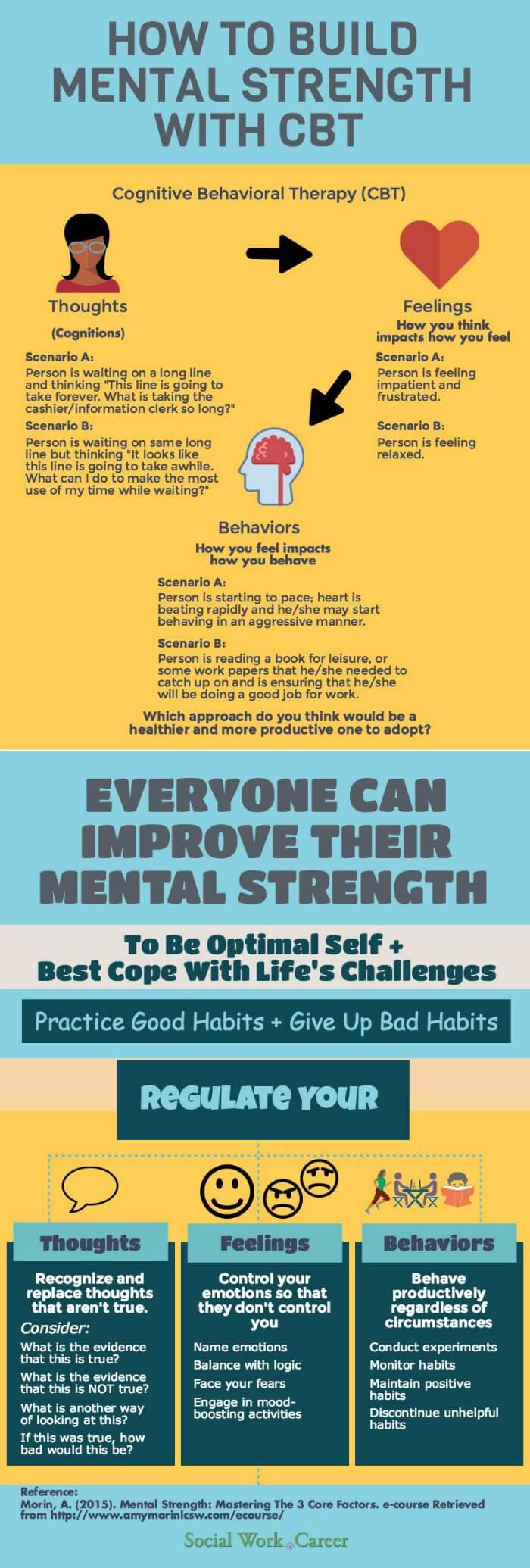
As per Amy Morin, LCSW, a licensed social worker and psychotherapist, we may inadvertently create negative self-fulfilling prophecies by the way we think, feel and behave. This is because the way we think influences our thoughts, which in turn impacts our emotions and ultimately our behaviors, or actions, the underlying premise of cognitive behavioral therapy (CBT). However, by changing the way we think, we’re able to set up a more favorable sequence of events. Please see the graphic below for an example.
Amy’s Journey: How to Build Mental Strength Through Adversity
To backtrack for a moment, Amy developed her expertise in mental strength as a result of having to face and triumph over a number of terrible personal losses. She had lost both her mother and her 26-year old husband in a three-year time frame, both suddenly and unexpectedly. As if this wasn’t difficult or painful enough, she had to cope with anticipatory grief as her father-in-law was diagnosed with terminal cancer a few years later.
The lessons Amy learned from what life threw at her was that in order to survive and thrive, having good habits wasn’t enough; you had to get rid of bad habits as well. Hence, the list, book and ultimately this course to optimize your mental strength were born.
The online Mental Strength course is powerful. It contains the following units:
- The Mental Strength Advantage
- How Your Way of Thinking Can Hold You Back
- Train Your Brain to Think Differently
- How Your Behavior Can Hold You Back
- How to Behave Productively Despite Your Circumstances
- How Your Emotions Can Hold You Back
- How to Control Your Emotions so Your Emotions Don’t Control You
- How to Keep Building Mental Strength
As Amy wisely notes, we all go through difficult times and obstacles. However, building mental strength will fortify you so that you will be able to handle whatever gets thrown your way.
What Is Mental Strength?
How to Build Mental Strength: The Foundation
- Mental Strength = Regulation of Your Thoughts, Emotions & Behaviors
- Mental Strength is NOT the same as mental health; you may increase your mental strength irrespective of your state of mental health.
Mental Strength Tips
- To Regulate Your Thoughts
- Recognize and replace untrue (irrational) thoughts
- What is the evidence that this is true?
- What is the evidence that this is NOT true?
- What is another way of looking at this?
- If this was true, how bad would it be?
- Recognize and replace untrue (irrational) thoughts
- To Regulate Your Emotions
- Control your emotions so that they don’t control you
- Name emotions
- Balance with logic
- Face fears (gradually)
- Engage in mood-boosting activities
- Control your emotions so that they don’t control you
- To Regulate Your Behaviors
- Behave productively regardless of circumstances
- Conduct experiments
- Monitor habits
- Maintain positive habits
- Discontinue unhelpful habits
- Behave productively regardless of circumstances
Why Learn How to Build Mental Strength? It Will:
-
Improve your resilience
-
Increase your happiness
-
Increase effectiveness and efficiency of your brain > Improved judgment and insight (because you’ll be making rational and emotionally balanced decisions)
-
Increase your ability to step outside your comfort zone, and problem-solve
When you understand how to build mental strength, you gain the ability to face challenges with confidence and clarity.
I highly recommend Amy’s Mental Strength course as a comprehensive guide on how to build mental strength. It not only provides you with the knowledge, skills and exercises to regulate your thoughts, emotions and behaviors, but it also provides you with engaging illustrations/games of the various concepts.
Furthermore, it provides you with assessments of where you’re at prior to learning the skills in the course (in terms of managing your thoughts, feelings and behaviors) vs. the end of the course, as well as three subsequent times after you’ve completed the course. You may also repeat the course as often as you like. The ability to measure your progress plus repeat the course are a particularly valuable benefit because the truth is that we are all works in progress, and we are likely to benefit from improving ourselves in a number of different areas (and may need to go through the course a few times to get there)!
Lastly, I believe that this course may be particularly helpful to social workers and other helping professionals. This is not only because we need to be emotionally optimized in order to be fully present to help our clients, but the tools and examples presented may serve as useful illustrations or exercises for us to employ in our work with clients.
About the author:
Dorlee Michaeli, MBA, LCSW, specializes in EMDR therapy for high-achieving professionals struggling with imposter syndrome. She provides consultation for complex cases involving perfectionism and workplace anxiety. Learn more.
Like this Post? Please share it!
Disclosure of Material Connection: I was given free access to the course mentioned above in the hope that I would mention it on my blog. In addition, the link to this course is an “affiliate link.” Regardless, I only recommend products or services I use personally and believe will be good for my readers. I am disclosing this in accordance with the Federal Trade Commission’s 16 CFR, Part 255: “Guides Concerning the Use of Endorsements and Testimonials in Advertising.”
Last updated December 25, 2025


