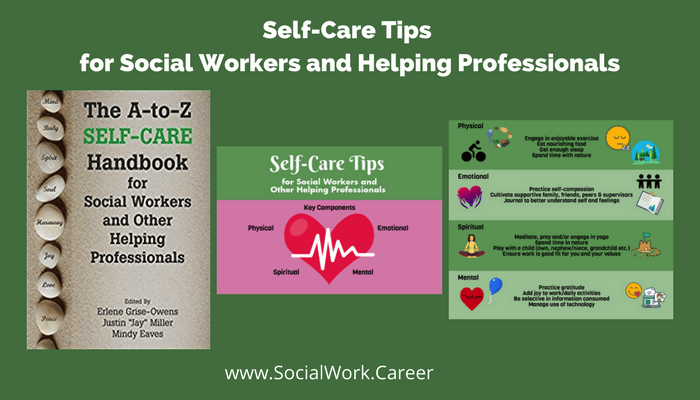
 The A-to-Z Self-Care Handbook for Social Workers and Other Helping Professionals: Book Review
Looking for practical self-care tips for social workers? Are you a social worker or other helping professional who struggles with incorporating self-care into your daily life? If yes, you are likely to find Erlene Grise-Owens, Justin “Jay” Miller, and Mindy Eaves book “The A-to-Z Self-Care Handbook for Social Workers and Other Helping Professionals” [affiliate link] very helpful. This complete A-to-Z guide offers 26 evidence-based strategies to prevent burnout and sustain your ability to help others.
The authors argue that we must see self-care as not only critical for our mental health but as a necessity for ethical practice. Without taking care of ourselves, we will be hindered from providing the best care to our clients and are likely to suffer from stress, burnout, compassion-fatigue or secondary/vicarious trauma.
The authors are themselves practitioners and have put together 26 tips (each one corresponding to a different letter of the alphabet) that have been tested by them.
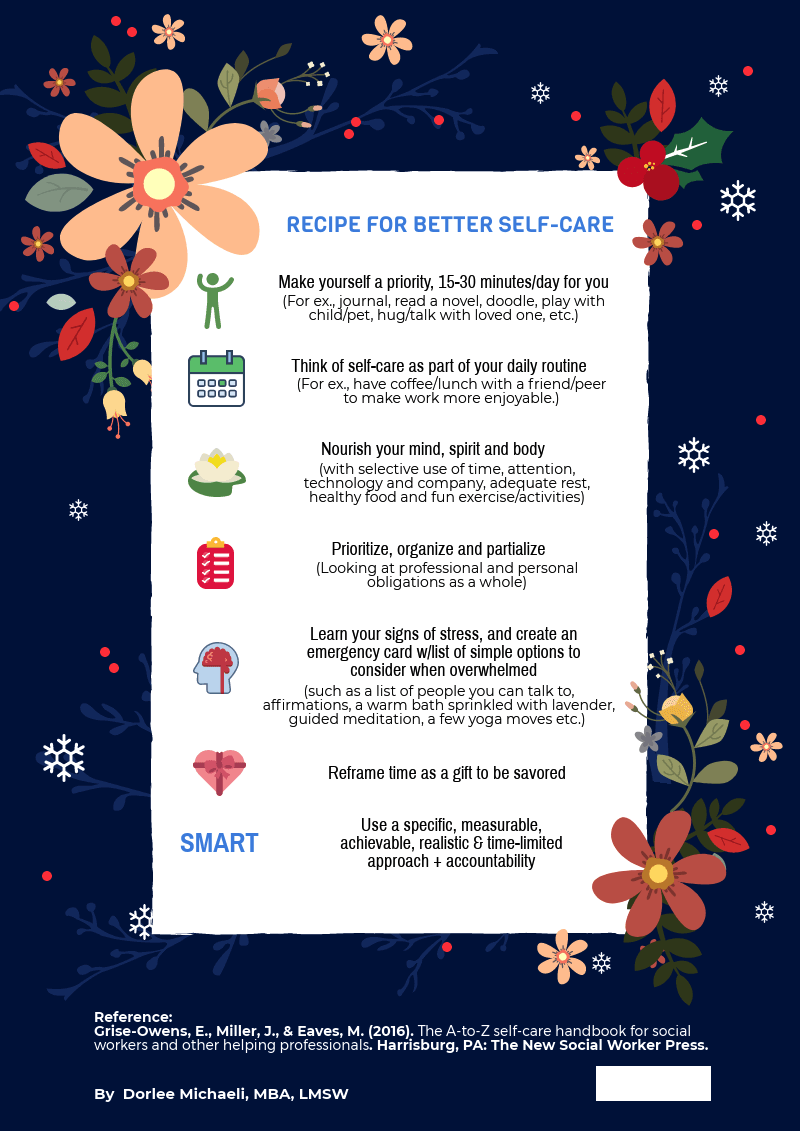
They also provide a template form to make it easy for us to set our specific goals using the SMART method (specific, measurable, achievable, realistic and time-limited) along with accountability measures (to evaluate our progress such as tracking forms/apps).
I highly recommend this book for social workers and helping professionals, as well as caregivers. It provides us with helpful approaches and creative ideas to making self-care a part of our daily life. These include simple activities from journaling and cooking to making changes in the workplace on both an individual and organizational level. I expect to be referring to this book in the future, as I adjust my own work-in-progress self-care plan!
Quick Answer: A-to-Z Self-Care Framework
Self-care isn’t selfish—it’s essential for sustaining your ability to help others. This A-to-Z framework covers 26 evidence-based self-care practices you can integrate into daily life, not just save for weekends or vacations.
8 Essential Self-Care Categories
Physical Self-Care
- Exercise & movement
- Nutrition & hydration
- Sleep quality
- Nature time
Emotional Self-Care
- Mindfulness & meditation
- Journaling & reflection
- Therapy & processing
- Setting boundaries
Social Self-Care
- Quality relationships
- Connection & community
- Asking for help
- Saying no when needed
Spiritual Self-Care
- Gratitude practices
- Purpose & meaning
- Prayer or meditation
- Values alignment
Mental Self-Care
- Learning & growth
- Creative expression
- Problem-solving
- Intellectual stimulation
Professional Self-Care
- Work-life balance
- Time management
- Professional development
- Supervision & support
Playful Self-Care
- Hobbies & interests
- Fun & laughter
- Creative play
- Spontaneity
Environmental Self-Care
- Organized spaces
- Beauty & aesthetics
- Safe environments
- Decluttering
Key Insight: Effective self-care isn’t about adding more to your to-do list. It’s about intentionally choosing practices that replenish your energy across physical, emotional, social, spiritual, mental, professional, playful, and environmental dimensions.
Based on the A-to-Z Self-Care Handbook framework – 26 practical strategies for sustainable wellbeing.
Below is a poem illustrating 8 key take-aways from this book. I’ve purposely chosen the poem format to make writing this review more fun for me, thereby practicing what the authors are recommending, incorporating more joy into my everyday routine.
Simple Ways to Embrace Self-Care
A is for awareness,
Start observing your routine,
When are you feeling stressed?
What areas need improvement?
How are you doing in terms of food, sleep etc.?
B is for balance,
Life balance is a myth!
Determine what’s important,
Build supports; manage technology,
Be selective in your choice of opportunities.
C is for connection,
When and how are you connected?
Who are the people you’re most connected to?
Are they an antidote to your anxiety/stress,
Or are they primarily an added stressor?
D is for diet,
You are what you eat,
This applies to food, information and spirituality,
How can you make what/how you’re consuming…
More nourishing for your body, mind and spirit?
E is for exercise,
Aim for an enjoyable activity,
At least twice a week,
Consider doing simple stretches in bed,
To start your day with an energy boost!
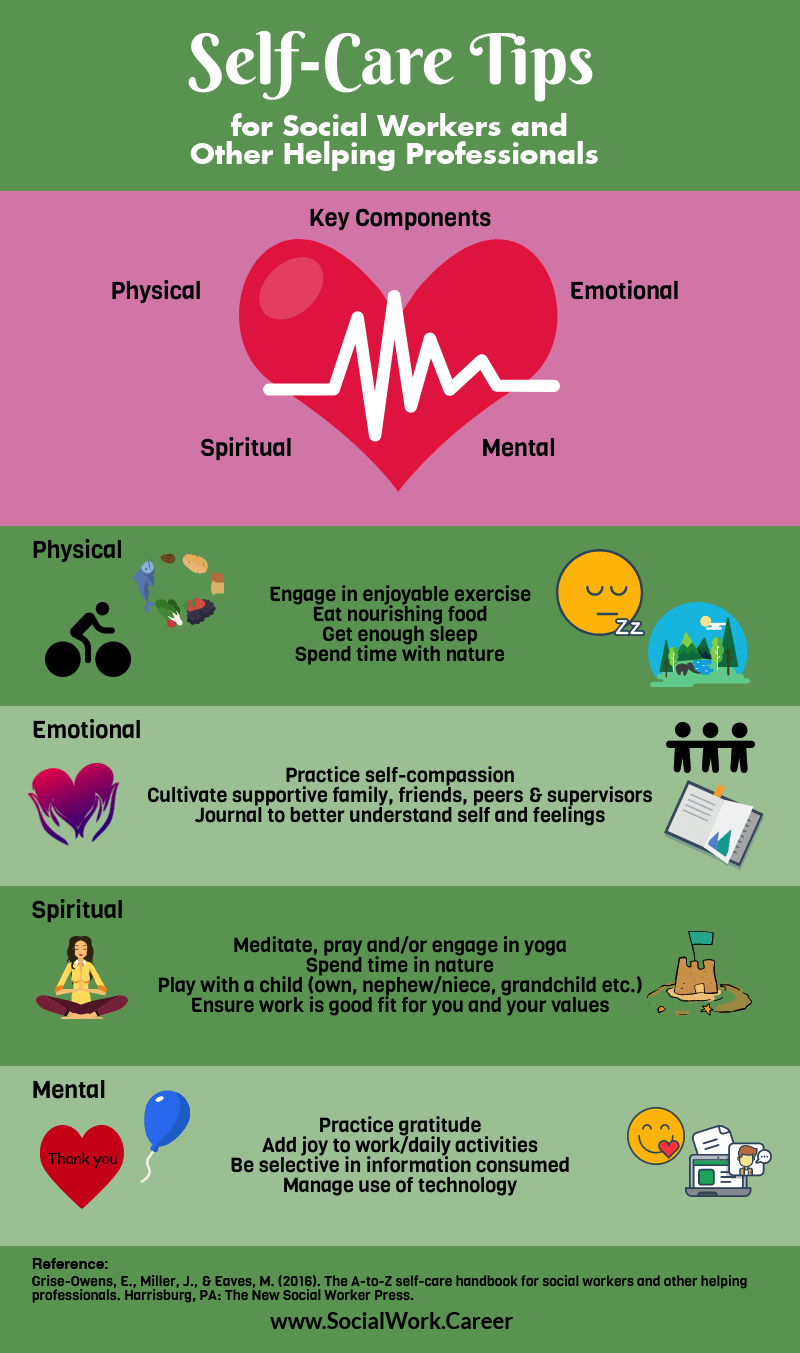
Essential Self-Care Tips for Social Workers: 8 Categories
Jumping to J for job satisfaction,
Create an emergency self-care plan card,
To carry in your wallet,
Why? Because it’s hard to think of self-compassion,
When you are feeling overwhelmed.
K is for kaizen method,
Boost your self-care with small changes,
One positive shift encourages yet another,
There is only so much to know/do,
You’re but one link in a chain!
L is for lifestyle,
Include a contingency plan for your self-care,
Whether it’s stopping to breathe,
Or focusing on the joy in what you do,
Make self-care part of your daily routine!
M through Z: Completing the Self-Care Alphabet
M is for mindfulness
Being present in this very moment
Noticing what’s happening right now
Without judgment or trying to change it
N is for nature
Getting outside
Breathing fresh air
Connecting with the natural world
O is for organizing
Creating order in your environment
Decluttering physical and mental space
Making room for what matters
P is for play
Doing things just for fun
Not everything needs a purpose
Joy is its own reward
Q is for quiet
Turning down the noise
Creating silence and stillness
Letting your nervous system rest
R is for relationships
Investing in meaningful connections
Spending time with people who energize you
Letting go of relationships that deplete you
S is for sleep
Prioritizing rest
Creating bedtime rituals
Honoring your body’s need for recovery
T is for time management
Protecting your calendar
Saying no to what doesn’t serve you
Making space for what does
U is for unplugging
Stepping away from screens
Taking breaks from social media
Reclaiming your attention
V is for values
Living in alignment with what matters most
Making choices that reflect your priorities
Saying yes to what’s truly important
W is for water
Staying hydrated
Nourishing your body
Supporting your physical health
X is for X-ray vision
Looking beneath the surface
Examining what’s really going on
Understanding your deeper needs
Y is for yes
Saying yes to yourself
Yes to rest, yes to joy, yes to boundaries
Yes to what you truly need
Z is for zest
Finding enthusiasm for life
Cultivating energy and vitality
Living fully, not just surviving
Frequently Asked Questions About Self-Care
How do I find time for self-care when I’m already overwhelmed?
Self-care doesn’t have to mean adding more to your schedule. Start with micro-practices: 3 deep breaths between clients, drinking water mindfully, a 5-minute walk, or saying no to one thing. The most effective self-care often happens in small moments throughout the day, not just during scheduled “self-care time.”
What’s the difference between self-care and self-indulgence?
Self-care replenishes your energy and supports your wellbeing long-term. Self-indulgence might feel good in the moment but doesn’t truly restore you (like binge-watching TV when you need sleep, or stress-eating when you need to process emotions). Ask: “Will this help me show up better tomorrow?” If yes, it’s self-care.
Can self-care prevent burnout in helping professionals?
Yes, but only when practiced consistently across multiple dimensions—physical, emotional, social, spiritual, mental, professional, playful, and environmental. Research shows that social workers and therapists who practice regular self-care across these areas have significantly lower rates of burnout, compassion fatigue, and secondary traumatic stress.
Why does self-care feel selfish?
Many helping professionals were trained to prioritize others’ needs above their own. This creates guilt around self-care. However, you cannot pour from an empty cup. Self-care isn’t selfish—it’s essential for sustaining your ability to help others. When you care for yourself, you model healthy boundaries and show up more present and effective for clients.
Which self-care category should I focus on first?
Start with the category where you’re most depleted. If you’re exhausted, prioritize physical self-care (sleep, exercise, nutrition). If you’re isolated, focus on social self-care. If you’ve lost meaning in your work, explore spiritual self-care. The A-to-Z framework helps you assess which dimensions need attention and choose practices that address your specific needs.
Lastly, to obtain valuable guidance on each of the tips mentioned, read: “The A-to-Z Self-Care Handbook for Social Workers and Other Helping Professionals!”
What would you like to add to your daily/weekly routine of self-care? Please share in the comments section below 🙂
Reference:
Grise-Owens, E., Miller, J., & Eaves, M. (2016). The A-to-Z self-care handbook for social workers and other helping professionals. Harrisburg, PA: The New Social Worker Press.
You may also enjoy reading:
How to Build Mental Strength (Even If You’re Overwhelmed)
Re-energize and Provide the Best Therapy
Disclosure of Material Connection: I received one copy of the book mentioned above for free in the hope that I would mention it on my blog. In addition, the link to this book is an “affiliate link.” Regardless, I only recommend products or services I use personally and believe will be good for my readers. I am disclosing this in accordance with the Federal Trade Commission’s 16 CFR, Part 255: “Guides Concerning the Use of Endorsements and Testimonials in Advertising.”



Dear Dorlee,
I love the poetic overview of takeaways. That’s brilliant.
Here is one of my favorite ‘stanzas’:
K is for kaizen method,
Boost your self-care with small changes,
One positive shift encourages yet another,
There is only so much to know/do,
You’re but one link in a chain!
Such a good reminder – change happens, one link at a time; before you know it, you’ll have pieced together not only a chain, but in many cases a cohesive story that reveals your larger intentions. You can witness your goals materializing, over time.
I also really liked the idea of creating an emergency self-care plan card, to carry in your wallet (to help remind us what to do amid overwhelm!).
Thanks so much for another well-thought-out post that will help many of us in your audience with ‘go-to’ tools for daily self care.
Your blogging fan + friend,
Jacqui
Dear Jacqui,
Thanks so much for your kind feedback and thoughtful comment!
I’m so glad the Kaizen method stanza and the emergency self-care card resonated with you.
Regarding the “one link in a chain” piece, I love how you interpreted it as a continuation of the theme of one small positive change triggering further positive changes.
I had actually been referring to the fact that we as mere mortals only have so much knowledge/control and to recall this when we are trying to help someone to enable us to be both more patient and compassionate with our clients, as well as with ourselves when change is happening at a slower pace than they or we would like.
To further elaborate, this was a theme that Jack Kornfield had also raised in a talk about psychotherapy and mindfulness/meditation – we are given the honor of hearing so many people share their troubles with us but we cannot carry these home with us. We need to recognize that we are only humans and there is a higher power, god, the universe etc.
I so appreciate your support and friendship!
Warmly,
Dorlee
Dorlee,
I’m so grateful you elaborated on the Kaizen reference; I love the intended meaning, especially the aspect of (and I’m paraphrasing) ‘not carrying (all of our clients’) troubles home with us. ‘
Patience/compassion with our clients as well as ourselves is soooo important, and not always easy.
And YES, recognizing that we are only humans – there is a higher power. Yes, YES.
Thank you, again!
Jacqui
Thanks so much, Jacqui!
I most appreciate your value-added thoughts and comments.
Warmly,
Dorlee
It was my pleasure, Erlene
I loved the variety of self-care ideas and creative ways of incorporating them into one’s daily life.
Thank you for this wonderful review! I love how you succinctly summarize the entries! Take Care! ✌????✌????