Self-compassion, as per Kristin Neff, PhD, a pioneering self-compassion researcher, entails giving ourselves “the same kindness and care we’d give a good friend.” Self-kindness will not only help increase our ability to cope with difficulties, but also help us succeed.
A few weeks ago, I was most fortunate in being able to meet Dr Kristin Neff and attend her wonderful NYC workshop “The Art of Self-Compassion: Accepting your Imperfections.” This post will provide you with key learnings and exercises to help you bring self-compassion into your daily life. Part two of this post will focus on Neff’s recommendations to avoid empathy fatigue or burnout.
Quick Answer: Self-Compassion Tips to Boost Wellbeing
Self-compassion is treating yourself with the same kindness, care, and understanding you would offer a good friend during difficult times. Research by Kristin Neff shows it’s more effective than self-esteem for building lasting wellbeing.
3 Core Components of Self-Compassion
1. Self-Kindness (vs. Self-Judgment)
Be warm and understanding toward yourself when you suffer, fail, or feel inadequate, rather than ignoring pain or being harshly self-critical.
2. Common Humanity (vs. Isolation)
Recognize that suffering and personal inadequacy are part of the shared human experience – you’re not alone in your struggles.
3. Mindfulness (vs. Over-Identification)
Observe negative thoughts and emotions with balance – neither suppressing nor exaggerating them. Hold your experience in awareness without becoming consumed by it.
Why Self-Compassion Feels Hard (The “Backdraft” Effect)
When you first practice self-compassion, you may experience “backdraft” – painful emotions that surface when you finally offer yourself kindness. This happens because:
- You’re accessing old pain that’s been suppressed or ignored
- Kindness toward yourself may feel unfamiliar or undeserved
- You’re finally safe enough to feel what you’ve been holding back
What to do: Start with small doses. If self-compassion feels overwhelming, practice compassion for others first, then gradually extend it to yourself.
Practical Self-Compassion Exercises
- Self-Compassion Break: When struggling, say: “This is a moment of suffering. Suffering is part of life. May I be kind to myself in this moment.”
- Supportive Touch: Place your hand over your heart or give yourself a gentle hug. Physical gestures activate the care system in your brain.
- Write a Letter: Write to yourself from the perspective of a compassionate friend who sees your situation clearly and with kindness.
- Change Your Self-Talk: Notice harsh inner criticism and ask, “What would I say to a friend in this situation?” Then say that to yourself.
Research Finding: Self-compassion is strongly associated with emotional wellbeing, lower anxiety and depression, and healthier relationship patterns. Unlike self-esteem (which depends on success), self-compassion remains stable even during failure.
Based on Kristin Neff’s research on self-compassion and wellbeing from Self-Compassion.org
Self-Compassion for Mental Health Professionals: Preventing Empathy Fatigue
If you work in mental health, you’ve likely heard the term “compassion fatigue.” But Kristin Neff’s research challenges this concept. There is no such thing as compassion fatigue. You cannot feel too much compassion for yourself or others. What exists is empathy fatigue – the exhaustion that comes from absorbing clients’ emotions without adequate self-care and self-compassion.
The Distinction: Empathy fatigue occurs when you’re constantly attuned to clients’ pain without replenishing your own nervous system. Self-compassion – treating yourself with the same kindness you offer clients – is the antidote. The more self-compassion you practice, the more sustainable compassion you can offer others.
Why Mental Health Professionals Struggle with Self-Compassion
Mirror neurons are brain cells that fire both when we perform an action and when we observe someone else performing it. As a therapist or social worker, your mirror neurons are constantly activated by your clients’ emotional states. This is what allows you to empathize deeply – but it also means you’re absorbing their nervous system activation.
Without intentional self-compassion practices, this constant mirroring depletes your own emotional resources. The solution isn’t to care less – it’s to care for yourself with the same intentionality you care for clients.
On-the-Job Self-Compassion Techniques
You don’t need to wait until after work to practice self-compassion. These techniques can be used during sessions or between clients:
1. Soothing Words in the Moment
When you feel activated by a client’s pain, silently say to yourself:
- “This is hard. I’m doing my best.”
- “I’m not alone in this. Other therapists feel this too.”
- “May I be kind to myself in this moment.”
- “I can handle this. I have resources.”
These phrases activate your care system and help regulate your nervous system without requiring you to leave the session.
2. Serenity Prayer Adaptation
When you feel overwhelmed by a client’s situation, use this adaptation:
“Grant me the serenity to accept what I cannot change in my client’s life, the courage to support what they can change, and the wisdom to know the difference – and to care for myself in the process.”
This reminds you that you’re not responsible for solving your client’s problems – only for showing up with compassion and skill.
3. Self-Compassion Break Between Clients
Between sessions, take 1-2 minutes to:
- Place your hand over your heart
- Take three deep breaths
- Say: “That was hard. I showed up with care. I’m doing my best. Now I reset for the next person.”
- Shake out your body or move to reset your nervous system
This prevents emotional residue from one session bleeding into the next.
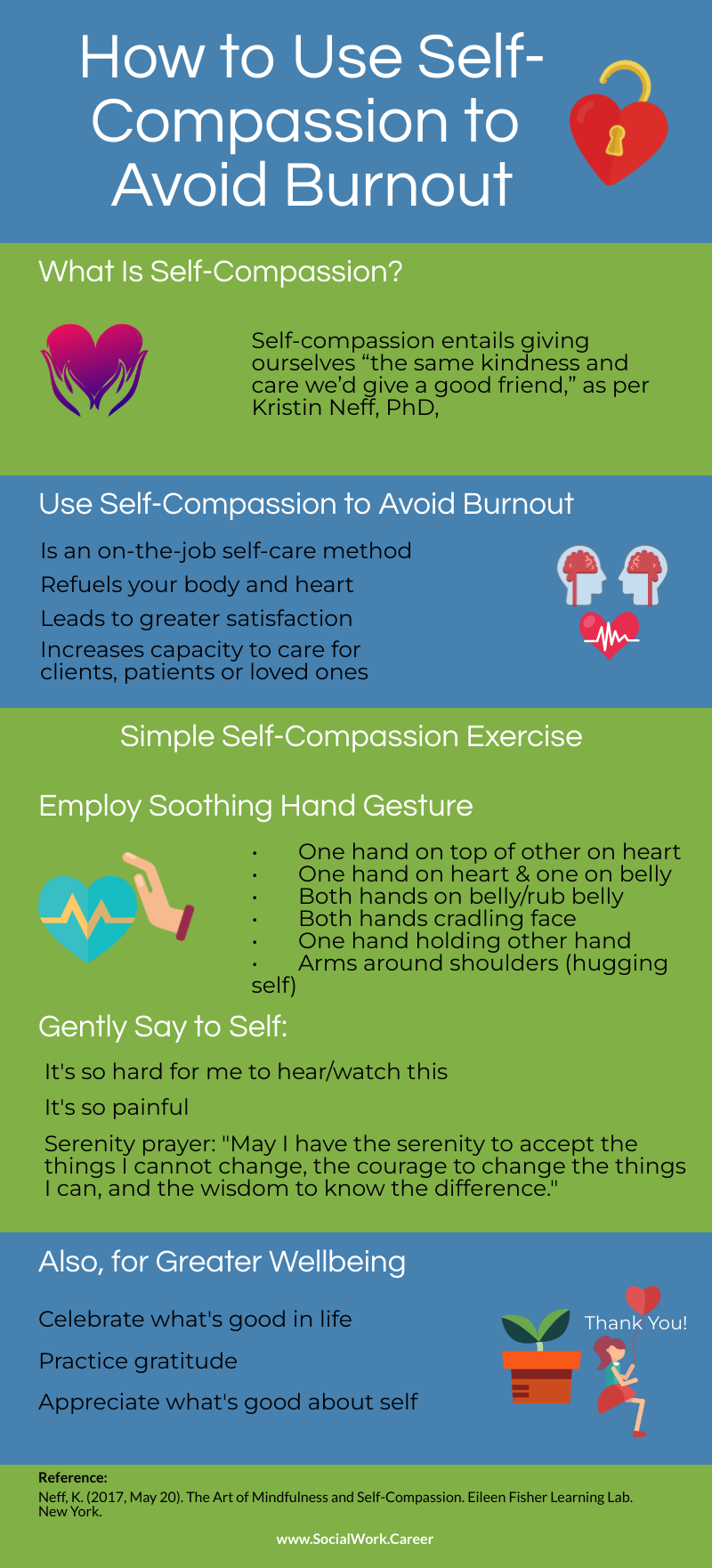
Visual Guide: On-the-Job Self-Compassion Techniques
Here’s a visual breakdown of specific self-compassion techniques you can use while working with clients:
The Bottom Line: Self-Compassion Is Professional Practice
Practicing self-compassion isn’t selfish or self-indulgent. It’s essential professional practice. When you treat yourself with kindness and understanding, you:
- Prevent empathy fatigue and burnout
- Model healthy self-care for clients
- Show up with more authentic presence and compassion
- Build sustainable career longevity
- Maintain your own mental health
“There is no such thing as compassion fatigue. You cannot feel too much compassion for yourself or others. There is only empathy fatigue.” – Kristin Neff
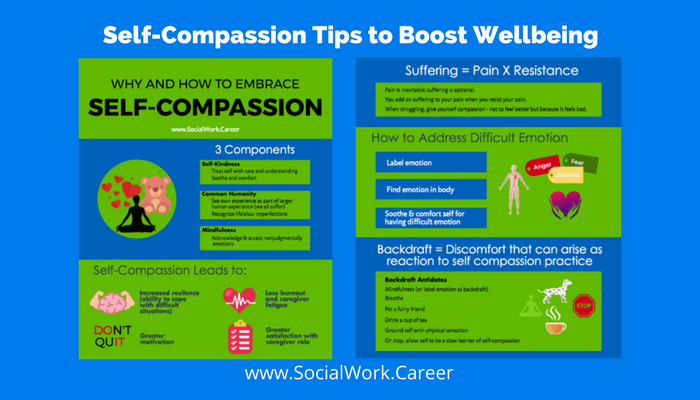
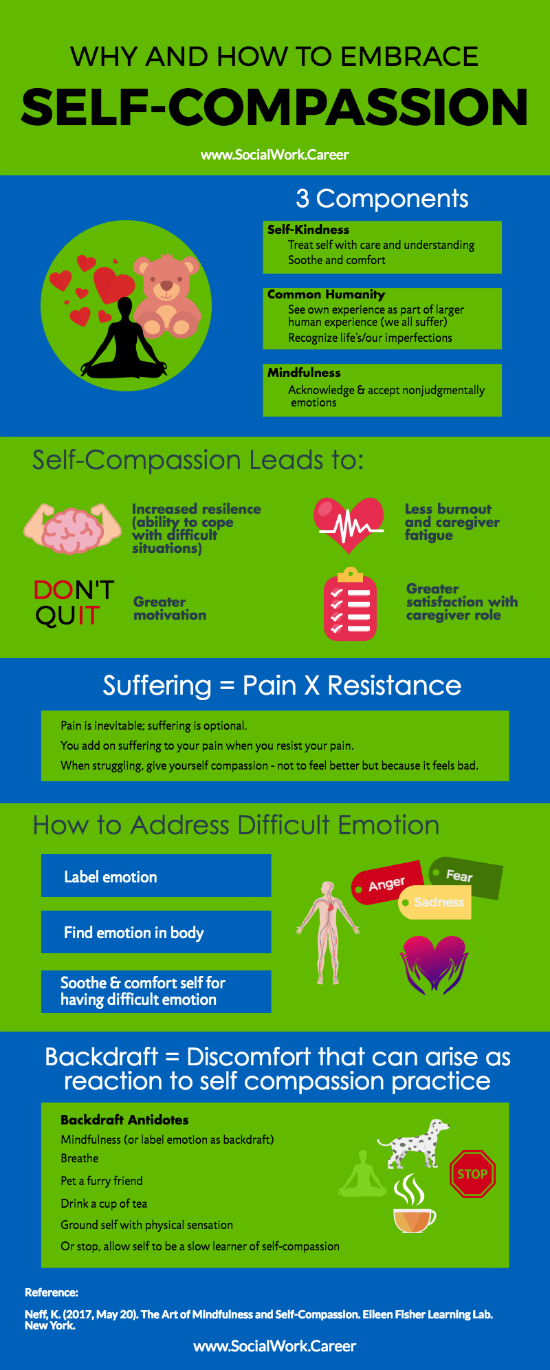
Self-compassion consists of self-kindness, common humanity and mindfulness.
-
Self Kindness (vs. Self Judgment) refers to:
- Treating yourself with care and understanding rather than harsh judgment
- Actively soothing and comforting, supporting to protect self
- Having the desire to alleviate suffering (any pain or emotional discomfort)
-
Common Humanity (vs. Isolation) means:
- Seeing your own experience as part of the larger human experience
- Understanding that it is normal to suffer and struggle
- Recognizing that life is imperfect (us too)!
Our unconscious assumption is that normal is perfect. This, in turn, leads us to feel isolated in our suffering when something goes wrong. When you realize and acknowledge how suffering is part of life and that we all suffer, you are no longer alone in your pain, and are more likely to share what is going on with someone and be comforted.
In addition, it may sometimes be beneficial to consider that whatever you are going through could be worse, and it could be better.
-
Mindfulness (vs. Over Identification) helps us:
- Accept, or “be” with powerful feelings as they are
- Avoid the extremes of suppressing, or running away with painful feelings
Some of us may like the idea of self-kindness but have a few misgivings about actually employing it towards ourselves. We assume that it may be indulgent, self-centered, or take away our drive and motivation to succeed. Neff explains how research shows that these misconceptions are false. In reality, self-compassion decreases negative emotions/results, and increases positive emotions/results!
Specifically, self-compassion is positively linked to coping and resilience. For example, Neff shares that when employing self-kindness, veterans are less likely to suffer from PTSD than those who beat themselves up, and individuals are better able to cope with divorce and get through hard times.
Self-compassion is also positively associated with motivation. This is because when you are less afraid of failure/mistake, you are more likely to try again and persist in efforts after a failure. You are also more likely to take responsibility for mistakes and have the motivation to fix them. Therefore, address test (or interview) anxiety with self-compassion. You are more likely to be able to pick yourself again if you don’t do well on the test (or interview).
In addition, self-compassion is a valuable tool for caregivers (and mental health professionals). It helps them experience less burnout and caregiver fatigue, as well as greater satisfaction with caregiver role.
Suffering = Pain x Resistance (exponential rather than multiplicative)
Pain is inevitable; suffering is optional. We add on suffering when we resist the pain.
As Neff explains, if you resist your pain, compassion will fail you. In a moment of struggle, we give ourselves compassion, not to feel better but because we feel bad. Self-compassion provides the emotional safety needed to mindfully be open to our pain.
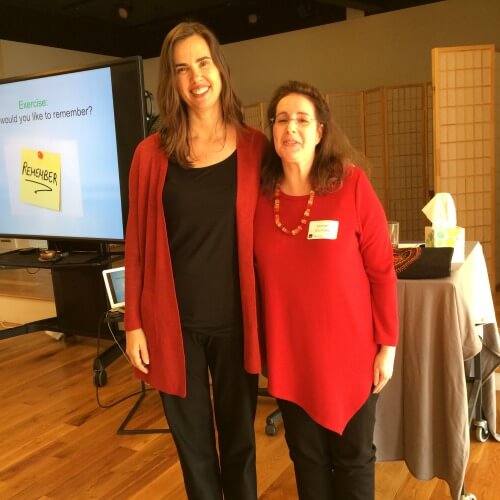
So excited to have met Dr Kristin Neff !
Below are two exercises to help you be more self-compassionate when you are either facing a painful/difficult situation or emotion.
Soothing Touch/Self-Compassion Break Exercise
Part 1: Experiment to find out which touch feels [most] soothing to you.
Close your eyes and notice what you feel after placing:
- One hand on top of the other over your heart.
- The other hand on top of your hand over your heart [notice which order feels most soothing].
- One hand on your heart and one hand on your belly.
- Both hands on your belly.
- Rub belly.
- Your hands around your face so that you are cradling it with both your hands.
- One hand above the wrist of the other hand.
- Your arms around your shoulders so that you are hugging yourself.
One or more of the above hand motions is likely to feel most soothing to you, and is a gesture you may engage in for a few minutes when you need some comfort.
Part 2: Touch + Kind Words
Think of a current difficulty and say to yourself in a gentle voice:
- It is difficult
- It is a normal part of life; suffering is a normal part of life
- Place hand in soothing gesture
How to Cope with Difficult Emotion Exercise
- Label emotion in neutral tone – this helps the brain feel less emotional and calm down, and gives you a sliver of time to disengage with difficult emotion.
- Find the emotion in your body – ask yourself, where do I feel the anger, fear or disgust ? Many people feel their anger in their gut. By identifying where you feel your difficult emotion, you will stay present without getting lost in the feeling.
- Soothe and comfort yourself for having difficult emotion (as suggested in Soothing Touch/Self-Compassion exercise above)
Backdraft refers to the discomfort that may arise as a reaction to self-compassion practice. Part of the transformation process is to experience resistance to self-compassion.
It includes an uncomfortable feeling arising in you and/or negative reactions from others. Part of the cause for backdraft is that you begin to recognize lack of self-compassion experienced in the past when you see what self-compassion looks like.
To deal with backdraft, try:
- Mindfulness, or labeling emotion as backdraft
- Breathing
- Petting a furry friend
- Drinking a cup of tea
- Grounding yourself with a physical sensation
- Or stopping your self-compassion practice [allow yourself to be a slow learner]
How to Address Self-Criticism?
- Show your inner critic some self-compassion. It is trying to:
- Keep you safe from any perceived threats to your survival
- Motivate you to improve
- Beat others to the punch – this gives you an illusion of strength, power and control
- For some, replicate the internal voice of caregiver(s), whom you had to listen to for survival
- Don’t wait to see imperfections (we falsely believe that we can make disappear by focusing on them)
- Make mistakes in front of others. Research shows that if you criticize yourself in front of others, no one else has to, and you’re more likely to get praise.
Frequently Asked Questions About Self-Compassion and Burnout:
What is self-compassion and why is it important?
Self-compassion is treating yourself with kindness during difficult times, recognizing that struggle is part of being human. It’s important because research shows it reduces anxiety, prevents burnout, and builds lasting emotional resilience, especially crucial for caregivers and helping professionals.
How is self-compassion different from self-esteem?
Self-compassion focuses on how you treat yourself during struggles, while self-esteem measures how positively you view yourself. Unlike self-esteem, which drops during failure, self-compassion remains stable and doesn’t require comparing yourself to others or achieving success.
Can self-compassion make me lazy or unmotivated?
No, research shows the opposite. Self-compassion actually increases motivation because when you’re less afraid of failure, you’re more likely to try again, persist after setbacks, and take responsibility for mistakes. It provides a secure base for growth rather than harsh criticism.
What are simple self-compassion exercises for beginners?
Start with the Self-Compassion Break: When struggling, acknowledge “This is a moment of suffering,” remind yourself “Suffering is part of life,” and say “May I be kind to myself.” Combine this with supportive touch, like placing your hand over your heart.
How long does it take to develop self-compassion?
While some people notice benefits within weeks of regular practice, developing deep self-compassion typically takes several months of consistent exercises. Start with small doses and be patient—ironically, being compassionate about your journey to self-compassion is part of the practice.
What’s the difference between compassion fatigue and empathy fatigue?
According to Kristin Neff, there’s no such thing as compassion fatigue—you cannot feel too much compassion. What caregivers experience is empathy fatigue. Empathy means feeling others’ pain, while compassion includes kindness toward that suffering. When you practice self-compassion alongside empathy for others, you create a protective buffer against burnout.
How can I practice self-compassion while actively caring for clients or patients?
Use self-compassion as an “oxygen mask in the moment.” When feeling overwhelmed by someone’s suffering, pause and say: “It’s so hard for me to hear this right now. It’s so painful.” You can also use the Serenity Prayer or place a soothing hand on your heart. These on-the-job techniques work better than traditional off-the-job self-care like massage or yoga because they’re available exactly when you need them.
Is self-compassion just for therapists and caregivers?
No—while self-compassion is particularly valuable for preventing burnout in helping professionals, it benefits everyone. Whether you’re dealing with work stress, relationship difficulties, parenting challenges, or personal struggles, self-compassion provides emotional resilience and reduces anxiety and depression.
Won’t focusing on myself make me less effective at helping others?
Actually, the opposite is true. Self-compassion provides you with the emotional resources to care for others more effectively. When you only experience empathy without self-compassion, you absorb others’ pain with nothing to balance yourself. Self-compassion creates a protective buffer that allows you to sustain your caregiving without burning out.
What’s the negativity bias and how does it relate to self-compassion?
Our brains naturally focus on negative experiences over positive ones at a 7:1 ratio—a survival mechanism. This makes self-criticism feel more natural than self-compassion. However, you can train your brain through practices like gratitude, celebrating what’s good, and acknowledging your own positive qualities. These practices, combined with self-compassion, help rebalance your brain toward wellbeing.
Find Inner Compassionate Voice Exercise
- Identify behavior – think about a changeable habit that is causing a problem that you criticize yourself for and would like to change (for ex., eating, exercise, sleep etc.).
- Describe the problem(s) that behavior is causing in your life.
- Consider the types of things you say to yourself when you are being critical about yourself vis a vis that behavior (also keep in mind your tone of voice).
- Switch perspective to the part of yourself that is receiving the criticism. How does the criticism make you feel? (review above statements in step 3)
- Write some words of compassion and understanding towards that [wounded] part.
- Turn towards inner critic. Become curious as to what is going on. Ask yourself: Is there some way it is trying to keep me safe?
- Write some words of thanks to your inner critic.
- Ask self-critic to leave space for self-compassion (include some words of wisdom and encouragement to yourself from statements in step 5).
Meet yourself where you are. If you are unable to access compassionate voice, acknowledge pain of inability to access compassionate voice [for now].
Neff also provides valuable guidance on how we may employ self-compassion to assist as caregivers or mental health professionals in Self-Compassion as an Antidote to Empathy Fatigue.
Like this post? Please share it!
References:
Neff, K. (2017, May 20). The Art of Mindfulness and Self-Compassion: Accepting your Imperfections. Eileen Fisher Learning Lab. NYC.
Neff, K. (2017). Self-Compassion
Last updated: January 2026



Hi Sidonna,
You offer wise counsel! Having ones’ own therapist, as well as nourishing food and friendships, are key to our wellbeing. I’m wondering whether weekly (or bi-weekly) supervision beyond those required hours may also be advisable.
I’m so sorry to hear about your good friend, and hoping that you’re making sure to take good care of yourself.
Sending you a virtual hug.
A healthy lifestyle includes your own therapist (when and if needed), a balanced diet with less fat, sugar and salt and more vegetables and fruits and nourishing relationships.
As a whole, social work needs to confront our rate of obesity and find ways to get accurate, knowledgeable and medical information to our members.
It is apparent from the loving care we give our patients and clients that we often “absorb” their aches and wounds leading to ill-health and lack of mental and emotional care for ourselves.
I write this for my good friend, “T”, who died too soon because she could not care for others and her self. She chose others and she is gone from us.
Maintaining self-care is a huge deal, especially as a social worker when we are always helping others and burn-out becomes a reality!
I think you should find something that you really enjoy doing (i.e. Exercise, meditation, prayer, spending quality time with friends & family, etc…) and take part in it often.
It’s important not to think about or talk about your work or personal troubles while participating in your favorite activity.
I like to walk in the park/on the track during the weekends and I also love going to the spa. I try to treat myself to the spa as often as possible and just concentrate on myself.
Find whatever keeps you sane, grounded & happy then just run with it!
Thanks so much, Pascale for sharing your guidance on how to avoid burnout.
Being fully present (mindful) while participating in your chosen activity is truly a way to maximize the time and activity you’ve allocated to self-care!
Thanks so much, Cleonie, for sharing how you use daily connection to nature as your method of self-care!
It helps one recharge in such a positive life-sustaining manner 🙂
I recommend daily connection to nature [for self-care]. It is so easy to spend days indoors, especially when the weather is not ideal.
Research shows that we are hard wired to seek connections to nature. It is during my walks outside when my most creative thoughts come to me.