Motivational interviewing is a powerful client-centered approach that helps clients make lasting behavioral changes. Whether you’re working with substance use, chronic health conditions, mental health issues, or co-occurring disorders, motivational interviewing (MI) respects autonomy while evoking intrinsic motivation to change.
This complete guide to motivational interviewing features an in-depth interview with Kathleen Sciacca, a trainer and pioneer in integrated treatment for co-occurring disorders. Her motivational interviewing programs have been implemented across numerous states and communities..
Motivational Interviewing is grounded in Carl Rogers’ “client-centered” counseling and “empathic reflective listening.” As Kathleen emphasizes, “These are the pervasive elements of MI’s practice and spirit.” This approach facilitates change across a range of health behaviors—from addiction recovery to medication adherence, weight management to domestic violence prevention.
In this comprehensive guide, you’ll learn:
- What motivational interviewing is and its foundation in Carl Rogers’ work
- The OARS skills (Open questions, Affirming, Reflective listening, Summarizing) plus evoking change talk
- The 4 MI processes: engagement, focusing, evoking, and planning
- How MI integrates with Stages of Change (Prochaska & DiClemente)
- Specific techniques for each stage: pre-contemplation through maintenance
- Change talk vs. sustain talk and how to strengthen commitment
- Practical case examples showing MI in action
- Resources and training to deepen your MI skills
Whether you’re new to motivational interviewing or looking to refine your practice, this guide provides the theoretical foundation and practical techniques you need to help clients move from ambivalence to action.
Section 1: Understanding Motivational Interviewing – The Foundation
What Is Motivational Interviewing?
And now, without further ado, Kathleen, could you please expand upon your initial comment about Motivational Interviewing?
The depth to which Rogers’ client-centered approach can evoke a client’s intrinsic understanding and motivation to change is phenomenal. As a communication style MI requires transitioning from traditional question answer advice giving “expert” grounded interventions to a set of five core interviewing skills that must be used as a comprehensive skill set.
These are known as OARS – Open questions, Affirming responses, Reflective listening, Summarizing and the fifth is “evoking and reinforcing” client change talk—one of the research based elements of MI. I repeatedly observed how this communication style works and I have maintained that Carl Rogers’ empathic reflective listening is the most potent intervention in MI practice.
Kathleen Sciacca’s Background: From Business to Pioneering Dual Diagnosis Treatment
Before deep-diving into MI, could you share with us a bit of your background? What led you into the field of mental health?
I started out on a very different unplanned path whereby I advanced in business, accounting and comptroller positions. As I became more aware of myself and the world around me, I found the work lacked “meaning” and it was not the way I wanted to spend a good portion of my life. Inadvertently, I learned about psychotherapy and knew that was the work I wanted to do. For me, it was work that could make a positive difference in people’s lives.
When I returned to school to study psychology, I was 28 years old and a single parent with two children. I worked full time and did my undergraduate and graduate work in the evenings for about eleven years. I was fortunate to find my first job in the field as the administrator for a group leading training institute. This was the theme-centered group-leading model developed by Ruth C. Cohn, a pioneer and genius in her own right.
This three-year training program covered numerous therapy models of its time during the 1970’s. Much of the training was experiential and I gained a wealth of experience and a certificate as a group leadership trainer. Also, during my undergraduate years, I had an externship in a therapeutic community.
During graduate school, I worked as a counselor in a methadone maintenance program in the south Bronx of NYC. I provided individual and group treatment for clients who were addicted to heroine and a variety of other drugs and alcohol. Many of them had mental health issues and quite a few were Vietnam war veterans who had PTSD and addictions. The term dual-diagnosis had not yet been uttered, but the clients certainly needed mental health treatment. I gained a wealth of experience and knowledge. This work became my foundation in the treatment of addictive disorders; it was accepted as my practicum towards the Ph.D.
Kathleen describes her background and MI in this video clip.
In the end, it was necessary for me to take time off from work to study for the comprehensive exams for the Ph.D. During that time I applied for master’s level psychology positions with the New York State office of mental health. I was hired for a temporary position and assigned to work with clients who were severely, persistently mentally ill and in attendance in a day treatment program.
It became apparent that many of these clients had long-standing drug and alcohol addictions that had gone untreated. Many were treated as behavioral problems and terminated which led to incarceration and homelessness. I had an innovative, caring supervisor who wanted to provide treatment for them. He approached me to address this since I had some experience in treating addictions. Dual diagnosis as it became known, was relatively new to me as a concept, as well as to many others.
First, I tried to refer clients to substance abuse treatment, but each of them was rejected. I became an advocate for their care and I developed group treatment interventions through trial and error. Much of what happened after that was serendipitous.
The NY State quality of care commission released an 18-month report detailing the neglect and downward spiral of the “multiply disabled.” It is only fair to say that all of the states across the country neglected these clients as well. By the time the commission learned about my work, I had replicated my integrated treatment programs across the six outpatient sites affiliated with the psychiatric hospital I worked for.
This entailed not only a treatment approach, clinical materials and outcome measures, but also a training program for workforce development under very adverse circumstances. The NYS commission visited a number of my programs and heralded them in their news outlets and invited me to present my work at their conference.
The facility I worked for attained a grant for the MICAA training site for program and staff development New York state-wide. I was appointed as the director and went on to implement integrated treatment programs throughout the NY State MH system and across systems to include substance abuse, criminal justice, homeless services and others.
During this transition, I decided to forego what might have been about three years concentrating on my dissertation, and instead I focused on and pursued my work in the field of dual diagnosis. That left me ABD (all but dissertation). This work ensued from 1984-1992; then due to extreme budget cuts, I was relocated to another facility and I voluntarily went to part time. By then I had become rather well-known in the field. I had some published work and outside assignments (with a lot of NY State scrutiny). Therefore, after I was laid off, it was a natural step for me to become self-employed.
My career took a new path as a program developer, trainer, consultant, author. I moved on to numerous statewide assignments across the country, as well as some international work. I designed a training/program implementation process that works and results in lasting dual diagnosis programs for people who have co-occurring disorders.
What Led Kathleen to Specialize in Motivational Interviewing?
What led you to specialize in motivational interviewing?
I learned about motivational interviewing (MI) from a trainee in my program implementation course who read the first book (1991) and noted the similarities between the dual diagnosis treatment approach (1984) and MI.
I eventually wrote an article “Removing Barriers” about the similarities in approach, the different skill sets in each model and the benefits of integrating these skills. After studying MI, I formally became a trainer. I began teaching MI in more depth and integrating MI training into the dual diagnosis best practices model. Eventually, I began addressing providers, administrators, etc. from disciplines and fields outside of dual diagnosis.
My latest article “A New Language for Integrated Care” addresses the integration of behavioral health care and primary health care.
In 2009, I wrote the Motivational Interviewing Glossary and Facts Sheet because I found that many providers underestimated MI and believed they were practicing when they were not. I defined all of the terminology, each element, each core skill, the spirit of MI etc. to clarify that MI is a comprehensive communication style that requires all of its elements practiced.
I have stayed with teaching this approach because it yields results when practiced skillfully, and it applies to many kinds of behavior change both clinical and non-clinical; to behavioral health care and primary health care; and providers with varying degrees of clinical skills can utilize it. The presence or absence of provider clinical skills may be what distinguishes MI as therapeutic for some providers and clients and a counseling style for others.
Section 2: The Five Core Skills of Motivational Interviewing
The OARS Skills Plus Evoking Change Talk
Motivational interviewing requires transitioning from traditional question-answer, advice-giving “expert” interventions to a comprehensive set of five core interviewing skills. These skills must be used together as an integrated approach, not applied selectively.
These are known as OARS – Open questions, Affirming responses, Reflective listening, Summarizing and the fifth is “evoking and reinforcing” client change talk, one of the research based elements of MI. I repeatedly observed how this communication style works and I have maintained that Carl Rogers’ empathic reflective listening is the most potent intervention in MI practice.
Why Empathic Reflective Listening Is the Most Potent MI Intervention
Of all the OARS skills, Carl Rogers’ empathic reflective listening stands out as the most powerful. As Kathleen notes from her extensive experience: “I repeatedly observed how this communication style works and I have maintained that Carl Rogers’ empathic reflective listening is the most potent intervention in MI practice.”
Kathleen addresses this question, empathic listening and OARS in this clip.
Section 3: The Four Processes of Motivational Interviewing
MI’s Four Processes: Engagement, Focusing, Evoking, and Planning
MI now organizes its approach within four key processes. These areas and their sequence aren’t new to counseling or therapy, but they provide a clear roadmap for MI providers. Understanding these processes is essential before diving into how MI works with the Stages of Change model.
MI now postulates that the approach be practiced within four areas or processes. These areas and their sequence are not new to counseling or therapy; they provide somewhat of a road map for MI providers. They are engagement, focusing, evoking and planning.
Engagement is essential in all models. MI applies Roger’s client-centered skills in this area. Following the client, listening carefully and reflecting what is believed to be understood by the provider –empathic, reflective listening – in a non-judgmental, supportive manner; the provider follows the client including all feedback until the client agrees that he or she has been understood. There is no assessment, evaluation or hidden agenda during the engagement process.
Roger’s evolved a client-centered approach that professes that the client is the main figure of importance. Roger’s believed if the provider established a safe trusting environment for the client, the client would use that opportunity to communicate more deeply. MI distinguishes itself from Roger’s work by postulating that there must be a “target behavior” or a change goal in order to be practicing MI.
The second process, “focusing,” begins to hone in on what target behavior will be addressed in the session. This is done collaboratively: what is most important to the client? what is on the agenda of a provider? A doctor, for example, may want to discuss medication or other medical issues. Through collaboration, the client and the provider will agree to focus in on a target behavior –or perhaps more than one.
Once this is agreed upon, the “evoking” process begins. Here the provider works strategically or directionally to reinforce or elicit client “change talk.” Change talk is a key element of MI. It is elicited from the client, deepened by reflective listening and strengthened to the degree where it becomes “commitment” talk. Commitment talk is the correlate to behavior change in this area of MI research.
If they get as far as considering what the client may do in-between sessions, a plan will be designed collaboratively – or if the client is ready to make a full change in one or more of the areas a “change-plan” will be collaboratively worked out.
Motivational Interviewing Case Example – Applying MI in Practice
Case Example: Applying MI with Multiple Co-Occurring Issues
To understand how motivational interviewing works in practice, let’s examine a complex case involving multiple co-occurring issues, the kind of situation clinicians frequently face in real-world practice.
Could you describe a case example in which you are applying some motivational interviewing techniques with a fictional client?
MI studies and training usually evolve around addressing “one” target behavior, for example HIV treatment compliance. In my own work, it is very clear that clients present with multiple target behaviors, symptoms and issues.
A case example might be a client who is on probation, who has addictive disorders and may also suffer from impulse control/anger management such as domestic violence.
In this example we have a client with several interacting symptoms and behavioral issues. Rather than advising the client as to what he or she should do about these – the provider engages the client by building rapport and conveying an empathic, genuine stance in relationship to the client’s perceptions, beliefs, opinions and respects the client’s autonomy.
If an agreeable target behavior comes into focus during the engagement process, the provider can readily segway and focus on that area, if not, the provider may proceed by finding out what the client views as important to discuss right now… It could be any one of the three, all three or something different. The provider may also have areas to discuss and will present those to the client.
Together they will collaborate, agree upon what the focus will be. This is known as “guiding.” The provider will be directional in staying focused on the selected target and “evoke” or elicit and reinforce client change talk using a variety of strategies. Empathic reflective listening serves to deepen this exploration.
Let’s say the client and provider agree that the target behavior for a particular session is the client’s adjustment/success with probation and moving on to being free of the criminal justice system. The focus will be on this area and may include the client’s dislikes, adjustments, reasons to make changes, needs to make changes, etc. These will be evoked/elicited rather than recommended.
Why does this person want to be free of the criminal justice system?
Why must this person complete this supervision successfully?
It is the client’s reasons that will lead to the motivation to do what is necessary to accomplish this. Example: “I do not want my children to have a father who is in and out of prison, who is a criminal.” A strong motivator that is latent with personal values.
“There is no excuse for me to hit my wife.”
“My children should never witness such a thing.” Equally strong motivators that are value-laden.
Each area or target behavior will be approached from this perspective: How does the client view it? What are the client’s reasons to change this?
The drug problem may relate to both the criminal justice-related issues and the physical abuse. These reasons and other reasons may suffice for changing one’s behavior.
MI is directional by attempting to elicit from the client the negative, impinging factors on the client’s life that may be associated with these symptoms or behaviors and the benefits of change as the client sees them.
The provider does not forego his or her expertise. The provider may make suggestions, provide education, participate in generating solutions, etc. But only when he or she has asked the client for permission to do so.
“Would you like to know more about withdrawal from alcohol and how it might be made a bit easier?”
If the client says yes the provider can educate and then follow by asking for feedback – “What do you think about that in your case?”
As I often put it, the role of the provider in MI has changed from what many of us have learned through traditional interventions – that it is our responsibility to “make people change,” a completely unrealistic stance; to the responsibility to make certain as best as possible that the client has had the opportunity to explore every aspect of the symptom, behavior, the impact on his or her life, the emotional underpinnings and more.
Therefore the client can make an informed, intrinsic decision about how he or she may want to proceed. One element of MI is to respect the client’s autonomy, therefore it may turn out that the client decides not to change and the provider would accept the client’s decision.
Section 5: Beyond Addiction – MI’s Broad Applications
Is Motivational Interviewing Only for Addiction Treatment?
Is Motivational Interviewing primarily used for working with clients who have addictions? Are there other mental health illnesses or concerns that lend themselves to use of this model?
[KEEP VIDEO EMBED from Part 1 if there’s one about MI applications]
Motivational interviewing began in the field of alcoholism and broadened out to various addictions. Over the years and at present, it is applied across numerous systems and behaviors. Examples include: criminal justice interventions, primary health care – weight change, diabetes, HIV, cardiology and more; mental health; dual diagnosis; homeless services; educational settings and more.
Section 6: Integrating Stages of Change with Motivational Interviewing
Now that you understand MI’s foundation, core skills, and processes, let’s explore how motivational interviewing integrates with Prochaska and DiClemente’s Stages of Change model—and more importantly, how to use specific MI techniques at each stage to help clients move from ambivalence to action.
Prochaska and DiClemente’s Stages of Change Model
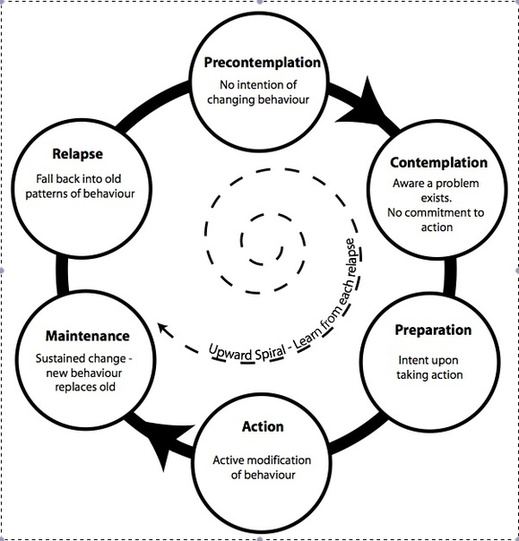
What role does Prochaska and DiClemente’s Stages of Change Model play within the model of motivational interviewing (MI)? Is it sort of a gauge as to when/how you would employ the various motivational interviewing techniques?
In the original book on MI (1991), the authors embraced Prochaska and DiClemente’s stages of change (SOC) and integrated their interventions with the SOC. As time went on, providers did not experience the SOC and MI as two separate distinct models which they are; this became a concern and it was declared that the SOC are not MI and need not be a part of MI.
The SOC have very strong merits when it comes to practicing interventions. One thing that both MI and SOC agree upon is that the intervention must be one that the client is willing/able to accept. If the provider is intervening at a readiness stage that differs from the client’s readiness to change or to accept the intervention it will engender discord, defensiveness or withdrawal and will not lead to change.
I have written extensively about the positive elements of SOC in a number of chapters/articles and most recently in the “New language for integrated care” article. One element that the two models have in common is that one can begin working with a client regardless of the client’s stage of readiness to change. SOC holds that change is incremental. They have done a masterful job of delineating the transition through stages people go through before reaching the “plan.”
Stages of Change reference: Prochaska, J.O., DiClemente, C.C. & Norcross, J.C. In Search of How People Change: Applications to Addictive Behaviors. American Psychologist, September 1992; Vol. 47(9) 1102-1114.
The fourth process in MI, is planning. It is followed in the SOC by going into the action stage with elements of the plan. MI interventions work well in the various stages. It is a collaborative respectful communication style that takes the client’s goals, perceptions and ideas into account as do the SOC.
The SOC are indispensable when it comes to working with multiple behaviors and symptoms. Clients are frequently at different stages of readiness to address different symptoms. The SOC can revolutionize how we assess and record client outcome. Whereby only clients in action have been considered successful outcome, each increment across the SOC change is progress and in many cases is over-looked; this can be detrimental to clients.
For example, there may be more than one provider who addresses a client from the perspective of a different stage of readiness. Or the client with multiple symptoms and behaviors may be at different stages of readiness to change or address different symptoms or behaviors. MI does not address multiple symptoms, behaviors or disorders. It is studied around specific, individual change areas rather than multiple ones.
Here is where it is very important that providers have a language for client readiness or readiness scales such as the ones I developed for co-occurring disorders. In the example I gave earlier, the client may be in pre-contemplation regarding alcohol, action regarding getting off probation and out of the criminal justice system; and contemplation regarding domestic violence – ambivalent. MI defines itself as a model that assists clients to resolve ambivalence – that is a direct correlate to the SOC contemplation stage, and where a pre-contemplator will be headed if he or she identifies reasons to change or change talk.
Section 7: Moving Clients Through the Stages – Specific Techniques
How to Use Motivational Interviewing Techniques at Each Stage
Understanding the stages is one thing—knowing which motivational interviewing techniques to use at each stage is what makes MI effective. Let’s walk through how to help clients progress from pre-contemplation all the way through maintenance and relapse prevention.
Still thinking about the Stages of Change Model, how would you employ motivational interviewing in order to help a client take action?
For a client to move from pre-contemplation to contemplation, it requires that he or she identify negative elements of the target behavior in his or her life.
The provider needs to listen carefully for even the weakest change talk. “My wife doesn’t like my drinking.” Provider: “so it seems your relationship with your wife is affected by your drinking.”
A person in pre-contemplation will usually identify what I refer to as “peripheral problems” regarding the behavior rather than problems with the behavior itself. The provider may employ a SOC intervention known as the decision balance. Here the client might be asked to consider what is
good about staying the same and not so good about it. What is good about changing or not so good about it. The strategy is to elicit from the client reasons to change and reasons why not changing could be a problem. Once a client has identified negatives in relationship to the behavior he or she has moved to the contemplation stage.
Contemplation: Resolving Ambivalence
Contemplation is marked by ambivalence – the client recognizes both positives and negatives but is stuck. Now the client feels both ways and is unsure about what to do. Here is where the “evoking” elements and the directional properties of MI would come into stronger focus. One wants to minimize attending to sustain talk – sustain talk is reason(s) not to change; and evoke, reinforce and strengthen change talk. When the client has identified more reasons to change or has strengthened his or her determination to make the change he or she may then decide to change. Empathic, reflective listening can deepen this process.
Preparation: Collaborative Planning
This would be followed by preparation or the “plan.” This is also a collaborative process. What does the client think may work toward effectuating this change. The provider asks permission to make his or her suggestions as well. The client and provider collaborate on a potential plan that is acceptable to both. The plan is flexible in that it can be revised as the client sees fit. There should not be anything in the plan that the client does not want to do.
The plan should optimize success and minimize failure. In the planning stage I recommend that a functional analysis be worked up with the client to find out what the triggers are regarding the target behavior and building in the acquisition of coping skills around those triggers as part of the plan.
Action: Confidence Building
As the client moves from preparation to action, the element of “confidence building” will be employed. One begins with the action that the client believes he or she is most likely to succeed with. Additional actions from the plan are employed at a pace that will most likely assure success.
As the client implements the plan into action and the target behavior goes into remission, the client is in action. The provider needs to maintain the same degree of support and direction in the action stage as in all the other stages; this is not a time to back off.
Maintenance: Preventing Relapse
The maintenance plan (relapse prevention) should begin while the client is in action particularly if your work with the client is coming to a close. Just as there is collaboration, agreement and flexibility in the action plan there should be the same approach to the maintenance plan.
The client should have the opportunity to make some adjustments to the maintenance plan while they still have your support. If the client adjusts to the maintenance plan and it prevents relapse then he or she may permanently exit the stages of change. If the client “relapses,” this is not considered treatment failure, there are no punitive or negative consequences.
What it means is that something went wrong with the maintenance plan. We may have left something out; the client may have new people, situations in his or her life that we did not account for; the client did not follow through with part of the plan, etc. The approach is to revise the plan and get back to action and maintenance. However, once the client re-enters the stages he or she may be at any one of the SOC stages and one would need to intervene from that stage.
Section 8: Learning Motivational Interviewing
Are there any books/articles that you would recommend to readers interested in learning about motivational interviewing?
First, one must understand Roger’s work and the direct and indirect influence it has on MI. I recommend Carl Rogers and Carl Rogers – Wikipedia; it provides a good integration across the span of Rogers’ work.
Second, I recommend: “Motivational Interviewing: Preparing People to Change Addictive Behavior” by W.R. Miller & S. Rollnick. I acquired my own foundation in MI from this book.
There is also a “free” TIP #35 available from SAMHSA. Although there have been changes over the years, the basic elements of MI are consistent and well grounded in the MI book.
Lastly, a more recent article that I found to be specific and well rounded is: Toward a Theory of Motivational Interviewing by William R. Miller and Gary S. Rose.
Motivational Interviewing Training with Kathleen Sciacca
I understand that you provide a motivational interviewing training seminar. Could you provide a brief description of it and tell us how it differs from others offered?
When I sponsor an MI training seminar myself, I have the luxury of designing a three-day course that allows me to provide the extent and depth of information I prefer. This enables some grounding in the theory and practice of MI, the SOC and some compatible cognitive behavioral therapy (CBT) interventions.
I have time to include live demonstrations, early practice, and discussions to follow all areas of training. There is ample opportunity for experiential practice that becomes more advanced incrementally and results in the practice of MI sessions with real situations and not role-play.
The key to learning MI is to practice. Practice with your own “real play” rather than role-play. The provider can personally experience what the interventions feel like, where they take them and whether or not they are worthy of continued practice that requires self-discipline.
I make an effort to remain current with MI’s transitions and nuances. I can respond to questions that pertain to many case examples presented by participants from a variety of disciplines; I have a wealth of examples from my own practice and my work as a consultant, trainer, educator and program developer.
Section 9: Developing Your MI Skills – Career Advice
Beyond Training: Developing Your Motivational Interviewing Practice
Lastly, aside from taking a course in motivational interviewing, what other career advice would you offer to mental health professionals who are looking to develop their motivational interviewing skills?
First, would be to develop a “client-centered” communication style to be integrated with whatever model of intervention one uses or prefers. As Roger has eloquently described, this is a “way of being with people.” The client-centered approach is a respectful, collaborative, empathic communication style that is necessary for building a trusting relationship where clients are free to communicate.
Next, would be to practice being present – staying with the person – listening carefully – conveying your understanding of the client’s thoughts, perceptions in a “non-judgmental” manner, following.
Learning to elicit from the client rather than “telling” him or her what to do. Always ask the client’s permission to give advice, education, suggestions and ask for feedback after you have done so -collaborate.
Then it will be worthwhile to learn reflective listening and to discipline oneself to practice it. This is a potent skill that can serve ones practice very well throughout one’s career.
Putting Motivational Interviewing Into Practice
Motivational interviewing is more than a set of techniques; it’s a way of being with clients that honors their autonomy, evokes their intrinsic motivation, and partners with them in the change process. As Kathleen Sciacca emphasizes, the depth to which Rogers’ client-centered approach can evoke clients’ intrinsic understanding and motivation to change is phenomenal.
Key takeaways from this complete motivational interviewing guide:
Foundation: MI is grounded in Carl Rogers’ client-centered counseling and empathic reflective listening—these remain the most potent interventions in MI practice.
Core Skills: Master the OARS skills (Open questions, Affirming, Reflective listening, Summarizing) plus evoking and reinforcing change talk. These must be used as a comprehensive skill set, not selectively.
Four Processes: Structure your work through engagement (building trust), focusing (identifying target behaviors), evoking (eliciting change talk), and planning (collaborative action steps).
Stages of Change: Understand that change is incremental. Match your interventions to clients’ readiness stage—intervening at the wrong stage engenders discord, defensiveness, or withdrawal.
Change Talk: Listen for, reflect, evoke, and strengthen change talk while minimizing sustain talk. Commitment talk (strengthened change talk) correlates with actual behavior change.
Respect Autonomy: Your role isn’t to “make people change” (unrealistic). It’s to ensure clients have the opportunity to explore every aspect of their situation so they can make informed, intrinsic decisions about how to proceed.
Practice, Practice, Practice: As Kathleen emphasizes, “The key to learning MI is to practice.” Use “real play” with your own situations rather than role-play to personally experience what interventions feel like and whether they’re worthy of continued practice.
Motivational interviewing applies across numerous systems and behaviors—from substance use and mental health to chronic disease management, criminal justice interventions, and beyond. Whether you’re working with a client struggling with addiction, a patient resistant to medication adherence, or someone ambivalent about leaving an abusive relationship, these motivational interviewing techniques can help you partner with them in creating meaningful, lasting change.
Ready to deepen your MI skills? Explore the resources throughout this guide, consider formal training, and most importantly, start practicing empathic reflective listening today. Your clients will notice the difference.
Frequently Asked Questions About Motivational Interviewing
What are the stages of motivational interviewing?
Motivational interviewing follows four stages: engaging, focusing, evoking, and planning. These stages guide the client from building rapport through to committing to change, with the therapist using open questions, reflective listening, and affirmations throughout.
What is the cycle of change in motivational interviewing?
The cycle of change, also called the Transtheoretical Model, includes six stages: precontemplation, contemplation, preparation, action, maintenance, and relapse. Motivational interviewing is designed to meet clients wherever they are in this cycle.
What are the steps of motivational interviewing?
The core steps of motivational interviewing are: expressing empathy, developing discrepancy, rolling with resistance, and supporting self-efficacy. These principles guide the practitioner in helping clients resolve ambivalence about change.
How many phases does motivational interviewing have?
Motivational interviewing has four phases: engaging (building the relationship), focusing (identifying a direction), evoking (drawing out the client’s own motivation), and planning (developing a concrete change plan).
What is the difference between motivational interviewing stages and steps?
The stages refer to where a client is in their readiness to change (the cycle of change), while the steps or phases refer to how the practitioner structures the conversation. Both work together in a motivational interviewing session.
Thanks so much, Kathleen, for providing us with this comprehensive introduction to motivational interviewing!
You may follow Kathleen on twitter at @DualDiagCoOccur
What are your thoughts about motivational interviewing? Have you used MI techniques in your practice? What challenges or successes have you experienced? Share in the comments below!
Additional Resources from Kathleen:
Dual Diagnosis
Motivational Interviewing Clips in Primary Health
Motivational Interviewing articles, fact sheets and more
Additional Motivational Interviewing articles
Motivational Interviewing Training Seminar
Last updated: April 25, 2026


