 Financial stress social workers face often gets reduced to one simple explanation: low pay. You chose social work because you wanted to help people. You knew the salary wouldn’t be impressive. You were okay with that trade-off. But somewhere along the way, the financial stress became unbearable. Maybe you’re carrying student loan debt that feels insurmountable on a social worker’s salary. Maybe you’re watching colleagues leave the profession because they can’t afford to stay. Maybe you’re working a second job just to cover basics, which means you have less energy for the clients who need you most. Or maybe, and this is the part nobody talks about, you’re financially stable by most measures, but you still feel financially stressed.
You make decent money for social work. You have savings. You’re not in crisis. Yet you feel anxious every time you think about money. You can’t enjoy your paycheck. You avoid looking at your accounts. You feel guilty spending on yourself.
Here’s what most people get wrong about the financial stress social workers experience: It’s not just about the salary. It’s about your relationship with money, and that relationship was formed long before you became a social worker.
Quick Answer: Financial Stress Social Workers Face
Financial stress in social work isn’t primarily about low pay—it’s about your relationship with money. This relationship is shaped by childhood experiences, professional conditioning, and daily exposure to financial trauma. Even financially stable social workers experience money anxiety because the stress lives in your nervous system, not your bank account.
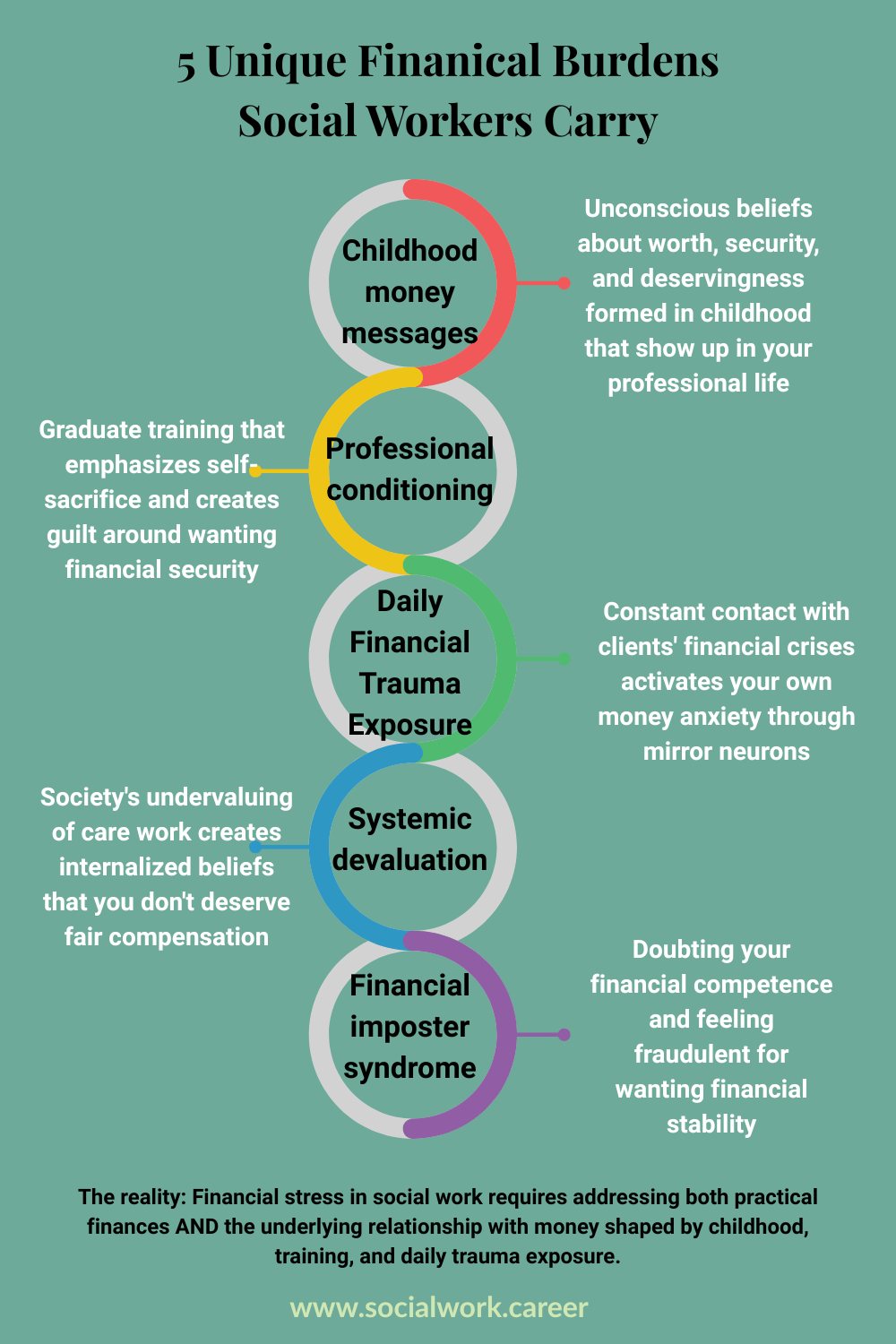
5 Unique Financial Burdens Social Workers Carry
- Childhood Money Messages – Unconscious beliefs about worth, security, and deservingness formed in childhood that show up in your professional life and financial decisions.
- Professional Conditioning – Graduate training and field culture that emphasizes self-sacrifice, reinforces the “helper” identity, and creates guilt around wanting financial security.
- Daily Financial Trauma Exposure – Constant contact with clients’ financial crises activates your own money anxiety and creates vicarious financial trauma through mirror neurons.
- Systemic Devaluation – Society’s undervaluing of care work creates internalized beliefs that you don’t deserve to be well-compensated for emotional labor.
- Financial Imposter Syndrome – Doubting your financial competence, attributing struggles to personal failure rather than systemic issues, and feeling fraudulent for wanting financial stability.
Why Budgeting Advice Doesn’t Fix Financial Anxiety
Traditional financial planning addresses symptoms, not sources. When financial stress is rooted in your nervous system—shaped by childhood experiences, professional conditioning, and daily trauma exposure—a budget spreadsheet won’t resolve the anxiety. You need trauma-informed approaches like EMDR therapy that address the worthiness wounds underneath financial stress: the belief that your worth must be proven through sacrifice, that you don’t deserve ease, or that caring about money makes you selfish.
Research Finding: Approximately 75% of social workers experience burnout, with financial stress as a significant contributing factor. Financial stress isn’t just about money—it’s about professional survival patterns that affect clinical work, boundary-setting, and career sustainability.
Financial stress in social work requires addressing both practical finances AND the underlying relationship with money shaped by childhood, training, and daily trauma exposure.
Quick check: Do any of these sound familiar?
- You avoid checking your bank account even when you know you’re fine
- You feel guilty every time you spend money on yourself
- You can’t accept compliments about your financial decisions
- You downplay your financial stress because “others have it worse”
- You feel anxious about money even when the numbers say you’re okay
If you said yes to 2 or more, keep reading.
The Financial Stress Social Workers Face Goes Beyond Salary
Social workers carry a specific kind of financial burden that goes beyond low pay.
We’re trained to put others first. From day one in social work school, we learn to prioritize client needs, agency needs, community needs. We learn that self-care is important (in theory), but we practice self-sacrifice.
We internalize scarcity. We work with clients in poverty. We see the impact of financial instability every single day. We absorb their financial stress into our own nervous systems. Even when we’re financially stable, we carry the weight of knowing how quickly things can fall apart.
We feel guilty for having more. If you grew up with financial privilege and now work with clients in poverty, you might feel shame about your relative security. If you grew up with financial struggle and now earn more than your family, you might feel guilt about “leaving them behind.”
We’re taught that money is selfish. Social work culture often frames financial ambition as antithetical to our values. Wanting to earn more, negotiate for raises, or build wealth can feel like a betrayal of the profession’s mission.
We absorb our clients’ financial trauma. Hearing stories of eviction, food insecurity, and impossible choices all day doesn’t just affect our clients; it rewires our own nervous systems around money and safety.
These dynamics create the specific financial stress social workers carry, a burden that no amount of budgeting advice will fix.
The Double Burden: Imposter Syndrome Meets Financial Stress
Social workers face a unique intersection of imposter syndrome and financial stress that compounds both conditions.
Research shows that approximately 70% of people experience imposter syndrome at some point in their lives, and social workers are particularly vulnerable.
You entered a helping profession driven by values and purpose, yet you’re confronted daily with:
- Societal messages that devalue care work (“Those who can’t, teach… or do social work”)
- Low compensation that doesn’t match your education, expertise, or emotional labor
- The expectation to martyr yourself financially for your calling
- Guilt about wanting financial stability when your clients are struggling
Let’s Be Clear About the Financial Reality
The salary disparity is real and measurable.
According to the Bureau of Labor Statistics and NASW data:
• The median salary for social workers is approximately $55,000-$62,000, depending on setting
• This requires a master’s degree (MSW) and often clinical licensing (additional training and supervision hours)
• Average MSW student loan debt: $115,000-$150,000
• For comparison: school psychologists (also master’s-level helping professionals) earn a median of $81,500; occupational therapists earn $93,000
That’s a $20,000-$30,000 gap for similar education levels, similar emotional labor, and similar client-facing work. Over a career, that gap compounds to hundreds of thousands of dollars in lost earnings, retirement savings, and financial security.
This structural undervaluation is real, unjust, and needs to change.
AND, even if every social worker got a 30% raise tomorrow, many would still carry the psychological patterns that financial stress created. Because the issue isn’t only about the paycheck.
You doubt your competence with money: “I chose this profession, so I should have known I’d struggle financially. I must be bad with money.”
You attribute financial struggles to personal failure: Rather than recognizing systemic undervaluation of social work, you blame yourself for not budgeting better or working harder.
You feel fraudulent wanting financial security: “Real social workers don’t care about money. If I’m worried about finances, maybe I’m not cut out for this work.”
You can’t internalize your worth: Despite your degrees, licenses, and expertise, you struggle to charge appropriate fees in private practice or advocate for raises.
Why This Matters For Your Practice
The financial stress social workers carry doesn’t just affect personal life; it directly impacts your ability to do your job.
When financial stress social workers experience goes unaddressed, you:
- Have less cognitive capacity for complex clinical work
- Make decisions from a place of scarcity rather than abundance
- Struggle to set boundaries with clients (because you need the work)
- Can’t afford supervision or continuing education that would improve your practice
- Consider leaving the profession not because you don’t love it, but because you can’t afford to stay
- Bring your own financial anxiety into the room with clients
- Model financial stress and scarcity to the very clients you’re trying to help
The irony: Social workers are trained to help people heal their relationships with money and resources. Yet many of us are struggling with our own financial stress, often without even realizing it’s a relationship issue, not just an income issue.
The Hidden Pattern: Your Money Relationship Shapes Your Social Work Practice
Your relationship with money may impact the quality of care you provide.
If you grew up with financial instability, you might:
- Over-identify with clients in poverty (losing professional boundaries)
- Feel unable to charge appropriate fees if you’re in private practice
- Struggle to advocate for your own needs (raises, caseload limits, supervision)
- Experience burnout faster because you’re operating from a place of scarcity
If you grew up with financial privilege, you might:
- Struggle to understand clients’ financial constraints
- Feel guilt about your relative security
- Avoid discussing money with clients (because it feels uncomfortable)
- Underestimate the impact of financial stress on your clients’ mental health
If you experienced financial trauma, you might:
- Absorb clients’ financial stress into your own nervous system
- Struggle to maintain professional boundaries around money
- Feel triggered by discussions of poverty or financial instability
- Carry unprocessed financial anxiety that affects your clinical presence
None of these patterns make you a bad social worker. They make you human. But they do affect your practice, and your wellbeing.
The Perfect Storm
For social workers, childhood experiences and professional training collide to create a perfect storm:
1. Childhood experiences formed unconscious beliefs: “Money isn’t safe,” “I don’t deserve ease,” “Struggle proves commitment”
2. Professional training reinforced self-sacrifice: “Good social workers sacrifice,” “Self-care is selfish,” “Put others first always”
3. Systemic undervaluation confirmed worthlessness: “Care work isn’t worth much,” “You should be grateful for anything,” Society’s message that helping professions don’t deserve compensation
4. Daily trauma exposure activates old wounds: Absorbing clients’ financial stress into your own nervous system, retraumatizing your money anxiety with every session
And here’s the devastating cycle: Financial stress increases imposter feelings, and imposter feelings prevent you from addressing financial stress.
When you feel like a fraud, you:
- Don’t negotiate for raises (you don’t believe you deserve them)
- Undercharge in private practice (you attribute success to luck, not skill)
- Avoid financial planning (you don’t trust your ability to manage money)
- Absorb clients’ financial stress (you don’t have strong enough boundaries)
- Stay in jobs that undervalue you (you don’t believe you’re competent enough for better)
Even When You’re “Doing Okay”
You might be reading this thinking: “But I’m doing okay financially. I’m not in crisis. Why do I still feel so stressed?”
“This isn’t about the numbers. This is about your nervous system. Your rational brain knows you’re okay, but your amygdala is still operating on old programming.”
This is the part that’s hard to talk about in social work circles.
You make decent money for a social worker. You have savings. You’re meeting your bills. By most objective measures, you’re financially stable.
Yet you:
- Feel anxious every time you think about money
- Can’t enjoy your paycheck without guilt
- Avoid looking at your accounts
- Feel shame spending on yourself
- Carry constant low-level financial stress
- Wonder if you can afford to stay in social work long-term
This isn’t about the numbers. This is about your nervous system.
Your rational brain knows you’re doing okay. But your amygdala (threat detection system) is still operating on old programming:
- “Money is never safe”
- “I don’t deserve financial ease”
- “Caring about money makes me selfish”
- “I should be grateful for what I have”
- “Real social workers sacrifice”
And every time you interact with clients in financial crisis, that programming gets reinforced. Your nervous system absorbs their stress. You leave sessions carrying financial anxiety that isn’t even yours.
How Financial Stress Social Workers Experience Leads to Burnout
Research shows that approximately 75% of social workers report experiencing burnout at some point in their careers. Financial stress is a significant contributing factor.
One of the methods to prevent social worker burnout is to employ self-compassion.
The connection is direct:
The financial stress social workers carry means you:
- Can’t afford to take time off (even when you desperately need it)
- Stay in jobs with poor working conditions (because you need the income)
- Don’t have resources for therapy, supervision, or professional development
- Bring financial anxiety into your clinical work
- Feel resentful toward clients (because you’re sacrificing so much)
- Consider leaving the profession
When financial stress is unaddressed:
- Compassion fatigue increases
- Boundaries deteriorate
- Clinical presence suffers Self-care becomes impossible
- Leaving feels inevitable
But here’s what’s crucial to understand: This isn’t primarily a budgeting problem. It’s a professional survival pattern.
The Worthiness Wound
Both financial imposter syndrome and money beliefs are fundamentally about worthiness.
Imposter syndrome says: “I haven’t earned this success. I don’t deserve recognition.”
Financial stress says: “I don’t deserve security. I don’t deserve ease.”
The common denominator? A deep, often unconscious belief that your worth is conditional – that it must be constantly proven through:
- How much you sacrifice
- How little you need
- How hard you work
- How much you give
- How selfless you are
For social workers, this belief gets reinforced at every level:
- Childhood (“Your value depends on what you provide”)
- Education (“Put others first”)
- Training (“Self-care is selfish”)
- Work culture (“Real social workers sacrifice”)
- Client interactions (“You have more, you should feel guilty”)
- Society (“Social work isn’t ‘real’ work”)
No wonder you can’t just “budget better” and feel secure.
Why Traditional Financial Advice Fails (And What Actually Works)
Budgeting apps can’t rewire your nervous system. Trauma-informed approaches target the root: the childhood experiences and professional conditioning that created these patterns. When you process the memories where these beliefs formed—”money isn’t safe,” “I don’t deserve ease,” “wanting more makes me selfish”—your relationship with money shifts at the neurological level, not just the intellectual level.
EMDR therapy is particularly effective for this work, as it processes traumatic memories and updates the beliefs formed in those experiences. Other approaches that target the nervous system and unconscious patterns, such as somatic therapy, Internal Family Systems (IFS), or psychodynamic work, can also be effective. The key is addressing the root patterns, not just the surface symptoms.
This trauma-informed approach aligns with the work pioneered by Reeta Wolfsohn, CMSW, founder of the Center for Financial Social Work, who developed Financial Social Work as an interactive behavioral model that helps people explore and address their unconscious feelings, thoughts, and attitudes about money. By combining trauma-informed therapy with Financial Social Work principles, you can address both the practical and psychological dimensions of financial stress.
If This Resonates
If you’re reading this and thinking “Yes, this is exactly what I experience,” you’re not alone.
The financial stress social workers feel isn’t because you’re bad with money.
It’s not because you’re ungrateful for your salary.
It’s not because you chose the wrong profession.
This isn’t a budgeting problem. It’s a professional survival pattern.
It’s what happens when:
- Childhood beliefs about worth and money
- Professional training in self-sacrifice
- Systemic undervaluation of care work
- Daily exposure to clients’ financial trauma
- Cultural messages about “good” social workers
All collide in your nervous system.
And that nervous system is doing exactly what it was trained to do: prioritize others, minimize your needs, equate worth with sacrifice, and stay hypervigilant about money.
The problem isn’t you. The problem is that no one taught you how to update the programming.
Frequently Asked Questions About Financial Stress Social Workers Face:
Why do social workers experience financial stress even with stable incomes?
Financial stress in social work isn’t just about salary; it’s rooted in your relationship with money. This relationship is shaped by childhood experiences, professional training that emphasizes self-sacrifice, daily exposure to clients’ financial trauma, and internalized beliefs that equate worth with sacrifice. Even financially stable social workers may experience anxiety around money due to these deeply ingrained patterns, not their actual financial situation.
How does financial stress affect social work practice?
Financial stress reduces cognitive capacity for complex clinical work, makes it harder to set boundaries with clients, and can lead to burnout. Social workers may make decisions from scarcity rather than abundance, struggle to charge appropriate fees, absorb clients’ financial anxiety, and consider leaving the profession, not because they don’t love the work, but because financial stress makes it unsustainable.
What causes financial imposter syndrome in social workers?
Financial imposter syndrome occurs when social workers doubt their financial competence, attribute financial struggles to personal failure rather than systemic issues, and feel fraudulent for wanting financial security. It’s reinforced by societal devaluation of care work, cultural messages that “good social workers don’t care about money,” and guilt about having more resources than clients.
How do childhood money messages affect social workers?
Early money messages from caregivers create unconscious beliefs about worth, security, and deservingness that show up in professional life. Social workers who grew up with financial instability may over-identify with clients, struggle to charge appropriate fees, and operate from scarcity. Those from privileged backgrounds may feel guilt that prevents healthy financial boundaries. These patterns affect clinical work, self-advocacy, and career sustainability.
What’s the connection between financial stress and social worker burnout?
Research shows approximately 75% of social workers experience burnout, with financial stress as a significant factor. Financial stress prevents taking needed time off, keeps workers in poor conditions, reduces access to therapy and supervision, brings anxiety into clinical work, and can lead to resentment toward clients. It’s not primarily a budgeting problem; it’s a professional survival pattern that requires addressing both practical finances and the underlying relationship with money.
Can therapy help with financial stress in social work?
Yes. EMDR therapy and trauma-informed approaches can help process the childhood experiences and professional conditioning that created problematic money patterns. Therapy addresses the worthiness wounds underneath financial stress, the belief that worth must be proven through sacrifice, that you don’t deserve ease, or that caring about money makes you selfish. This goes deeper than financial planning, targeting the nervous system patterns that drive financial anxiety.
Is it normal to feel guilty about wanting a higher salary as a social worker?
Yes, this guilt is extremely common and stems from professional conditioning that equates financial ambition with selfishness. Social work culture often frames wanting to earn more as antithetical to the profession’s values. But financial security doesn’t make you less committed to helping others; it actually enables you to stay in the profession longer and show up more fully for clients. The guilt is a symptom of the worthiness wound, not evidence that you’re wrong to want fair compensation.
Ready to address the root of financial stress? Learn how EMDR therapy and Financial Social Work can help you build a sustainable social work career without sacrificing your wellbeing in the next post in this series.
References:
Bravata, D. M., Watts, S. A., Keefer, A. L., Madhusudhan, D. K., Taylor, K. T., Clark, D. M., … & Hagg, H. K. (2020). Prevalence, predictors, and treatment of imposter syndrome: A systematic review. *Journal of General Internal Medicine, 35*(4), 1252-1275.
Clance, P. R., & Imes, S. A. (1978). The imposter phenomenon in high achieving women: Dynamics and therapeutic intervention. *Psychotherapy: Theory, Research & Practice, 15*(3), 241-247.
Lloyd, C., King, R., & Chenoweth, L. (2002). Social work, stress and burnout: A review. *Journal of Mental Health, 11*(3), 255-265.
Ravalier, J. M., McVicar, A., & Munn-Giddings, C. (2024). Relationships between stress, burnout, mental health and well-being in social workers. *The British Journal of Social Work, 54*(2), 668-690.
Sherraden, M. S., & Huang, J. (2019). Financial social work. In Encyclopedia of Social Work. Oxford University Press. https://doi.org/10.1093/acrefore/9780199975839.013.923
Stanley, S., & Sebastine, A. J. (2023). Work-life balance, social support, and burnout: A quantitative study of social workers. *The British Journal of Social Work, 53*(8), 4586-4602.
Wolfsohn, R., & Michaeli, D. (2014). Financial social work. Encyclopedia of Social Work. National Association of Social Workers and Oxford University Press.
You may also enjoy:
Financial Self-Care Is a Necessity, Not a Luxury!
What Every Social Worker Needs to Know About Financial Self-Care
About the author:
Dorlee Michaeli, MBA, LCSW, specializes in EMDR therapy for high-achieving professionals struggling with imposter syndrome. She provides consultation for complex cases involving perfectionism and workplace anxiety. Learn more.



Dorlee, thank you for raising this issue and bringing it to your followers’ attention.
Certainly, no one wants money problems, but most people face them today. The reasons are many, often systemic, and always varied, but HOLISTIC social work requires helping clients make sense of the role money plays in their lives: emotionally, relationally, and psychologically.
When we fail to invite money into our sessions, we fail our clients.
Thank you for naming this so clearly, Reeta. I agree that money is never just practical. It’s deeply emotional, relational, and psychological, and avoiding it in the clinical space leaves an important part of clients’ lived experience unaddressed.
At the same time, many of the money struggles clients bring into sessions are shaped or intensified by systemic conditions. Holding both, meaning-making and structural context, feels essential if social work is going to be truly holistic.
I appreciate you sharing this post. It’s important for SWs to understand this for sure, especially as we’re inundated with so much but valued so little. The discussions also need to address systemic pressures as well.
While I know childhood messages are a huge part of our financial stress, I’ve noticed that even when we’ve worked through that, we still exist in a system that values capitalistic goals (contribute to the economic cycle or perish mentality, if you will) and for those of us decolonizing how we offer services (including intentional access and equity) we’re often outmatched by larger corporations who have monopolized the treatment space.
All the while, folks are still coming to us asking for solutions to societal ills we cannot provide, then blaming us for those ills since we don’t offer insurance (another systemic issue that often devalues SWs and clinicians).
This cycle is part of why even with all the childhood stuff managed, we have to unpack: 1) why folks believe that we need to serve for free,
2) why healthcare insurance doesn’t always cover behavioral health, and
3) how we can build sustainable access for the populations that need it most without burning ourselves out too.
Thank you for articulating this so clearly, Mercedes. You’re naming a critical tension: even when personal money narratives are worked through, clinicians are still practicing inside systems that prioritize scale, capital, and insurance logic over relational care.
When people trying to offer ethical, accessible work are structurally outmatched by corporatized care models, and simultaneously expected to absorb unmet societal needs for free, burnout and attrition become predictable, not personal.
Any honest conversation about financial stress in social work has to hold both layers: the internal work and the external conditions that make sustainability so difficult.
This is so true! I appreciate you posting about this, Dorlee! One thing I don’t see on the graphic but I hear about a lot from SW’s I interact with is the student loan debt! I know I’m not alone in having borrowed for grad school – needing funds above the cost of courses to pay household bills while I was in school since it’s nearly impossible to work full time with a full time academic load and an internship.
Just as an example, in 2008 I went from a Bachelor’s level job to grad school, still working 20 hours per week while also doing my internship and full time coursework. When I graduated and took a Master’s level job, the pay was the same as what I had made before starting grad school with my BS. I took loans and enrolled in an income based repayment plan promising forgiveness in 10 years, which didn’t happen, and ultimately the program was terminated so no forgiveness, and no more income based repayment.
The student loan burden, combined with low pay, is untenable. We need more SWs but I can understand why many leave the field shortly after graduation. The pay is terrible!
Thanks so much for sharing this, Laura. Student loan debt is a major part of the structural picture, especially given how social work education is designed around unpaid or underpaid training alongside full-time coursework.
When people are required to take on significant debt just to enter the profession, only to graduate into roles that don’t offer meaningful financial lift, the strain becomes untenable. In that context, early exit isn’t a lack of commitment; it’s a predictable response to an unsustainable pathway.
Really appreciate this framing. You’re naming how financial stress in social work isn’t just economic but psychically organized shaped by early money meanings, professional ideals of sacrifice, and the cumulative impact of working daily with scarcity. That layer is rarely articulated, and it matters clinically. Love this!!!!
Thanks so much, Heather. You’ve articulated that layer beautifully. Financial stress in social work is rarely just about numbers; it’s organized through early money meanings, professional ideals of sacrifice, and repeated exposure to scarcity and risk.
When that psychic organization goes unnamed, it quietly shapes practice and self-perception. Naming it matters clinically and structurally, because it helps us see where individual work ends and system responsibility begins.
Yesss, Dorlee! SO IMPORTANT! I have been talking with a colleague about how financial security plays a huge role not only in social workers’ own mental health but also in our clinical decison-making. Many clinical decisions that would be better for the client can harm the social worker’s financial health…when these things are in conflict, AND we pretend that conflict doesn’t exist in the therapy work, it’s not good for anyone. Then there is also the financial stress raised if social workers are dependent on partners for financial security, due to our poor pay. We know statistically social workers and therapists are deeply vulnerable to domestic violence, so that is another unspoken part of this puzzle. So glad you are raising this!
Thanks so much for naming this so clearly, Lisa. The conflict you describe, between clinical judgement and financial survival, is real, and it’s rarely acknowledged openly.
When that conflict is denied or pushed underground, it doesn’t disappear; it shows up in constrained choices, moral distress, and risk that’s quietly carried by individual practitioners rather than addressed structurally.
The links you’re drawing here matter, including the unspoken vulnerabilities created when financial dependence becomes normalised. These are exactly the kinds of pressures that need to be made visible if we want ethical, sustainable practice.
Excellent post Dorlee. I completely agree. Those who deal in crisis are inundated with so much trauma to their nervous system.
I reframe it like a home. The 2x4s provide structure to the walls, load-baring beams take the weight, trusses hold the roof up. The house is structurally armed to withstand the storms, but when too many storms come, or last too long without relief, the structure fails and walls crack, floors bulge and eventually the structure collapses.
The same happens with humans. We must get better at protecting, supporting, and providing stronger structures for those weathering the storms every day. I completely support you.
Thanks so much, Michelle. This metaphor is powerful because it makes clear that collapse isn’t about weakness, it’s about load, duration, and lack of reinforcement.
When storms are constant and relief never comes, structural failure becomes predictable, not exceptional. That’s exactly what we’re seeing when financial strain, trauma exposure, and responsibility accumulate without adequate support.
Protecting people in this work means strengthening the structures around them, not just asking them to endure more.