
Social work is built to respond to what’s happening right now, but what if the profession spent more time preparing for what’s coming next? That’s the work of a social work futurist: using tools from strategic foresight to scan for early signals of change, map out multiple possible futures, and help practitioners and agencies get […]
Financial Boundaries Social Workers Struggle to Set (and How to Build Them)

In the first two posts in this series, we explored why financial stress in social work goes deeper than low pay, and how the money beliefs we developed in childhood shape our financial behavior through the Relationship → Behavior → Circumstances chain. Today, I want to focus on one of the most common behavioral expressions […]
AI Tools for Therapists: 12 Questions with Kym Tolson, LCSW

The conversation around AI tools for therapists has never been more urgent, or more complicated. In the span of just a few years, artificial intelligence has moved from a distant abstraction to a daily presence in clinical practice: drafting notes, generating treatment plan language, powering chatbots that millions of people are already using for emotional […]
Forensic Social Work: Where Human Need Meets Legal Consequence – An Interview with Tireeka Watson, LCSW
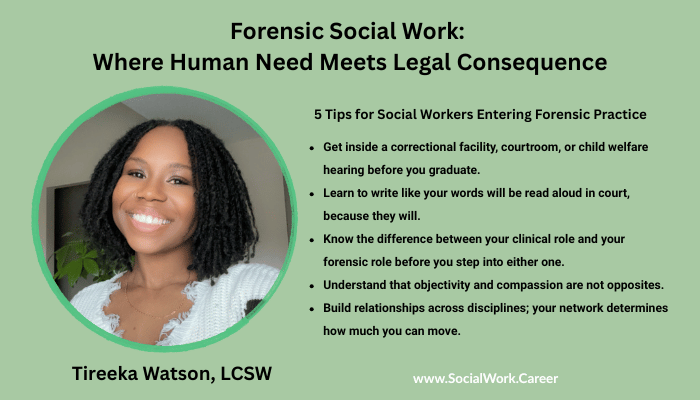
TL;DR Forensic social work is where clinical practice meets the legal system – courtrooms, corrections, child welfare, and reentry The forensic role is fundamentally different from the therapeutic one: the court is your primary client, not the individual Objectivity and compassion are not opposites; the best forensic practitioners bring both Trauma-informed practice matters even more […]
Social Worker Salary Guide 2026: What You Should Really Be Earning

Bureau of Labor Statistics, May 2024 $61,330 Median annual salary for social workers, about $29.50/hour. Your actual salary depends on where you live, your credentials, your setting, and your career path. Social work employment is projected to grow 6% through 2034, faster than the average for all occupations. What Most Social Workers Earn By Experience […]
