Why must social workers and mental health providers make the most of their first session with client? Most people drop out of therapy after only one session! Learning effective first therapy session strategies is critical to client retention.
Furthermore, on average, people go for a total of 5 to 8 sessions. This suggests that we need to start doing something differently during our first meetings with prospective clients [as well as perhaps in subsequent ones].
To increase my chances of getting things right with clients from the beginning, I listened to Robert Taibbi, LCSW‘s informative talk on “Making First Sessions Count” from the 2013 Psychotherapy Networker Symposium.
First Therapy Session Strategies: The Critical Goal
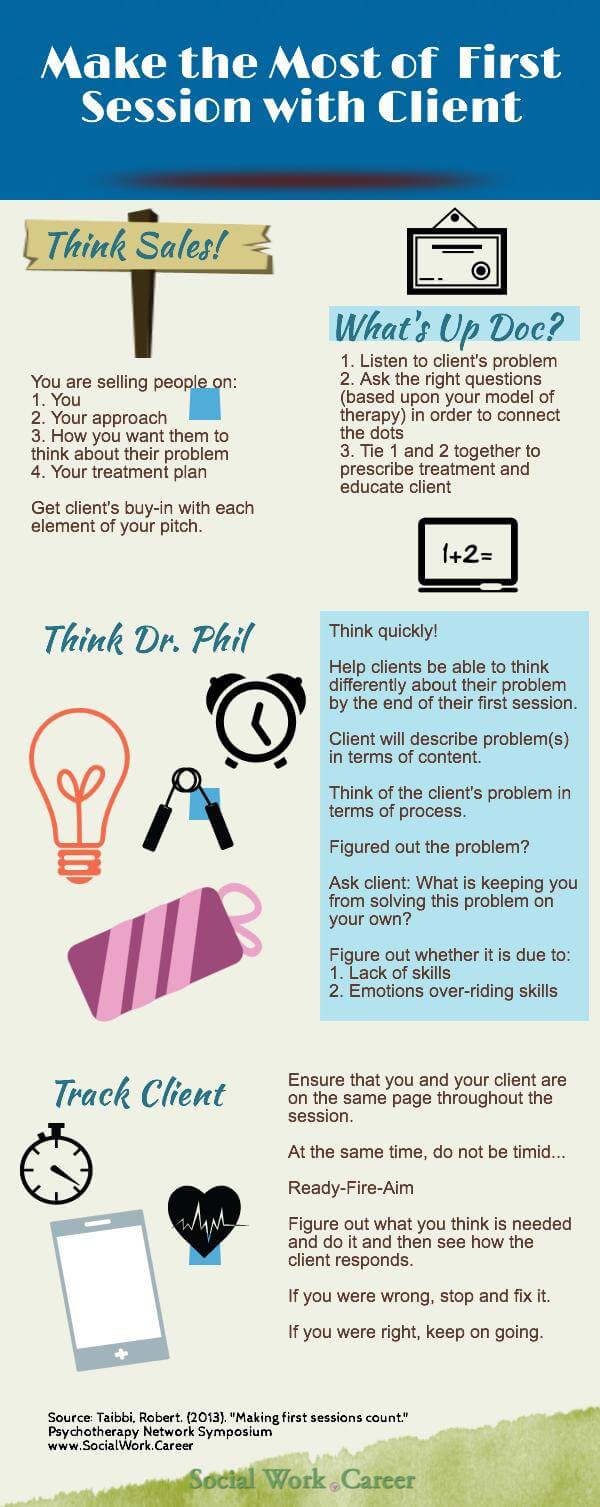
The infographic summarizes key first therapy session strategies from Robert’s talk. The overarching goal of your first session with client is getting a quick understanding of major issues and helping clients feel differently before they leave your office.
Why Traditional First Sessions Fail
Many therapists approach the first session as primarily an information-gathering exercise. They focus on completing intake forms, collecting detailed histories, and checking boxes on assessment protocols. While this administrative work feels necessary, it often misses what clients actually need from that crucial first encounter.
Clients come to therapy feeling stuck, confused, or overwhelmed. They’ve often struggled with their problem for weeks, months, or even years before finally making that first appointment. By the time they sit down in your office, they’re hoping for something to shift—some relief, clarity, or sign that therapy can actually help them.
When therapists spend the entire first session on paperwork and history-taking without addressing the client’s immediate distress, clients leave feeling exactly as they did when they arrived. They wonder: “Is this what therapy is? Just answering questions about my childhood?” Without experiencing any change or gaining new understanding, they see no compelling reason to return.
Robert Taibbi’s approach flips this script. Instead of making clients wait weeks to experience the benefits of therapy, his first session strategies help clients feel different—better, clearer, more hopeful—before they even leave that initial appointment. This immediate relief creates momentum and motivation to continue the therapeutic work.
As you can see, the overarching goal is for you to get a quick understanding of what the major issue(s) are with your clients and help them feel differently by the time they are ready to leave your office.
In other words, clients need to feel better in some way regarding their problem. For example, they may have a better understanding of what their problem is and what they will need to do in order to address it.
In this manner, clients will be more likely to return for following visits.
These first therapy session strategies increase the likelihood that clients will return for following visits. By implementing this first session with client approach, therapists can combat the high dropout rate.
I found Robert’s approach very interesting and relevant in today’s times. The one thing I’m not sure about is how one can integrate this style with the typical agency requirements of the long [and often boring] intake forms.
What are your thoughts/reactions to Robert’s guidance? Do you have some ideas of how one could meet an agency’s requirements while still adopting more of a solution-oriented, client-centered sales’ approach?
Some additional helpful resources from Robert:
The Art of the First Session in the Psychotherapy Networker
The Relationship Triangle in Psychology Today [includes discussion of the different roles a person may take: rescuer, victim, persecutor or adult and how to help your client move to the role of an adult]
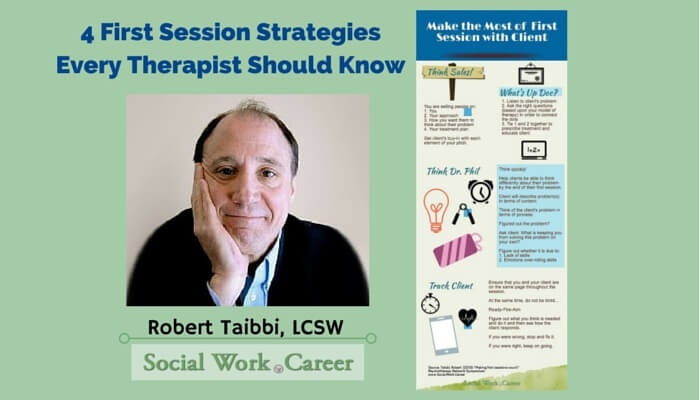
Image: Robert Taibbi, LCSW
About the author:
Dorlee Michaeli, MBA, LCSW, specializes in EMDR therapy for high-achieving professionals struggling with imposter syndrome. She provides consultation for complex cases involving perfectionism and workplace anxiety. Learn more.
Last updated: December 30, 2025



Thanks, Dorlee! This is such a practical, common sense breakdown that is going to be so helpful for new therapists. I’m going to remind my supervisees to drop back in here to check out their own first sessions and how they compare to the suggested steps here.
Have a great week!
Tamara,
Thanks so much for your kind feedback on the usefulness of this post. And how kind of you to plan to recommend that your supervisees compare how they are handling their first sessions vs. the recommendations here…
Best wishes,
Dorlee
Hi Dorlee,
As a coach, I find the idea of “do not be timid” and “if you were wrong, stop and fix it” to be freeing, allowing me to be more present with my clients. Thank you for sharing!
Not knowing the protocol and requirements for agency intake forms, I’m wondering if these can be made less boring just by asking the questions differently or offering the form in a different media (maybe mixing in gamification)?
Hugs to you!!
Jackie
Hi Jackie,
I love how creative you are 🙂 Thanks for sharing that great idea… using some form of gamification for the boring and long intake agency forms!
Hugs,
Dorlee