Thinking about starting a private practice but don’t know where to begin? As Michael Langlois, LICSW says, “private practice is a business, and you need to learn how to create and run a business if you are going to be successful.”
This comprehensive guide features in-depth interviews with two experts who’ve successfully built thriving practices while also teaching, supervising, and coaching other mental health professionals:
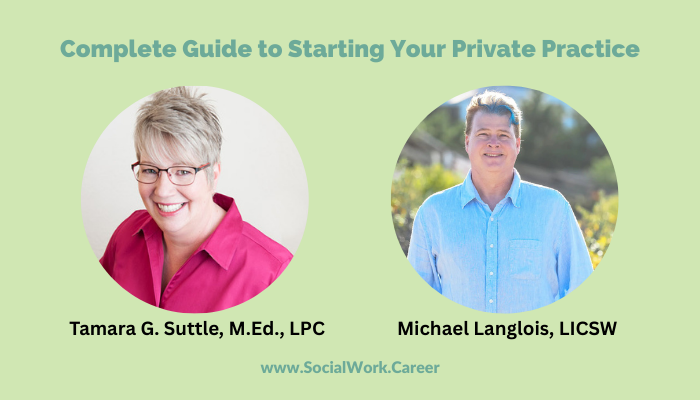
Expert guidance from Tamara G. Suttle, M.Ed., LPC (Private Practice from the Inside Out) and Michael Langlois, LICSW (Gamer Therapist)
Tamara G. Suttle, M.Ed., LPC – Mental health counselor with over 20 years of clinical experience, clinical supervisor, and private practice coach from Private Practice from the Inside Out.
Michael Langlois, LICSW – Social worker with 15+ years in private practice who also teaches at Boston College School for Social Work and Harvard Medical School. You may know him as the Gamer Therapist from his presence on a few platforms or his blog.
Together, they share invaluable guidance on:
- Building essential clinical skills before entering private practice
- Establishing your practice from scratch – two different approaches
- Getting your first clients and growing your caseload
- Marketing strategies including websites, blogging, and social media
- Managing the business side of private practice
- Creating systems and workflows that support your practice
- Balancing multiple professional roles (portfolio career)
- Finding your niche including specialized populations
- Professional associations and networking strategies
- Top 10 must-know start-up tips
Whether you’re fresh out of graduate school or transitioning from agency work, this guide provides everything you need to successfully launch and grow your private practice.
Starting a private practice can feel overwhelming, but you don’t have to figure it out alone. The experts featured in this guide have navigated the challenges of starting a private practice themselves—from dealing with job loss and using unemployment benefits to build a practice, to learning the hard way that private practice is a business that requires both clinical excellence and entrepreneurial skills. Their honest, detailed advice will help you avoid common pitfalls and build a sustainable practice from day one.
Section 1: Understanding the Journey to Private Practice
Two Paths to Private Practice
Understanding how experienced practitioners built their practices can help you chart your own path. Here are two very different journeys that both led to successful private practices.
Michael Langlois’s Journey: From Agency Work to Portfolio Career
Understanding how experienced practitioners built their practices can help you chart your own path. Here are two very different journeys that both led to successful private practices.
What made you decide to become a social worker?
I had always had an interest in social justice growing up. As a teenager I remember buying donuts and delivering them to some workers striking at the mill that was a huge employer in my town. I was always excited and motivated by people standing up for others.
Also, I had a lot of turmoil in my emotional life growing up, and when I went to college it was really the work of a couple of different social workers who really helped pull me through.
Prior to that the only social worker I had ever seen was the one Joan Collins played on Star Trek. The idea that there was such a thing as a clinical social worker was news to me.
The other reason I decided to become a clinical social worker was a business one: I was putting myself through graduate school, and with an MSW I could be out in the field practicing as a professional in less time than other mental health degrees.
Can you briefly describe your career trajectory of how you first started out and how those initial steps led you to where you are today?
I have had such a great first 15 years of my career in terms of learning. Before I graduated from Smith College School for Social Work I went to Nantucket, where I had been living before school, and offered to work for free for 5 weeks at the local mental health agency doing whatever they wanted me to do. They were the only agency in town, and so if I wanted to move back to Nantucket I wanted to work there.
They hired me right after that, and I always encourage students to consider taking initiatives like this.
From there I decided I wanted to work more primarily with inner city kids, and I moved to the Cambridge/Boston area and got a job up in Lowell, MA in the public school system. I spent the next 11 years working there, and loved it! I got to work with kids ages 4-18 and their families, assessing them and providing a lot of group and individual therapy and class consultation. It was a great job in that it grew with me, and there was never a dull moment.
In 2005 I decided I wanted to try something a little different, namely being an administrator in another school setting, so I applied to and was hired to be the head of the school district’s guidance department. It was a bad job choice for me. I missed the direct work with the kids, and wanted to make too many changes to the department, so I made tons of political mistakes and it was a disaster. Fortunately for me, I was not rehired, because I might not have had the courage to move on and tried to stick it out a few years.
This was a great learning experience for me, in that I realized how stressful and debilitating a bad job fit can be, and decided that I’d take the time and unemployment resources to build a full-time private practice in the 30 weeks or so my unemployment insurance provided.
This is another thing I often encourage my supervisees to consider: if a job feels like a bad fit and you’ve tried to make it work and learn from it, and it is still making you miserable, get out! And do not ever be ashamed to use your unemployment benefits, that’s why they are there. They’re benefits you paid into your entire work life, and don’t be shamed or pressured into giving them up.
I had always had a private practice part-time, but since 2006 I have been in my own practice full-time. I have a portfolio career, in that I do a few things: I do psychotherapy, I teach at Boston College, and I provide clinical supervision privately and for Harvard Medical School.
If you were to divide your time between your different roles, about how many hours or what percentage of your time, do you spend on each of your roles per week?
I spend about 25 hours a week on providing psychotherapy, 5-10 on supervising students and postgraduates, and 5 hours teaching at Boston College. And then there is the time around that I spend blogging, marketing, doing workshops and growing the newer parts of my business.
Key takeaway from Michael: Don’t be afraid to use unemployment benefits to build your practice. A bad job fit is debilitating—if you’ve tried to make it work and it’s still making you miserable, move on. Consider a “portfolio career” that combines psychotherapy with teaching, supervision, and other professional activities.
Tamara Suttle’s Journey: Building Clinical Depth
Could you give us a bit of your background? What led you into the field of mental health?
In college, it was obvious that mental health was exactly where I was supposed to be. When I got ready for graduate school, I looked at psychology, social work, marriage/family therapy and counseling.
The emphasis on research and behavioral psychology was not a good fit for me. The social work curriculum I looked at emphasized working in hospitals, institutions and the welfare systems. That wasn’t what I was looking for.
Marriage and family therapy didn’t interest me at the time because I had no plans to marry and family was still quite narrowly defined back then. That wasn’t going to work for me either.
And, then I learned about counseling – I was immediately drawn to the proactive, holistic emphasis on working with individuals, groups, and families with both an educational and depth of focus.
I graduated, got licensed first in Texas as a Licensed Professional Counselor and then in Colorado. I have been in mental health since 1982.
What I know now that I didn’t know then is that research shows that while the various disciplines certainly provide different foundations for our work, after we’ve been in our respective fields for a while, regardless of our various disciplines, our clinical practices are much more similar to each other than they are different.
I started out in the 1980’s doing trauma work when the only research that had been done in the field was on war veterans. We were really flying by the seat of our pants working with adults who had been sexually abused as children, rape and domestic abuse survivors.
Our treatments back then were informed by the works of Pia Mellody, John Bradshaw, Melody Beattie, Charles L. Whitfield, and Claudia Black; the work was considered to be cutting edge; today, much of that work has been absorbed into many different protocols.
What experiences helped you the most in terms of building up the requisite clinical skills to enter private practice?
The first experience that comes to mind was early on in my career. I often fantasized about donning that white cape and swooping in to rescue my clients. I wanted to wrap them up in blankets and take them away from whomever it was that was mistreating them. It’s embarrassing to say that but I think it’s also important for new professionals to understand that it’s common . . . almost predictable for many clinicians to have to grapple with rescue fantasies.
This wasn’t talked about in my graduate training – at least not in any meaningful way – day dreaming about how to save / fix my clients . . . and how that isn’t about their dire straits nearly as much as it is about my own rescuer fantasies . . . the role my own history plays in the counseling relationship . . . countertransference.
The first time I heard anyone talk about this in a real and meaningful way was when I attended a feminist conference for mental health professionals in the mid 1990’s. Two psychologists facilitated a workshop that focused on what therapists don’t talk about.
As a new professional with probably no more than 5 years experience in private practice, I had never heard colleagues (or professors or anyone else, for that matter) talking about their own issues . . . emotional / physical attractions to their clients, how disgusted / repelled they were by some clients, how far they would go to avoid confrontation, their own dual relationships and the complications they incurred because of them, and many other personal disclosures.
The revelations in that workshop showed me that therapists don’t necessarily have all the answers; we’ve just been trained to help others find their own answers. It also showed me what countertransference looks like in real live situations and what confident and committed therapists do when they have their own stuff come up in their own offices with clients sitting across from them.
Another experience that really stepped up my game was learning what denial looked like. My first jobs in the field were working in community mental health – at a group home with teens who at the time were referred to as “emotionally disturbed” and then in an alcohol outpatient treatment program with court-ordered, coerced clients – mostly DUI [drinking under the influence] offenders – the majority of which were in total denial about the seriousness of their relationships with alcohol.
I will always be grateful for the seasoned clinicians that were so committed to mentoring me in those formative years of my professional life.
Nancy T. Heffernan, LPC showed me how to balance professional boundaries with deep compassion and how to advocate with righteous anger for children that had far more unmet needs than I could have possibly imagined with my privileged 22 year old eyes.
Frank Hunt was a co-worker working a 12-step recovery program who seemed to be ancient, ornery, and wise. I don’t remember how many years in recovery he had but what I do remember is that he took me – this very naïve 23 year old, middle class, tee-totaling young woman who wanted to save the world – under his wing – taught me how to recognize what the early stages of alcoholism looked like and the role that denial plays in keeping clients stuck, how to support clients in seeing clearly exactly what their relationship with alcohol is and how to chip away at that denial.
He gave me a copy of The Big Book, took me to my first Alcoholics Anonymous meetings, and answered endless questions that guided me in becoming the therapist I am today.
Geneva Heckard, LPC offered me opportunities to work with the county court system when she hired me. She afforded me the opportunity to better understand the interconnectedness of community systems of support. I think that’s something that social workers are taught to understand early on. But, most counselors don’t get that lesson until they are actually out in the field – often learning in a more haphazard way that leaves gaps in knowledge.
Each of these individuals taught me what professional boundaries look like and how to confront clients in supportive ways, what denial looks like and what to do when countertransference shows up in my work; they modeled humility and grace and the appropriate use of humor in the face of incredibly challenging work.
Key takeaway from Tamara: Find mentors who will teach you what graduate school doesn’t—how to handle rescue fantasies, recognize denial, understand countertransference, and balance boundaries with compassion. Seasoned clinicians who are committed to mentoring make all the difference in developing clinical depth.
Section 2: Building Essential Clinical Skills
Before launching into private practice, both experts emphasize the critical importance of developing strong clinical skills. Here’s their guidance on building the foundation you need.
Essential Reading: Books Every Therapist Should Read
Which are the 4 or 5 primary go-to books that you find helpful (or did at the beginning of your journey as a therapist) to support you in terms of your clinical work?
From Tamara:
Oh, my gosh! I love this question, Dorlee! Can you ever have too many books?!
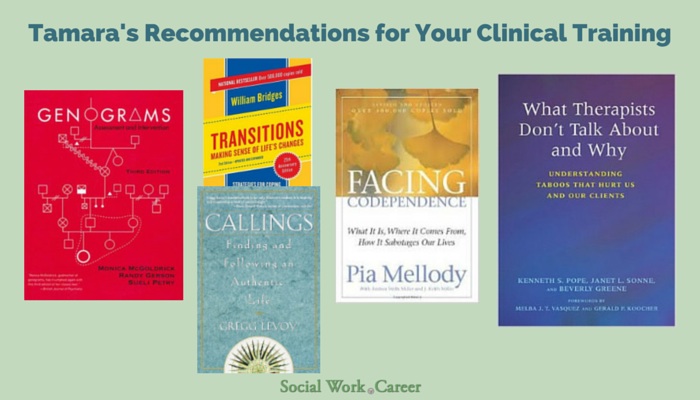
One of my mentors taught me to use a genogram as the structure for my intake with new clients. This format, based on the book Genograms: Assessment and Intervention by Monica McGoldrick, Randy Gerson, and Sueli Petri, floats up problem areas and potential treatment goals all the while couched in a conversational and educational format. I can’t think of a better first book and early skillset to develop for a therapist.
Every client that we work with is either seeking change or has been thrust into the middle of change. For that reason, William Bridge’s book Transitions: Making Sense of Life’s Changes has been invaluable to me in conceptualizing and normalizing my own and clients’ reactions to change.
Callings: Finding and Following an Authentic Life by Gregg Levoy is a book that really upped my clinical game. The premise of the book is that life is whispering invitations to each of us every moment of every day pointing us toward our life’s purposes. Sometimes therapists struggle with this . . . and often clients come to us not knowing but wanting to know what their own life’s purpose is. This is the book that I point them to.
Almost all clients will be touched in some way by family dysfunction / addictions. Facing Codependence: What It Is, Where It Comes From, How It Sabotages Our Lives by Pia Mellody, Andrea Wells Miller, and Keith Miller is one of the classics that helps both therapists and clients to understand the patterns that erode away at our personal power and our ability to even recognize what it is that we want, need, and deserve to attain.
And, finally, Ken Pope, Ph.D. and Beverly Greene, Ph.D. wrote a little white book called What Therapists Don’t Talk about and Why: Understanding Taboos that Hurt Us and Our Clients. I think it ought to be required reading in any graduate program. It’s an easy read that will help float up a therapist’s own issues that need to be considered, reflected upon, and resolved if you are going to do the work of psychotherapy.
What They Enjoy Most About Their Work
What do you find most rewarding about each of the positions (therapist, committee member, professor, researcher, supervisor/mentor) you have?
From Michael:
Please don’t make me choose! For two reasons: First, because I don’t want to give any of the positions up, and second, because each of the positions enriches and informs the others. I will always enjoy the work and privilege of being a psychotherapist, I get to have so many meaningful conversations daily, and see people confront and overcome huge problems in their lives.
The biggest challenge is not to take on too many patients at a time, because if I get overextended the quality of each person’s treatment begins to suffer. I enjoy being on the MCLGBTY and other committees I serve on because they help me stay politically active and affect policy, while representing people who don’t always have a voice in society.
The biggest challenge with that is trying to make the most of my time with committee work and not get bogged down in process—I really don’t like meeting for the sake of having a meeting.
The most rewarding part of my teaching MSW students is the students. I feel very confident in the future of our profession: The students at Boston College Graduate School for Social Work are extremely dedicated and talented to becoming social workers. They work so hard!
The biggest challenge is that I sometimes can see how stressed out they are getting because they want to be perfect!
How do you help your students deal with their stress and/or desire to be perfect?
I try to stress being professional and human over being perfect, because it is possible (and necessary) for us to be professional and human but impossible to be perfect. I also help them reframe mistakes: the goal in therapy is not to stop making mistakes, but to decrease the amount of time between making the mistake and correcting it.
From Tamara:
For the first 20 years in mental health (the first 10 working in agencies, criminal justice, and a hospital setting), I was 100% immersed in clinical work. Then, in 2002, when I relocated to Colorado, I had an opportunity to start over and redesign a new practice with a split focus. It was an unexpected perk!
These days I keep a 50-50 split between my clinical work and the coaching / consulting work and I love it. Each half informs the other.
By keeping my head and hands in the clinical work with more seasoned professionals, I get to experience first hand the highs and challenges of continually honing that edge.
And, by staying connected to relatively new therapists – at least new to private practice – I get to feed off of their fresh ideas and enthusiasm! That keeps me current and on my toes!
What I love most about my work is really hard to say . . . . I love the variety of my work, the puzzle of something new and the sleuthing to make it all make sense. I love connecting the dots and mentoring the way for therapists to leave me with a greater sense of purpose, a clearer understanding of their strengths and gifts, and my own sense of changing the world by supporting them on their journey. What’s not to love about all of that in a day?!
What They Find Most Challenging
And what aspects are the most difficult/challenging?
From Tamara:
At 54 years of age with 30 years in the field, it is easy to get sloppy and there’s tons of research out there that shows that the longer we’re in the field, the more likely we are to make errors. So the challenge, of course is to stay sharp!
It’s easy to assume that the new clinician I am talking to understands what I am talking about. It’s easy to rationalize skipping over finishing a report or putting off balancing a checkbook, but each one of those rationalizations has consequences for both me and my clients.
In my coaching and consulting work, the same is true. Putting off responding to emails or even writing down a date for an interview can be costly for everyone involved.
Another challenge is that I meet so many people in a month both face-to-face and online. I really love talking to therapists in particular so it’s frustrating when I don’t have time to visit with every single one or remember every one’s names. I hate that! Often I will remember a face but can’t connect where I last saw it or what name goes with it!
Section 3: Establishing Your Practice – The Business Side
Both experts emphasize that private practice is a business. Here’s how they learned to navigate the business side and what resources helped them.
Learning the Business of Private Practice
From Tamara:
Oh, of course! There were lots of books (because I started in private practice pre-internet) and, at least in the first 10 years, none of the books I read were about setting up a counseling practice because they just didn’t exist.
The first book I read about marketing, The 101 Best Practice-Building Strategies for Today’s Physician by Alan L. Bernstein with Donna Freiermuth, was actually written for physicians and it was ridiculously expensive – $40 (and that was way back in 1991!)
I found it at a medical bookstore. It was incredibly well-researched and I still remember some of the things that I learned from it like where you physically locate your office matters, what to tell clients when you are selling your practice to another owner to maximize continuity of clientele, and advertising do’s and don’ts.
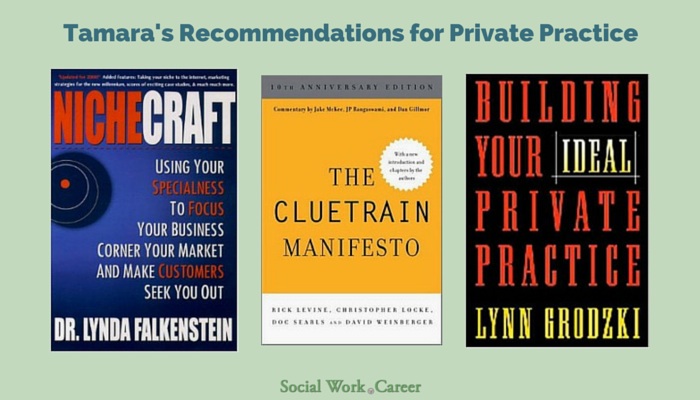
Another book that really helped me hone my niche was Nichecraft: Using Your Specialness to Focus Your Business, Corner Your Market, and Make Customers Seek You Out by Lynda C. Falkenstein. Although most of us hear early on that we “should choose a niche” to help focus our businesses, we really resist this – mostly out of fear. This classic book spells out exactly why niching is a really smart business move and exactly how to drill down to find your own niche.
The Cluetrain Manifesto: The End of Business as Usual by Rick Levine, Christopher Locke, Doc Searls, and David Weinberger probably seems like an unlikely book for me to mention. However, I am a bit of a digital dinosaur. Even though today you find me on LinkedIn, Twitter, Pinterest, Google +, Facebook and blogging away on Private Practice from the Inside out, the truth is that I have resisted every one of those tools every step of the way until I got over my fears and saw the results I got from using them.
Reading this book back in 1999 before therapists were ready to embrace even simple, static, old-fashioned, HTML-based websites was a game-changer for me. These geeks wrote this little book predicting the many ways that the World Wide Web would change business practices around the world.
They were making audacious claims like “Markets are conversations,” insisting that businesses should be having those conversations with their audiences in voices that “sound human,” and noting that “Hyperlinks subvert hierarchy” and thus level the playing field for small businesses like yours and mine!
It took me another 8 or 9 years before I put my first website up for my clinical practice but by the time I got there, those visionary geeks-turned-authors had predicted the upheaval and leveling of business, communications, and marketing in ways that we are still unraveling today. And, even today, 15 years later, when I get bored with my marketing and want to spice things up, I typically turn to the first few pages of this book and re-read The Cluetrain Manifesto’s 95 Theses for inspiration.
And, then finally, Lynn Grodzki came out with Building Your Ideal Private Practice: A Guide for Therapists and Other Healing Professionals in 2000. It was the first book I ever saw or read specifically for mental health professionals about building a private practice.
Although I had been in independent practice for 8 years by the time this book was published, I read it and found it useful in helping me reinvent my practice in 2002 when I relocated from Texas to Colorado. While there are now several books out there competing for new practitioners’ attention, I almost always recommend Lynn’s as a favorite place to start learning about growing a business in mental health.
Two Approaches to Establishing Your Practice
From Michael:
As I mentioned above, I decided to make the best out of a job loss situation. That said, it took a lot of hard work and marketing. It also took a lot of time reading and getting consultation on how to start a business.
One thing I discovered is that if I had a part-time frame of mind, my practice lingered at part-time. But when I rented an office, rather than subletting a few hours from somebody else, I had more pressure AND freedom. I began to take myself more seriously as an entrepreneur, and I began to have more mature attitudes about money and managing the expenses that come from running a business.
I was also lucky to have a partner who was able to help out the first year when I was ramping up. But it is not at all impossible, I guarantee you that. It is hard work and takes a lot of consistent effort, but I can’t begin to tell you how worth it it is in the long run. If you’re thinking about starting one I say, research it a little and then GO FOR IT!
Section 4: Getting Your First Clients and Growing Your Practice
One of the biggest questions when starting a private practice is: ‘How do I get my first clients?’ This is often the most anxiety-provoking aspect of starting a private practice; you’ve invested in your education, rented an office, created your paperwork, but will anyone actually call? Here are two different strategies that worked for our experts and can work for you.
How They Got Their First Clients
How did you get your first clients and ultimately manage to build up your practice to be large enough to support a full-time practice? And what advice would you recommend to someone thinking about starting up a practice in this regard?
From Michael:
I started by applying to be on insurance panels of all kinds and EAPs of all kinds. That way I could take referrals from all insurances and EAPs. However, I should stress that that has limitations, specifically income limitations. But the second phase of growing a practice is beginning to discontinue being on the insurance panels one at a time, beginning with the one that reimburses the lowest.
I’d also recommend that if you are starting a practice you invest in some private supervision to get started. If you don’t think you can afford it than you aren’t ready to start a practice—you are either reluctant to commit your resources to your business, or you need a few months to save up to have some resources.
Professional Associations and Networking
Are there some professional associations that you have found helpful when you first established your private practice?
From Michael:
I always think NASW is a good place to start, I have met some great friends and colleagues through our MA Chapter and the DC office. There is always something that needs doing, and usually you can find groups that best suit your interests.
Depending on your theoretical interests there are usually associations that you can join as well. I’m a member of the Massachusetts Institute for Psychoanalysis because I work very psycho-dynamically. Other than that I think the Small Business Association has good free materials for developing a business plan.
By the way, did you notice how many times I used the words “business?” That’s because you need to remember that private practice is a business, and you need to learn how to create and run a business if you are going to be successful.
Additional Training After Your MSW
Do you feel that getting some training from a psychoanalytic training institute is a good idea following one’s MSW degree?
From Michael:
I think it is, because I am a psychodynamically-oriented therapist. I think that social work schools have decreased the amount of training in this theory over the past 10-15 years, for a number of political and economic reasons, and if you want to get that training you may need to look outside of the MSW program you are in.
Section 5: Marketing Your Practice – Traditional and Digital Strategies
In today’s world, marketing requires both traditional networking and digital presence. Here’s expert guidance on both.
Traditional Marketing and Career Advice
What career advice would you offer to upcoming MSW graduate students who are looking to develop their own private practices?
From Michael:
My first career advice would be, “don’t sell yourself short!” Don’t take the first fee-for-service job that calls you back. You have 2-3 years before you can get licensed in most states, and that is a lot of time to spend bouncing from one unhappy job to the other, or becoming increasingly hopeless and helpless in the job you first pick.
I really do think that your first job out of school has much more value to it than just money. It sets the tone for your professional development and your career. So if you are just graduating don’t act desperately, wait for a job that provides you with good learning supervision and benefits, even if that means you have to do something else in the short run to earn money.
Also, when you are ready to move into private practice get coaching and supervision from someone who’s done it, someone who has what you’d like in a practice.
Digital Marketing: Websites, Blogging, and Social Media
Finally, when did you first start your blog and what is it that you are hoping to achieve via your blog?
From Michael:
My blog started a few months ago, when I decided to start focusing more on Psychotherapy in a Web 2.0 world. A lot of my colleagues were spending time complaining about insurance companies, and although I still do some political advocacy around managed care, I quickly discovered that complaining about it was not going to help my business.
Instead I started to notice how we therapists neglect to learn about technology and the technological worlds of our patients, when that very technology could begin to help us do better work and make money.
So now I blog about these things and more and more colleagues are coming to me to ask for consultation and supervision around technology. And I love talking about it with them, and seeing how they begin to get more enthusiastic about the work they do, and more willing to take risks.
I am also a gamer-affirmative therapist, and am going to start blogging more about that in the next few months, to help complement the workshops and webcasts I have done on it. In fact, the next blog coming out Tuesday is on Second Life.
And next weekend I’m going to be at Blizzcon 2010, so you can bet there will be a blog or two about World of Warcraft in the future too! I hope people will get curious about all these ways technology and psychotherapy connect, and check out and subscribe to my blog!
Understanding Technology and Your Clients’ Worlds
I understand that you are researching the impact of social networks on interpersonal relationships. What drew you to this subject and what is it that you are hoping to learn or achieve through this research?
From Michael:
Partly because in my other life my partner and I founded and own a social media software company. We’ve had the opportunity to work with lots of different groups and companies to set up social networks, and over the years we have learned what works and what doesn’t.
And I have learned that social media is changing the ways we interact permanently. It’s not going away, and as a therapist we’d better learn about it, because more and more of our patients are finding us that way.
I’m also doing a lot of work on Massively Multiplayer Online Role-Playing Games (MMORPGs) and my goal is to help colleagues learn about them, rather than dismiss them as silly or pathologize them as addictions without understanding what they mean to their patients.
Finding Your Niche: The Gamer-Affirmative Therapist
What do you mean by a gamer-affirmative therapist?
From Michael:
A gamer-affirmative therapist is a therapist who does not pathologize people who game online. Rather than dismissing gaming as silly or an addiction or a substitution for the “real important stuff,” a gamer-affirmative therapist sees gamers as a specific population and culture, with values and ways of being that need to be understood, not criticized.
It is similar to the idea of being a “gay-affirmative therapist.” If you are coming to therapy because you want me to change you into a non-gaming person, I’m not the therapist for you. If you are coming to therapy to find a way to understand your gaming and integrate it into the rest of your life in a way that feels enriching to you, that I can help you with.
What is World of Warcraft and Second Life?
World of Warcraft is the largest Massively Multiplayer Online Role-Playing Game on the internet. Basically imagine an internet version of Dungeons and Dragons that you can log onto and play with thousands of other people all over the world.
Second Life is a virtual simulation platform that allows you to create an avatar and live a virtual life online. You can do most things with your avatar that you would do in real life, including shopping, making friends, attending lectures, exploring the world, etc.
Key takeaway: Finding your niche—whether it’s working with gamers, LGBTQ clients, trauma survivors, or any specific population—helps you stand out and allows you to develop deep expertise. Don’t be afraid to specialize in something you’re passionate about, even if it seems unconventional.
Section 6: Joining an Established Group Practice
Before starting your own solo practice, you might consider joining an established group practice. Here’s what to expect.
Interview Questions for Group Practice Positions
Could you share a few questions that a mental health provider hoping to join an established private practice might expect to encounter in an interview?
From Tamara:
Sure! I think most owners of a group practice are wise to ask “What are your long term plans for your career?”
Some owners of group practices pride themselves on being training grounds for new clinicians. Mentoring, consultation, and even training – both clinical and business-focused may be included in their expectations. Other owners want clinicians coming in ready to function independently both clinically and from a marketing / business perspective.
Another question that many group owners ask is “How do you plan to bring in clients to this group practice?”
Even if that question doesn’t come up, therapists would be wise to find a way to weave this answer into their interviews. Whether a group owner expects clinicians to actively market the group or not, marketing skills and knowledge will always be appreciated by the owner.
If therapists don’t know yet how to attract clients, then let this be a good nudge to learn from the more seasoned therapists around you and from research both in and outside of health care about effective strategies for marketing a private practice. It will make you much more valuable to the clinician that hires you.
Section 7: Top 10 Must-Know Private Practice Start-Up Tips
From Tamara G. Suttle, M.Ed., LPC
After decades of experience starting a private practice, building it to full-time, and coaching others through the same process, Tamara has distilled the most critical lessons into these 10 essential tips. Whether you’re just beginning to think about starting a private practice or you’re ready to open your doors tomorrow, these strategies will set you up for success:
What would be your top 10 tips to mental health providers interested in starting up their own private practice today?
1. Start Your Networking NOW (Even Before Private Practice)
While you are honing your clinical skills in graduate school or in an agency, even if private practice is 10 years down the road for you, start your networking (online and face-to-face) now. Even if you plan on relocating and don’t have a clue where you will be, maintain your network at all cost. It will be the difference between starving to death and thriving when you open your doors to private practice.
2. Create a Plan for Your Own Self-Care
Read about it. Talk about it. Write your plan down and put it on your calendar before you ever schedule your first client. In the beginning, you may find that this is an exercise that feels totally disconnected to your clinical work. However, if you establish those habits of self-care now, when the crises hit (as they inevitably will), you will be better prepared to weather them.
3. Join or Create a Consultation Group
You will need them to bounce ideas off of, check in for reality checks, and to continue to grow your edges in private practice. Most therapists are not prepared for the extreme isolation of sitting in an office, listening all day, and giving, giving, giving of themselves. Your consultation group can be your lifeline to counterbalance your clinical work.
4. Be Strategic in Your Networking
Take the time to identify the clinical areas that you are not trained in, don’t have an interest in working in, or simply are not competent in. Declare your weak suits (as well as your strong suits) and know that those areas of weakness are the best places to strategically focus your networking.
There’s a good chance that your weak suits will nicely complement someone else’s strong suits and vice versa. When the clients start knocking on your door (but they don’t happen to need your strong suits), you’ll have a list of professionals who are better fits for those clients. In turn, you will have garnered favor with those that you referred to and will likely reap reciprocal referrals from them!
5. Stay Focused on Building Reciprocal Referring Relationships
There are only a zillion competent therapists these days working with trauma. Make every effort to build relationships with and refer to those who are qualified and are willing to also refer back to you. Referring a client out obviously needs to be a clinical decision based on that client’s particular needs; but referring out also needs to be a business decision. Make it your mission to find professionals to refer to that can meet both of those needs.
6. Get Your Paperwork in Order BEFORE You Schedule Your First Client
Intake forms, referral documents, progress notes, psychosocial history forms, disclosure statements, handouts, receipts, and more are required to conduct your work in private practice. In the beginning, you will have 0-2 clients and what you think of as “too many free hours” in the day. That’s a great time to be creating and polishing those documents.
7. Establish Systems for Everything
When you are in graduate school or working for an agency, the systems are already in place i.e. how to handle initial inquiries, how to write progress notes, how to deal with a client in crisis, how to handle no-shows, etc. Once you are out on your own, it’s entirely up to you. Set those systems up early on so that they become ingrained habits. Otherwise, you will find that 10, 20, even 30 years down the road, when your practice is full and thriving, you will be wasting your time reinventing everything from scratch with every new client.
8. Plan on Investing in a Website on a Good Solid Platform Like WordPress.org
Having a good website helps establish your credibility and tells the general public that this isn’t just a hobby for you – that you are a professional who is serious about their work. And, don’t be taken in by the sites that claim to offer you a “good deal” by hosting your site for you. Do the math. They are not cost effective in the long run – 3, 4, 5 years down the road you could have paid for a fully customized site with all the bells and whistles.
9. The Most Efficient Way to Get Known Online is Through Blogging
You can start blogging long before you hang your shingle out and make the move into private practice. Dorlee, you are a great example of doing this while still a student, and it has obviously helped you get connected around the globe with social workers and resources that you rely on today. It’s a very smart way to get a head start on your peers.
10. Remember That Private Practice is a Marathon . . . Not a Sprint
You need to pace yourself, anticipate the slow start and lulls that inevitably will come throughout your career and plan for how you are going to handle them both financially and physically. There will also be feast days when you can hardly come up for air. Plan for those, too – what you will do with the extra money and how you intend to fit into your schedule your own self-care, your family obligations, etc. And, throughout the feast and famine days of private practice, keep an eye on what it is that you are supposed to be learning . . . about yourself, about your clinical work, and about the business of running a private practice.
Section 8: Special Considerations – Establishing a Practice in a Foreign Country
Tamara, Could you give us a bit of your background? What led you to become a mental health counselor?
In college, it was obvious that mental health was exactly where I was supposed to be. When I got ready for graduate school, I looked at psychology, social work, marriage/ family therapy and counseling.
The emphasis on research and behavioral psychology was not a good fit for me. The social work curriculum I looked at emphasized working in hospitals, institutions and the welfare systems. That wasn’t what I was looking for.
Marriage and family therapy didn’t interest me at the time because I had no plans to marry and family was still quite narrowly defined back then. That wasn’t going to work for me either.
And, then I learned about counseling – I was immediately drawn to proactive, holistic emphasis on working with individuals, groups, and families with both an educational and depth of focus.
I graduated, got licensed first in Texas as a Licensed Professional Counselor and then in Colorado. I have been in mental health since 1982.
What I know now that I didn’t know then is that research shows that while the various disciplines certainly provide different foundations for our work, after we’ve been in our respective fields for a while, regardless of our various disciplines, our clinical practices are much more similar to each other than they are different.
I started out in the 1980’s doing trauma work when the only research that had been done in the field was on war veterans. We were really flying by the seat of our pants working with adults who had been sexually abused as children, rape and domestic abuse survivors.
Our treatments back then were informed by the works of Pia Mellody, John Bradshaw, Melody Beattie, Charles L. Whitfield, and Claudia Black; the work was considered to be cutting edge; today, much of that work been absorbed into many different protocols.
What experiences helped you the most in terms of building up the requisite clinical skills to enter private practice?
The first experience that comes to mind was early on in my career. I often fantasized about donning that white cape and swooping in to rescue my clients. I wanted to wrap them up in blankets and take them away from whomever it was that was mistreating them. It’s embarrassing to say that but I think it’s also important for new professionals to understand that it’s common . . . almost predictable for many clinicians to have to grapple with rescue fantasies.
This wasn’t talked about in my graduate training – at least not in any meaningful way – day dreaming about how to save / fix my clients . . . and how that isn’t about their dire straits nearly as much as it is about my own rescuer fantasies . . . the role my own history plays in the counseling relationship . . . countertransference.
The first time I heard anyone talk about this in a real and meaningful way was when I attended a feminist conference for mental health professionals in the mid 1990’s. Two psychologists facilitated a workshop that focused on what therapists don’t talk about.
As a new professional with probably no more than 5 years experience in private practice, I had never heard colleagues (or professors or anyone else, for that matter) talking about their own issues . . . emotional / physical attractions to their clients, how disgusted / repelled they were by some clients, how far they would go to avoid confrontation, their own dual relationships and the complications they incurred because of them, and many other personal disclosures.
The revelations in that workshop showed me that therapists don’t necessarily have all the answers; we’ve just been trained to help others find their own answers. It also showed me what countertransference looks like in real live situations and what confident and committed therapists do when they have their own stuff come up in their own offices with clients sitting across from them.
Special Question from a Reader:
Tamara, what would you advise a mental health professional who wanted to establish a private practice in a foreign country where psychotherapy is often seen as unnecessary and patients or clients would rather see a native healer or a physician for assistance?
From Tamara:
Off the top of my head, a few things come up:
Be cognizant of the need for consultation that is culturally competent. That will likely mean that a consultation group here in the USA won’t be sufficient or, possibly even appropriate. Start your search for that support early.
It is possible that the country may (or may not) have laws dictating who can and cannot provide the types of services that you would like to provide.
Before attempting to provide mental health services independently, I would recommend that you spend some time working with one of the NGOs, i.e. a local organization that is not part of the government, or a for-profit business. Working in this setting would allow you to build relationships with those in your community, learn some of the social norms, while also doing service work that is meaningful to you.
As with any practice, you will need to be prepared to handle crises i.e. threats of suicide, homicide, and self-harm, as well as what to do when your clients’ needs surpass your own ability to support them.
Depending on the country you are located in, it may not be desirable or even possible to have a web presence to market your services. If this is the case, you will need to fall back on traditional networking and marketing practices that were more common throughout the 20th century here in the USA. The good news is that while the tools may differ, the underlying principles of marketing will not – relationships are what build all businesses in the end.
I do recommend that your initial outreach for clients focus on the expat community to build your clientele. You will likely find that you have more in common with them and will have less of a cultural divide to bridge. Then, as your cultural competence grows, you can begin to integrate your services in a more appropriate way.
You must also consider the possibility that you will be unable to practice in the same way that mental health professionals are able to in the United States. It may not be legal or sustainable for you to do so in your country.
If that is the case, remember that even then, you still retain all of the skills and talents that you did before. You may simply be required to use them differently. You may be able to practice distance counseling from your country with individuals back here in the USA.
You might be able to leverage your skills into consulting, coaching, or educational gigs. You might be able to apprentice with natives in order to gain the skills and perspective needed to provide services at a later date. And, I’m sure there are many other possibilities as well.
My point is that you may need to get creative and think differently about how to use your skills and talents to best serve the population in your country of residence.
Conclusion: Your Path Forward
Starting a private practice is challenging but deeply rewarding. As you’ve learned from Michael and Tamara, there’s no single “right way” to build your practice, but there are principles and strategies that consistently lead to success.
Key Takeaways:
From Michael Langlois:
- Don’t sell yourself short; your first job sets the tone for your career
- Bad job fit is debilitating; don’t be ashamed to use unemployment benefits
- Renting your own office (vs. subletting) changes your mindset from part-time to full-time
- Consider a portfolio career combining practice, teaching, and supervision
- Embrace technology and your clients’ digital worlds
- Find your niche and specialize (even in unconventional areas like gaming)
- Private practice is a business; learn to run it like one
From Tamara Suttle:
- Find mentors who will teach you what graduate school doesn’t
- Learn to recognize rescue fantasies, denial, and countertransference
- Start networking NOW, even if private practice is 10 years away
- Get your paperwork and systems in order from day one
- Invest in a quality website on WordPress.org
- Blog to establish your expertise and get known online
- Join professional associations and get involved
- Private practice is a marathon, not a sprint; pace yourself
- Market strategically through reciprocal relationships
- Never stop learning and developing your clinical depth
Essential Reading List:
Clinical Skills:
- Genograms: Assessment and Intervention by McGoldrick, Gerson & Petri
- Transitions: Making Sense of Life’s Changes by William Bridges
- Callings: Finding and Following an Authentic Life by Gregg Levoy
- Facing Codependence by Pia Mellody, Andrea Wells Miller & Keith Miller
- What Therapists Don’t Talk About and Why by Ken Pope & Beverly Greene
Business Skills:
- The 101 Best Practice-Building Strategies for Today’s Physician by Alan L. Bernstein
- Nichecraft by Lynda C. Falkenstein
- The Cluetrain Manifesto by Levine, Locke, Searls & Weinberger
- Building Your Ideal Private Practice by Lynn Grodzki
Remember: As Michael says, “Private practice is a business, and you need to learn how to create and run a business if you are going to be successful.” But as Tamara reminds us, it’s also deeply fulfilling work where you get to “change the world by supporting therapists on their journey.”
You have the clinical skills. You have the passion. Now you have the roadmap. Go for it!
Thanks so much to Michael Langlois, LICSW from Gamer Therapist: Psychotherapy Meets Web 2.0 and Tamara G. Suttle, M.Ed., LPC from Private Practice from the Inside Out for sharing their invaluable insights and experience!
Related Resources:
Looking for more guidance on building your private practice? Check out these related posts:
- 10 Must-Know Private Practice Start-Up Tips – Visual infographic summary of Tamara’s top 10 tips plus bonus guidance on establishing a practice abroad
- The Zen of Online Marketing for Private Practice – Book review covering website design, SEO, blogging, and social media basics
- HIPAA Compliance: Private Practice Security Tips – Essential guide to protecting client privacy and meeting legal requirements
- Career Advice from a Dean of Social Work – Comprehensive career guidance including essential clinical competencies for private practice
What are your thoughts about starting your own private practice? What challenges or questions do you have? Share in the comments below!
Disclosure: This post contains affiliate links. This means Social Work Career may receive a small commission if you make a purchase. Regardless, I only recommend or include recommendations for products or services I believe will be good for my readers.
Last updated: December 31, 2025



You’re so welcome, Sharon! I look forward to networking with you!
Thank you Tamara and Dorlee. So much great info in this article/interview! You both have amazing websites, as well, with a wealth of resources.
Thanks so much for your kind feedback, Sharon 🙂
Thanks, Laura, for dropping in to chat! Hey, I’m curious . . . what is it that you’ve seen that has changed over time?
Thanks so much Dorlee for the interview and thanks Tamara for sharing your experience and widsom! It was really interesting to see how things have changed and developed over time and how some things stay the same. I’m pleased to be familiar with a couple of your recommended reads and will check out the others.
Hi Laura,
I’m so glad that you found the interview with Tamara as enjoyable and informative as I did!
Thanks so much for taking the time to share your kind feedback 🙂
Thanks Dorlee for bringing this generous and informative interview by Tamara.
My two biggest challenges in establishing private practice after 20 years NGO Agency work are keeping up with the process of social media marketing and deciding where to network.
In the first I am at the point of understanding a need to create a schedule and targets for blogging, etc within an established marketing strategy.
Overall, there has been just so much to learn and establish that I find my progress being achieved over a broad areas that I worry that these efforts are not focused in the right areas. I will study Tamara’s interview closely to further develop focused priorities.
Thanks very much to both of you!
Hi, Michael! I’m so glad you’re joining the conversation here because you are bringing up an issue that many therapists in private practice struggle with – the ideal that they need to be all over the internet. And, while that may feed egos, it doesn’t necessarily fill the appointment times on your calendar.
Before you go spreading yourself too thin and exhausting your resources, think about this. Yes, you need a website if you are going to be in private practice. And, the most efficient and effective use of time online will be to blog on a regular (and, if possible, weekly) basis in order to reach the maximum number of people with the least amount of effort / time invested. If, and only if, you are already doing those things well, should you (for the sake of your business) then consider adding on a social media network or two.
Before you take that last step though, you need to be really clear about why you want to do that. After all, if your goal(s) aren’t clear, it’s likely you will just be blindly spewing out stuff and wasting your time / money / energy with little return on your investment. However, if you are really clear about what you want to accomplish, then if might very well be wise to choose a social network tool to help you meet that goal.
Don’t get pulled in to the idea that you need to be everywhere all the time in order to keep the coffers full. It’s just not true. And, I would also add that you should be strategic in the choice of the tool that you use. Different tools serve different purposes — just like different therapists do. Choose your tool according to the goal you have. By using social media this way i.e. strategically . . . you won’t be in that constant exhausted state of feeling like a dog chasing its tail. Instead, you will be building authentic relationships online with individuals who have the potential to like you, trust you, and . . . when the time is right (for them, not you) . . . will pick up the phone to call you.
Hi Michael,
I’m so glad that this interview with Tamara came at the right time for you and looking over her detailed response, she has also given you some specific guidance to address your two biggest challenges. (Thanks so much, Tamara!)
Tamara’s guidance to focus on blogging for now (with a big picture strategy in mind) and have it become a part of your routine before deciding when/if to expand onto a social networking platform sounds wise. In this manner, you are more likely to enjoy blogging and less likely to become overwhelmed.
To get some ideas about what to blog about or see good examples of therapists’ posts, you may want to look over past “Best in Mental Health” issues (these are roundups of posts that I curate from around the web every week to two weeks in the social work/psychology realm). You can find prior issues under https://www.socialwork.career/category/mental-health-roundups .
Hoping this was helpful!
You know, Dorlee, when I talk to my BlogStart for Therapists class, I use you and Social work Career as the examples for what a committed blogger can accomplish with a blog.
You post like clockwork and the results show.
You have an audience that knows you show up for them and, because of that commitment and the fabulous info that you curate for them here, your following is exceptionally loyal to you.
You’ve gotten known. You’ve gotten liked. And, you continue to earn your audience’s trust. And, for those of us in private practice, ALL of that is necessary before anyone is going to pick up the phone to make that first phone call.
Thank you, Tamara
I am most grateful to the support and valuable information you and the rest of the blogging/mental health community have provided.
Blogging is truly a gift that keeps on giving. Your world expands (new people, knowledge) and you make connections with others.
It is thanks to blogging, social media and the relationships that I developed that I have my current consulting positions.
What does this mean for the private practice world?
Blogging regularly (whether it is once a week or once a month) is likely to not only increase the chances of prospective clients finding and getting comfortable with you, but it may also open up opportunities for collaboration with other mental health professionals… as we are doing 🙂
Thanks, Dorlee! I think we must be mutual fans of each other because I can say the same about you!
Aww, thanks so much, Tamara!
Dorlee, I really enjoyed your interview with Tamara. There are some great recommendations for those of us starting out in private practice and those that have been practicing for many years. Good luck to you!
Janet
Hi Janet,
I’m so glad that you enjoyed my interview with Tamara and feel that it provided helpful guidance for both new and experienced private practice clinicians.
Thanks so much for your kind feedback and good wishes.
Wishing you the best of luck as well !
Dorlee
Hi, Janet! Thanks so much for letting me know that you found our interview to be useful.
I wonder what you’ve found to be most useful in growing your own practice ?
I know that there’s a lot of wisdom here in Dorlee’s community that goes far beyond my own.
Care to share?
Thanks for the great information! I am still very new to private practice as a pediatric occupational therapist and I found several tips that I found very helpful.
Hi Jennifer,
Thanks so much. It is wonderful to hear that you feel that some of the guidance Tamara provided is quite relevant to you in your private practice journey.
Wishing you the best of luck with your private practice,
Dorlee
Hi, Jennifer! It’s so nice to meet you! I’m so glad you found some tips to help you grow your business. I’m curious . . . what is it you find to be your biggest challenge so far?
Great article! This came to me at the perfect time as I am just starting out in private practice. Thanks!
Hi Jenn,
How exciting that you are just starting out in private practice!
Thanks so much for your kind feedback. Tamara will be thrilled to hear that her guidance was of help to you.
Best of luck,
Dorlee
Dorlee, just dropping in this morning to say “thank you” for inviting me to drop in and visit with you and your fans. You really do have a fabulous and engaged audience!
I hope we’ll have an opportunity to collaborate again in the future! You represent the best of social work – you are generous, client-focused, and full of heart!
Aww, Tamara – You are most kind.
I’m most appreciative of all the time and careful thought you have given to the interview (and the follow up questions that have been coming through) and look forward to a future endeavor together.
By the way, I admire the way in which you respond to readers’ comments. You have such a wonderful way of extending the conversation and/or inviting additional questions.
Hi, Jenn! Thanks for dropping in to check out our interview! Hey, I noticed that you don’t have a little photo of you that shows up with your comments here (and on other blogs, too). Those are called “gravatars.” Using a gravatar helps others online get to know and trust you quicker.
Here’s a link to a quick tutorial that shows how to set up your own gravatar. I thought you might want to know so that you get recognized quicker as you’re surfing the internet. (Don’t worry! It’s so easy that even I could do it and it’s absolutely FREE!) http://www.allthingsprivatepractice.com/how-a-tiny-picture-of-you-can-help-drive-traffic-to-your-website-or-blog/
Best wishes on your journey!
Thank you, Tamara, for sharing that helpful link/article about setting up gravatars.
It would be so nice to see everyone’s faces 🙂