5 Best Resources to Help Victims of Domestic Violence
Are you looking for guidance on how to help victims of domestic violence? Whether you work directly with survivors or want to better support clients experiencing intimate partner violence, having the right resources and
understanding best practices is essential.
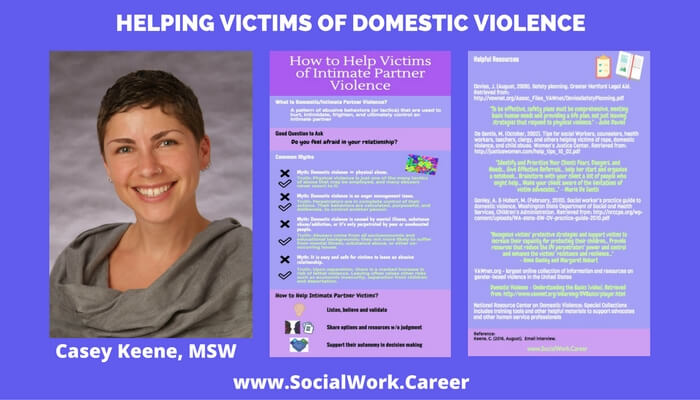
SocialWork.Career interviewed Casey Keene, Director of Capacity Building and Education at the National Resource Center on Domestic Violence, to provide expert guidance on helping victims of domestic violence effectively.
Casey Keene is a social worker who has been working on behalf of victims of intimate partner violence for over 15 years. Casey manages VAWnet.org and PreventIPV.org, and has also provided leadership to Adult Children Exposed to Domestic Violence.
Expert Guidance on How to Help Victims of Domestic Violence
Now, without further ado, let’s start with a bit of your background, Casey. What led you to the field of social work, and specifically, to become an expert in the area of domestic violence at the National Resource Center on Domestic Violence?
It was actually my movement work that led me to the field of social work, and not the other way around! My personal experience of domestic violence in childhood elevated gender based violence as my priority social justice issue.
Following my mother’s lead, and learning from her experience as the director of a community-based domestic and sexual violence program after her victimization, I started following my passion to impact change by volunteering at the Women’s Center Inc. of Columbia and Montour Counties in Pennsylvania.
From there, I learned about the work of the Pennsylvania Coalition Against Domestic Violence and was inspired by their statewide and national initiatives. I soon found a home at the National Resource Center on Domestic Violence, and driven to advance my capacity to do macro-level work, I pursued and earned my MSW in Management & Planning from Temple University.
I was, and continue to be, impressed by the social justice framework of the social work field and its alignment with the goals of the movement to end gender based violence – both striving to dismantle oppression and foster healthy families and communities.
To effectively help victims of domestic violence, we must first understand what domestic violence is and how it manifests in relationships.
How would you define domestic violence, and what are the different ways in which it may manifest?
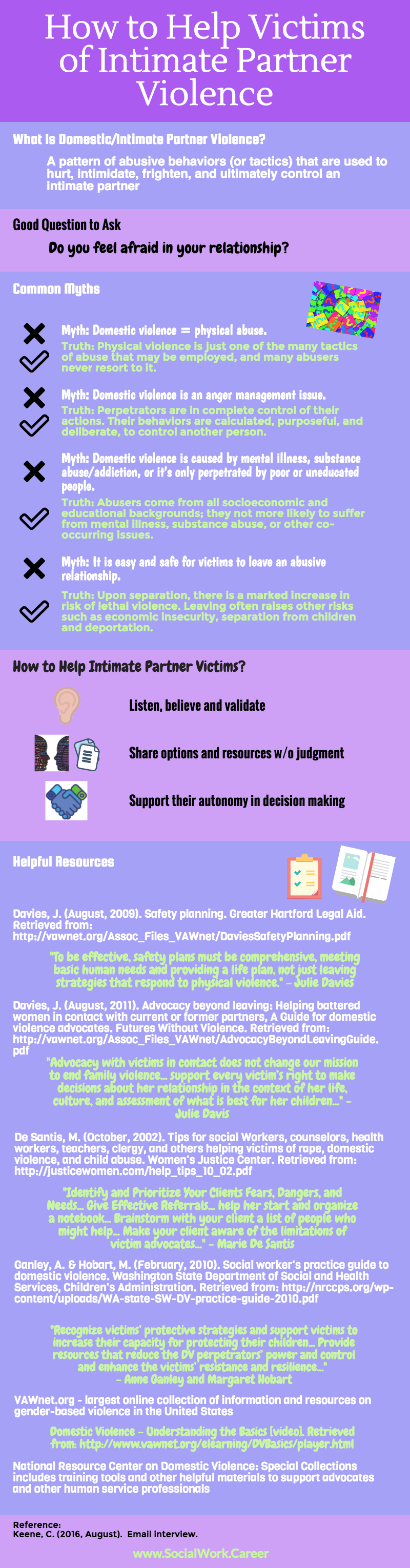
Domestic violence, or intimate partner violence, is a pattern of abusive behaviors (or tactics) that are used to hurt, intimidate, frighten, and ultimately control an intimate partner.
Abusers may use physical, sexual, and psychological attacks, and tactics such as economic abuse, isolation, and blame to gain or maintain control over their partner.
Are most victims of domestic violence aware of being abused by their partners? If not, what questions do you recommend we ask to find out whether someone is being abused?
Unfortunately, the heavy social stigma associated with victimization prevents many from identifying in that way, as does the common myth that domestic violence must include physical abuse.
Abusers are extremely intentional about trapping victims through tactics such as isolation and economic abuse, breaking down their sense of self worth through emotional and physical abuse, and manipulating people and environments to make the victim appear or feel as though they are confused, hysterical, or otherwise mentally unstable. It can be extremely difficult for victims of domestic violence to identify or name their experience within this context.
What victims commonly identify with is a sense of fear of their partner. The question, “Do you feel afraid in your relationship?” may be a good place to start. The National Domestic Violence Hotline offers an excellent list of warning signs and red flags that may indicate abuse in an intimate relationship.
What are a few of the most prevalent myths around domestic violence?
Perhaps the most common myth is one I’ve noted earlier – that domestic violence and physical abuse are synonymous. In fact, physical violence is just one of the many tactics of abuse that may be employed, and many abusers never resort to it. Many abusers understand the consequences of using physical violence – visible marks on the victims body, potential arrest or other measures of systems accountability, etc. – and will intentionally avoid it as a tactic. Instead, abusers are more likely to use threats of violence (often including murder and/or suicide) and the presence of weapons to intimidate their victim.
Another myth is that domestic violence is an anger management issue. Anger management programs are designed to address “out of control” tempers, teaching participants to learn to control, or manage, their behavior. In contrast, we know that perpetrators of domestic violence are in complete control of their actions. Their behaviors are calculated, purposeful, and deliberate, for the very goal of controlling another person. This is why anger management does not work to address battering behavior.
Other common myths about domestic violence are that it’s caused by mental illness, or substance abuse/addiction, or that it’s only perpetrated by poor or uneducated people. In fact, there is no personality profile of an abuser – they come from all socioeconomic backgrounds and levels of education, and look much like the general population when it comes to mental illness, substance abuse, or other co-occurring issues. This is also true for victims, but this goes without saying, as domestic violence is something that happens to them, and has nothing to do with who they are.
Abusers control and dominate their partners because centuries of patriarchal privilege has encouraged, supported, or condoned their right to do so. Lundy Bancroft, who has done extensive work with batterers, notes that “abuse grows from attitudes and values, not feelings. The roots are ownership, the trunk is entitlement, and the branches are control” (Bancroft, 2002, p. 75).
When it comes to victims, the most common myth is that it’s easy and safe to leave an abusive relationship. In fact, there is a marked increase in risk of lethal violence upon separation from an abusive partner. Leaving also may mean economic insecurity, separation from children, deportation, or other risks. People’s lives are complex, and victims analyze the risks of staying or leaving on an ongoing basis.
Share this Image On Your Site
How Social Workers Can Help Victims of Domestic Violence
What can social workers do to support victims of domestic violence?
It really takes all of us – social workers, advocates, healthcare providers, law enforcement, clergy, child welfare workers, and other human service professionals — to effectively respond to domestic violence. Part of social workers’ responsibility in direct practice is to screen for a client’s trauma history.
We know very well how a person’s experiences of trauma can impact them across the lifespan, and how important it is to address these — whether they occurred in the past or are currently existing. Social workers are uniquely positioned to help survivors of domestic violence increase their safety and well being and build their capacity for resilience and healing.
The most effective ways to help victims of domestic violence are:
1) **Listen, believe, and validate** their experiences
2) **Share options and resources without judgment**
3) **Support their autonomy in decision making**
These three principles form the foundation of how to help victims of domestic violence in any professional setting.
That said, domestic violence is a complex issue. Those who are best positioned to provide guidance and support are community-based domestic violence advocates who have engaged in extensive training on effective service delivery models. Social workers can access this training through their local domestic violence agency (standard courses are usually about 40 hours in length).
I strongly encourage that any social worker interested in building their capacity to work with victims not only take advantage of this training, but also work to build a relationship with the domestic violence program and advocates in your community. This collaboration will be one of your most valuable resources, especially as you encounter questions and challenges in supporting your clients.
Social workers are already especially skilled at delivering the most critical message that survivors can receive – that they are strong! Our strengths-based, empowerment-based approach mirrors the best practice model for domestic violence advocacy.
Social workers meet clients where they are and provide resources to support their decision making. We put our clients in the drivers seat, trusting that they are the experts on their own lives. To read more about the victim-defined model embraced in the movement, read Safety Planning and Advocacy Beyond Leaving by Jill Davies.
There are more resources available to learn more about the role of social workers in addressing domestic violence. Tips for Social Workers, Counselors, Health Workers, Teachers, Clergy, and Others Helping Victims of Rape, Domestic Violence, and Child Abuse by Marie De Santis for Women’s Justice Center/ Centro de Justicia Para Mujeres provides basic information on how to respond to victims/survivors of violence for those who may have limited formal training on violence against women and children.
Social Worker’s Practice Guide to Domestic Violence by Anne Ganley and Margaret Hobart for the Washington State Coalition Against Domestic Violence, Washington State Department of Social and Health Services provides guidance on working at the intersections of child welfare and domestic violence.
For (lots!) more, VAWnet.org offers an extensive library of free resources to support prevention and intervention strategies that enhance safety and well being and address the self-identified needs and concerns of victims and survivors.
Which online resources are the best “go-to” ones for good case management tools, videos or on-demand webinars to best support domestic violence victims?
VAWnet.org provides access to the most expansive online collection of information on gender-based violence in the United States and resources to help victims of domestic violence. This comprehensive site is essential for anyone wanting to learn how to help victims of domestic violence more effectively.
We have Special Collections of materials on key topics, applied research papers, training tools, and other helpful materials to support advocates and other human service professionals in the provision of effective prevention and intervention programs and services.
A great starting point for learning about this issue is the 1-hour free online learning module, Domestic Violence: Understanding the Basics.
Through her work at the National Resource Center on Domestic Violence, Casey has dedicated her career to developing better strategies to help victims of domestic violence and training professionals across the country.
What are the aspects of your work that you enjoy the most?
I love learning from the innovative work of fellow advocates and partners in social justice!
What are the parts of your work that you find most challenging?
Hearing stories of the horrors of gender based violence and the lives it has impacted continues to be the most difficult aspect of this work. Advocates engaged in this work must be attentive to the impact this may have on them, and be diligent in prioritizing their own well being.
Lastly, what are the ten important strategies/tips that you would give to new social workers working with victims of domestic violence?
I would boil it down to one: Believe her/him/them.
Hearing, validating, and honoring survivors’ experiences is the most important thing we can all do to help facilitate healing, safety, and justice, and ultimately shift our culture to a place that does not accept or condone gender based violence.
Thanks so much, Casey, for sharing with us all this valuable information on intimate partner violence!
Taking Action to Help Victims of Domestic Violence
Every social worker, advocate, and human service professional plays a vital role in helping victims of domestic violence. Whether you’re screening clients, providing direct services, or connecting survivors to resources, your commitment to helping victims of domestic violence can save lives.
Remember Casey’s essential message: Believe her/him/them. Helping victims of domestic violence starts with this single principle. Hearing, validating, and honoring survivors’ experiences is the most important thing we can do to facilitate healing, safety, and justice, and ultimately shift our culture to a place that does not accept or condone gender-based violence.
Ready to enhance your capacity to help victims of domestic violence? Start by:
– Taking the 40-hour domestic violence training through your local agency
– Building relationships with domestic violence advocates in your community
– Exploring VAWnet.org’s extensive free resources
– Practicing the three core principles: listen/believe/validate, share resources without judgment, and support autonomy
**National Domestic Violence Hotline:** 1-800-799-7233
**VAWnet.org:** Free resources and training for supporting survivors
Helping victims of domestic violence starts with one essential principle: Believe her/him/them. Hearing, validating, and honoring survivors’ experiences is the most important thing we can do.
What are your questions on this topic?
Last updated: January 6, 2026


