Resilience is a critical skill for us all, and learning how to increase resilience can transform how you and your clients handle life’s challenges.
As per Linda Graham, MFT, resilience refers to “the capacity to respond to pressures and tragedies quickly, adaptively and effectively.”
Furthermore, “being able to adapt our coping to a specific challenge is the skill that allows us to find our footing when we’re thrown off balance by the unknown, by stress, or by trauma. Responding flexibly can carry us through the ups and downs of our days.”
 |
| Linda Graham, MFT |
Quick Answer: How to Increase Resilience
Resilience is “the capacity to respond to pressures and tragedies quickly, adaptively and effectively” (Linda Graham, MFT). It’s the skill that allows you to adapt your coping to specific challenges and find your footing when thrown off balance by stress or trauma.
5 Neuroscience-Based Methods to Build Resilience
1. Practice Mindfulness
Spend 5-10 minutes daily in quiet reflection or meditation. This strengthens your brain’s ability to regulate emotions and respond flexibly to challenges.
2. Connect with Supportive People
Reach out to trusted friends or family. Social connection is one of the most powerful resilience factors – our brains are wired to heal through relationship.
3. Exercise Regularly
Physical movement rewires your brain for resilience. Even 20-30 minutes of moderate exercise boosts your capacity to handle stress.
4. Practice Self-Compassion
Treat yourself with the same kindness you’d offer a good friend. Self-criticism depletes resilience; self-compassion builds it.
5. Do One New or Scary Thing Daily
Step outside your comfort zone regularly. Your brain learns resilience through experience – including learning from mistakes.
Learning from Mistakes Builds Resilience
Your brain learns as much from mistakes as it does from successes. To build resilience through this practice:
- Share your mistakes with trusted friends
- Frame them as learning experiences: “This is what happened… This is what I did… This is what I’m learning… This is how I’ll be resilient going forward”
- Continue sharing your growing experiences with your support network
The Neuroscience: While we have innate brain capacities that allow us to cope with disasters and disappointments, resilience develops through practice. These methods rewire your brain for greater flexibility and adaptability.
Based on Linda Graham, MFT’s neuroscience research from “Bouncing Back: Rewiring Your Brain for Maximum Resilience and Well-Being”
While we have innate capacities in our brain that allow us to cope with life’s disasters, disappointments with flexibility and adaptability, resilience develops in many different ways.
To find out how we (and our clients) may boost our resilience, I listened to Linda Graham ‘s informative workshop at the 2013 Psychotherapy Networker Symposium.
How to Increase Resilience – 5 Practical Methods
Below is an infographic illustrating 5 different methods that you and your clients may use to increase resilience and improve your ability to cope with change, as well as difficult/painful situations.
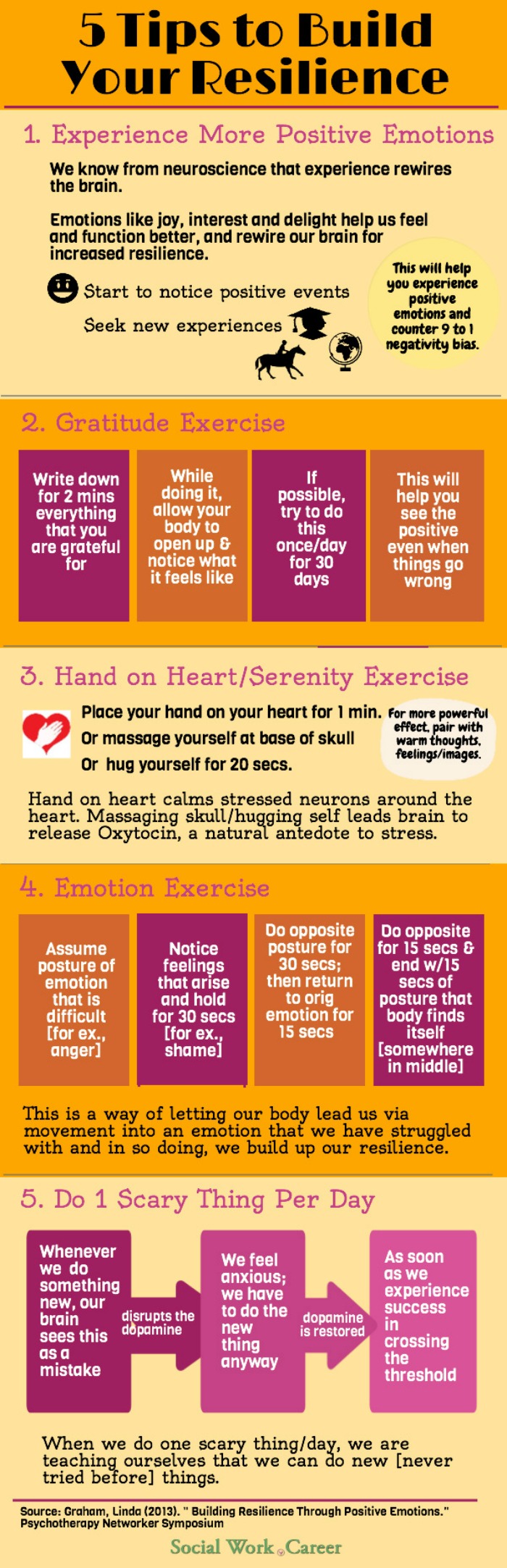
With regards to the last suggestion of doing one scary/new thing a day, it is suggested that we try to find the gift in our mistakes. Linda explains that our brains learn as much from our mistakes as they do from regular learning.
To increase resilience through this practice [and build compassion], she recommends that we share our mistakes with a trusted group of friends and do so in a way that illustrates our growth and learning.
For example: “This is what happened. [xxxx] This is what I did. [xxxx] This is what I’m learning. [xxxx] This is how I will be resilient going forward. [xxxx] And I will continue to share my growing experiences with you, my good friends…”
What are your thoughts about how to increase resilience? Which resilience boosters on the infographic would you consider sharing with your clients and/or incorporating into your routine?
About the author:
Dorlee Michaeli, MBA, LCSW, specializes in EMDR therapy for high-achieving professionals struggling with imposter syndrome. She provides consultation for complex cases involving perfectionism and workplace anxiety. Learn more.
Image: Linda Graham, MFT
References:
Graham, Linda (2013). Bouncing back: Rewiring your brain for maximum resilience and well-being. New World Library. Canada.
Graham, Linda (2013). Building resilience through positive emotions. 2013 Psychotherapy Networker Symposium.
Last updated: December 25, 2025



Hello Dorlee,
Alain de Botton wrote: “A good half of the art of living is resilience.” I’m thinking perhaps even more!
Your post is a good reminder that resilience is skill that we can cultivate and you outline practical exercises that can be put into practice right away. I will definitely be sharing these.
One other exercise to consider is meditation. Bill George from Harvard Business School wrote: “The best way to become more resilient is to develop oneself into a calm, compassionate and adaptable Mindful Leader.”
Thank you for yet another valuable post!
Jackie
Hi Jackie,
Thank you for sharing Alain de Botton’s quote about resilience. It is most wise…
For some strange reason, when we are in the midst of some storm, we often forget that we are not alone in our experiencing troubles and that “normal” life consists of dealing with disappointments, troubles, illnesses. losses etc
Re meditation, yes – that is an excellent way of increasing one’s ability to deal with stress.
Last but not least, you illustrate some additional ways of dealing with stressful situations in your post How To Get Over Overwhelm http://jackieyun.com/2012/12/21/how-to-get-over-overwhelm/. These may also be helpful in boosting one’s resilience!
Warmly,
Dorlee