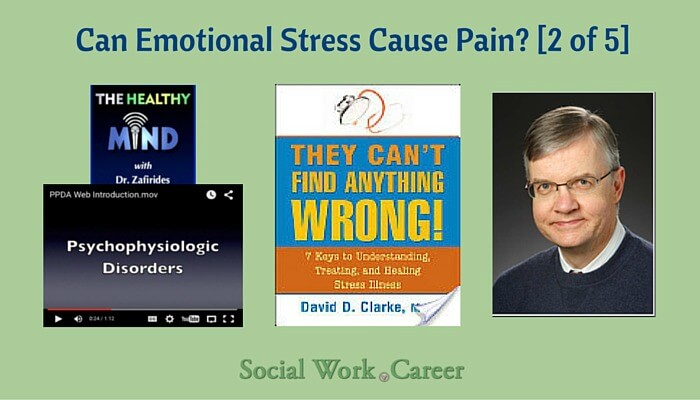
Would you like to find out how to help your clients who are suffering from pain and other medically unexplained symptoms that are the result of hidden stresses?
In this second post of the series on mindbody syndrome based upon the conference: When Stress Causes Pain: Innovative Treatments for Psychophysiologic Disorders, you will have the opportunity to hear Dr. David Clarke’s views and prescriptions for relief from unresolved pain, as well as the perspective of a recovering PPD patient, Forest, S.
Below is a 2 minute video clip in which Dr. Clarke describes psycho-physiologic disorders (PPD).
- Based upon his work as a gastroenterologist with 7000 patients [often sent to him as a last resort], diagnostic tests are unable to find the cause of symptoms in at least half of all medical patients, most of whom are ill because of hidden stresses.
- Labeling the cause of illness caused by past or present psycho-social stress as psycho-psychologic disorders (PPD) is an unhelpful strategy for patients.
- The recommended approach for a stress diagnosis is to conduct a stress check-up consisting of a review of the following for each patient:
- Illness chronology – i.e., looking at when and where did the symptoms start? When and where had they had stress in their lives? Sometimes you can get enough information through this investigation alone.
- Current stress – (ex: Insufficient personal time – Do you take care of everyone else but have little time for yourself?) Often, many patients have limited self-care skills due to having little time to play as they were growing up.
- Childhood stress – Did they experience any physical/sexual abuse, domestic violence in the home as well as more subtle types of stress such as favoritism, excessive criticism etc.
[Adults may have difficulty in recognizing their own emotions about the abuse; i.e., not be consciously aware and then these feelings get expressed somatically as they get older. This is because as children they learned to hold in their emotions in order to cope with the stresses they had to face. Typically, as self-esteem improves, adults become more aware of their anger, anxiety or resentment of their mistreatment as children. Hence, the appearance of symptoms after things are going well or a person has had a series of accomplishments.]
4. Depression – Patients may deny being depressed but display depressive symptoms such as early morning awakenings, insomnia etc.
5. Post traumatic stress – there is almost always a triggering event for such symptoms.
6. Anxiety disorders – general/social/panic anxiety disorder.
- In 15% of his cases, simply bringing hidden stresses to the awareness of his patients was enough to resolve their symptoms.
- For treatment of current stress – the Rx is usually self-care time; they often need to learn self-care skills; 4-5 hrs/per week doing something for no purpose other than its own joy.
- For treatment of childhood stress –
Dr. Clarke recommends to his patients to write a letter to the person who abused them (not to mail it) as a good start for relief of the symptoms. Some may need to work subsequently with a mental health professional; others may obtain sufficient relief and release of emotions via the act of writing alone.
He also stresses the importance of acknowledging the heroism of these patients for having survived the adverse situations they were thrown into as children.
For those of you who are wondering whether you may be suffering from a hidden stress, there is a brief questionnaire Hidden Stress Screening Test on Dr. Clarke’s website that you can take to uncover clues for some of your hidden stresses.
In the below podcast interview conducted by Dr. Zafirides, you may hear listen to Dr. Clarke being interviewed on this very topic “How Stress Causes Pain.”
Interview with Dr. David Clarke on Sept 13, 2012
Moving onto Forest S., MA, MS, he had a very unique perspective to share in the conference; that of a recovering patient, as well as that of someone who has created the largest source of information for the public about PPD at www.tmswiki.org. He is also the Vice-President of the Psychophysiologic Disorders Association (U.S.).
Forest shared his very touching and painful story of how he started suffering from various symptoms in his teens such as repetitive stress syndrome in his hands – symptoms which basically spread and made him increasingly debilitated as time went on.
This went on for about seventeen years until he happened to read an online success story about someone who had identical symptoms to him but who had recovered after following Dr. Sarno’s recommendations.
He then went ahead and started reading Dr. Sarno’s Healing Back Pain: The Mind-Body Connection [affiliate link] as well as following other suggestions discussed during this conference which ultimately led to him to slowly recover over the course of three years.
Since then, he has become an advocate for others who suffer from PPD and has started a successful peer support group at www.tmswiki.org.
Forest’s key messages for those suffering from PPD:
- See a doctor to rule out any serious medical conditions
- Learn the basics of PPD; knowledge is the penicillin of PPD [one helpful resource that also provides legitimacy is www.ppdassociation.org]
- Accept the PPD diagnosis
- Read success stories of other people who became pain free (they help normalize the condition; they help you accept your diagnosis and can also share tips with you throughout your treatment)
- Connect with other PPD peers at www.tmswiki.org/forum
- Be patient (some people heal within days, others within a couple of years)
This is the second post on the topic of stress and pain. In my next post on this series, I will share additional key learnings presented at this conference.
What are your thoughts/comments about mind-body syndrome?
References:
“When Stress Causes Pain: Innovative Treatments for Psychophysiologic Disorders.” NYU Postdoctoral Program and Psychophysiologic Disorders Association, New York, NY, October 6, 2012.


