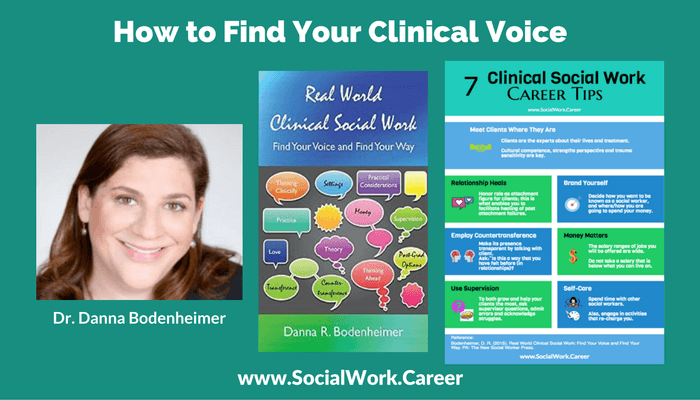
Essential clinical social work career tips from Dr. Danna Bodenheimer’s book “Real World Clinical Social Work: Find Your Voice and Find Your Way.” Dr. Bodenheimer, educator, psychotherapist, and head of Walnut Psychotherapy Center (trauma-informed outpatient setting specializing in LGBTQ treatment), wrote this book specifically to help new social workers feel more prepared as they leave graduate school and take on their first post-graduate position. The book’s five sections cover thinking clinically, getting your theoretical groove on, practical considerations, practice matters, and thinking ahead—nearly every clinical social work topic of concern before taking your first position including salary, setting choice, supervision use, key theories, case conceptualization, social work lens, and post-graduate options. Seven key takeaways include: (1) Meet clients where they are—they’re experts about their lives; cultural competence, strengths perspective, trauma sensitivity are key, (2) Relationship heals—honor your role as attachment figure, (3) Employ countertransference—make its presence known transparently for emotionally corrective experiences, (4) Use supervision—ask questions, admit mistakes, acknowledge struggles to grow, (5) Brand yourself—decide how you want to be known and where to spend continuing education money, (6) Money matters—don’t take salary below what you can live on; first job sets bar for subsequent salaries, (7) Self-care—spend time with other social workers, do low-cost recharging activities. Includes author interview discussing abundance/scarcity themes, financial freedom realities, geographic variations in career advancement, and agency culture challenges.
10 Essential Social Work Skills Every Practitioner Must Have
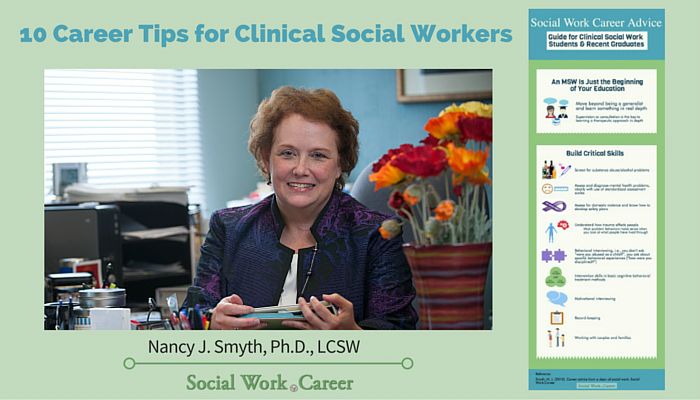
10 essential clinical social work skills infographic from Dean Nancy Smyth: substance abuse screening, mental health assessment, domestic violence safety planning, trauma understanding, dissociation assessment, behavioral interviewing, CBT interventions, motivational interviewing, record-keeping, and couples/family skills. The MSW is just the beginning; develop these competencies through specialized training.
Can Personal Narratives Help You Be a Better Social Worker?

Narrating Social Work Through Autoethnography – Book Review Have you been looking for a good book to help you gain a deeper understanding of some topics particularly relevant to social work such as cultural competency, end of life, transformative change, and more? If yes, you are likely to appreciate Narrating Social Work Through Autoethnography, edited […]
Got Triggered by Client in Therapy? Use Coping Tools!
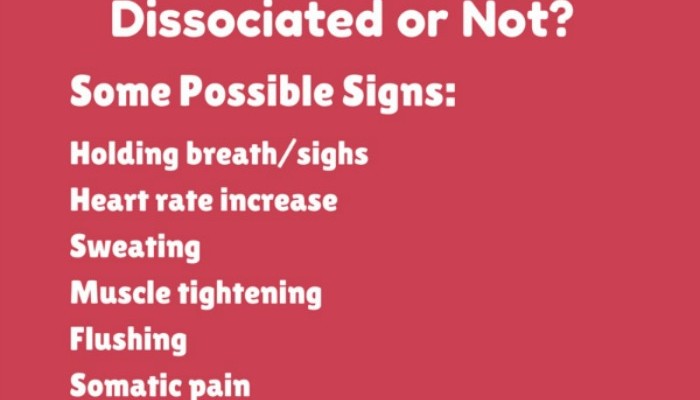
Triggered in Therapy? 4 Resources To Cope & Be Effective Are you a social worker or other mental health professional who occasionally experiences some reactions or countertransference when working with a particular client? Would you like to have some tools to help you avoid getting triggered while in session? Lisa Schwarz, M.Ed. and Ron Schwenkler […]
The Neurobiology of Trauma: Core Principles of Trauma-Informed Care [3 of 3]

How does trauma impact the brain and body, and what can you do to counteract its effects? Understanding the neurobiology of trauma is essential for effective treatment. Trauma can change your brain structure and alter your cells—when your body cannot process trauma, it gets expressed physically. This post explores the neurobiology of trauma, covering the four brain areas affected (brain stem, hippocampus, amygdala, frontal cortex), two stress response systems (hyperarousal and dissociation), and emotional dysregulation. Discover the neurobiology of trauma behind “neurons that fire together, wire together” and learn practical techniques to help clients repair their brains: strengthening family connections, building emotional regulation through breathwork and mindfulness, and understanding how naming emotions disrupts emotional responses in the brain. Part 3 of trauma-informed care series. See Part 1 for core principles and Part 2 for effective trauma treatments.
