What clinical social work skills do you need to develop for effective clinical practice? Whether you’re still in your MSW program, recently graduated, or transitioning into clinical work, this guidance from a leading social work educator will help you build a strong clinical foundation.
Dean Nancy Smyth, Ph.D., LCSW of the University at Buffalo’s School of Social Work shares the essential clinical social work skills that every clinical practitioner should master—from assessment and screening abilities to intervention skills and professional documentation.
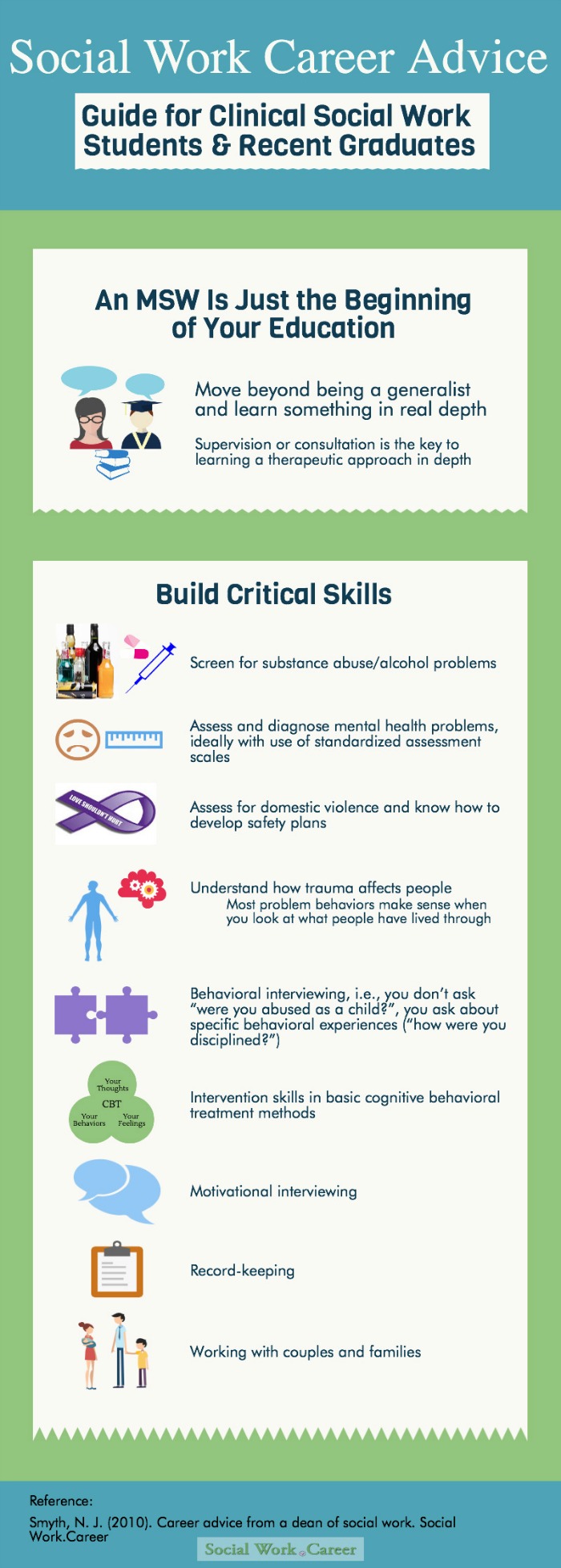
Below is an infographic summarizing ten of the most important clinical social work skills Dean Smyth recommends developing throughout your career.
For comprehensive career guidance and deeper context on each of these skills, check out the full interview with Nancy where she discusses clinical competencies, career development, women in academia, and innovative applications of virtual reality in therapy.
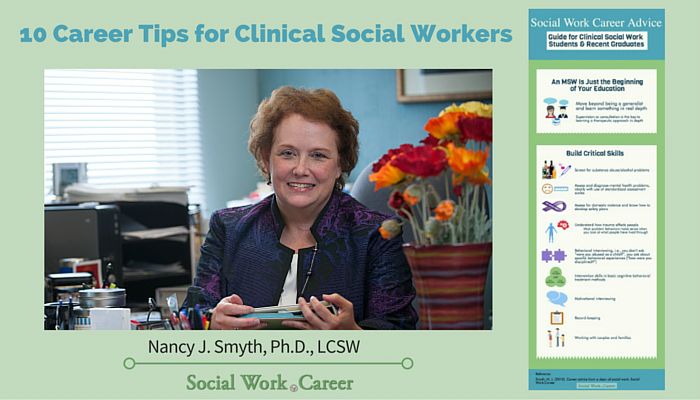
Top Clinical Social Work Skills Every MSW Graduate Needs
Dean Smyth shares the essential competencies that every practitioner should develop for effective clinical practice and private practice success.
These skills are foundational for building clinical competence and include assessment, screening, intervention, and documentation abilities that will serve you throughout your career.
Understanding These Essential Skills
The clinical social work skills outlined in this infographic represent core competencies that Nancy emphasizes are critical for new practitioners. Let’s break down why each matters:
Assessment Skills – The ability to screen for substance abuse and identify mental health problems are fundamental skills because these issues are often missed without systematic assessment.
Safety Planning – Skills in assessing for domestic violence are essential given that 1 in 3 women experience domestic violence.
Trauma-Informed Practice – Understanding how trauma affects behavior is among the most important skills for working with diverse client populations.
Specialized Assessment – Knowing how to assess for dissociation represents advanced competency that prevents treatment failures.
Interviewing Techniques – Behavioral interviewing is a core skill that improves the accuracy of your assessments.
Evidence-Based Interventions – Strong skills in cognitive behavioral treatment methods are essential even if you don’t identify as a CBT therapist.
Motivational Approaches – Skills in motivational interviewing are critical for working with ambivalent clients.
Professional Documentation – Record-keeping is a fundamental skill that protects both you and your clients.
Systems Perspective – Generalist skills in couples and family work round out essential competencies for holistic practice.
Why These Skills Matter
Dean Smyth emphasizes that the MSW is just the beginning of your education. Developing deep competence in these social work skills requires ongoing investment through:
- Specialized supervision or consultation – Essential for truly mastering clinical skills in depth
- Reading extensively – Stay current on best practices
- Attending workshops – Continue developing your expertise throughout your career
- Specialized training – Seek certifications to strengthen specific competencies
How to Develop These Competencies
From the Full Interview with Dean Nancy Smyth:
“I can’t emphasize supervision or consultation enough—there have been many times I thought I understood a therapeutic approach really well from reading and attending workshops, only to discover when applying it with clients there was much more to it. Supervision or consultation is the key to really learning clinical skills in depth.“
The competencies Nancy outlines aren’t just theoretical—they’re the practical skills that will make the difference between treatment success and failure with your clients.
Clinical Skills for Private Practice
If you’re planning to enter private practice, these competencies become even more critical. Nancy specifically recommends that social workers looking to go into private practice with adults need to develop this range of core skills:
Why focus on these specific competencies?
- Substance abuse screening helps you identify problems that are frequently missed
- Mental health assessment with standardized scales improves diagnostic accuracy
- Domestic violence assessment is essential given high prevalence rates
- Trauma understanding helps you see problem behaviors in context
- Dissociation assessment prevents common treatment failures
- Behavioral interviewing gets more accurate client information
- CBT methods are increasingly used in integrative therapies
- Motivational interviewing works with clients not ready for change
- Record-keeping – failure here is the #1 area for licensing board sanctions
- Couples/family basics allow flexible, comprehensive treatment
Moving Beyond Graduate School
Nancy emphasizes that students should “move beyond being a generalist (knowing a little about everything) and decide to learn something in real depth.” This means selecting which clinical social work skills you want to develop deeply through:
✅ Reading extensively about specific approaches
✅ Going to workshops on specialized techniques
✅ Getting specialized supervision/consultation in targeted areas
The social work skills you invest in now will define the kind of practitioner, and the kind of career, you build over time.
Ready to Dive Deeper?
This infographic summarizes key points from the comprehensive interview with Nancy J. Smyth, PhD, LCSW, one of the most thoughtful voices in social work education on the social work skills every new practitioner needs.
In the full interview, Nancy shares:
- Her journey from community residence worker to Dean
- Why she chose social work over clinical psychology
- Advice for MSW students considering doctoral programs
- Challenges and rewards of academic administration
- Her groundbreaking work with virtual reality and Second Life in therapy
- Detailed competencies for private practice
- Insights on women in social work academia
Read the Complete Interview with Dean Nancy Smyth
Related Resources:
- Career Advice from a Dean of Social Work – Full interview with detailed discussion of clinical competencies and much more
- Solution Focused Therapy: Key Principles and Case Example – Develop skills in this evidence-based approach
- Complete Guide to Motivational Interviewing – Master essential MI skills
- Real World Clinical Social Work: 7 Career Tips – Book review covering essential skills for new practitioners
Like this content? Please share it !
What are your thoughts? Does this make sense in light of your experience in the field? Do you have any learnings you’d like to share about developing clinical competencies?
About the interviewer:
Dorlee Michaeli, MBA, LCSW, specializes in EMDR therapy for high-achieving professionals struggling with imposter syndrome. She provides consultation for complex cases involving perfectionism and workplace anxiety. Learn more.
Last updated: April 25, 2026



This is so helpful! It is so easy to become discouraged after grad school! So to read that the MSW is truly only the beginning is like a little kick start, motivating factor to get back on track.
very bright idea i like it and i a sure you that evary social worker helping individual need the skills for social and economic well-being of our communities.
Thanks, Abotto!
Wonderful advice. And I love the graphic as well. I will definitely share this with my colleagues. Thanks!
Hi Sharon,
Thanks so much for your kind feedback and for planning to share this post with your colleagues!
Best,
Dorlee
Nancy,
I’m so glad you enjoyed my revival of your past interview. Initially, I started out with the idea of just adding the infographic to your interview but then once I had completed the infographic, I changed my mind and decided to have it stand on its own and provide people with a link to the full interview.
Everything you advised when I had interviewed you holds true today but now there is much more of a reliance on visual cues and this infographic relays in a quick snapshot some of your wonderful gems.
Re your qualification, I will change the title to accommodate this. You’re right, this guidance is primarily geared towards clinical practice. May I have the honor of following up with you regarding a part two interview in which I ask you some questions regarding macro social work?
Dorlee, what a creative way to summarize an interview! I truly laughed out loud, after I saw what you did. At first, I was confused, until I clicked through and read your whole post, becauseI had no memory of listing key skills in any place recently.
The only qualification I would add to this is that my focus was clinical social work, not macro social work. Some of the skills would still apply, but not all, to Macro practice.
Thanks so much for such a creative post, and also for the kind shout out about my blog.