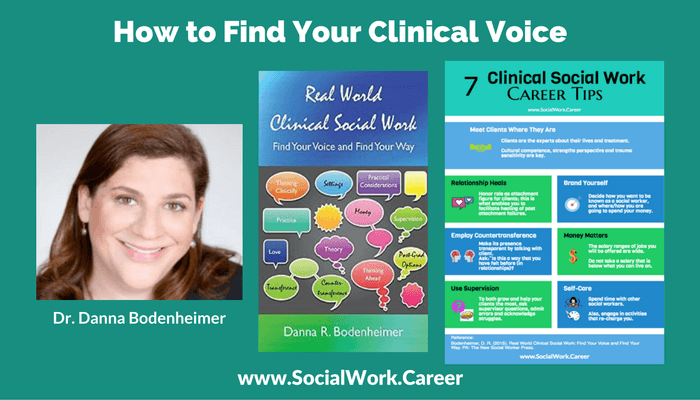
 Real World Clinical Social Work: Book Review and Author Interview
Are you looking for clinical social work career guidance as you transition from graduate school to your first professional position? Wondering how to navigate salary negotiation, supervision, countertransference, and building your clinical social work career?
If yes, you are likely to find Dr. Danna Bodenheimer’s book “Real World Clinical Social Work: Find Your Voice and Find Your Way,” [affiliate link] very helpful.
Dr. Bodenheimer is an educator, psychotherapist, and writer is the head of the Walnut Psychotherapy Center, a trauma informed outpatient setting that specializes in the treatment of LGBTQ patients eaches clinical practice and classes on gender and sexuality. Danna is now the head of the Walnut Psychotherapy Center, a trauma-informed outpatient setting that she founded, specializing in the treatment of the LGBTQ population.
Dr. Bodenheimer specifically wrote this book to help new social workers feel more prepared as they leave the secure environment of graduate school and take on their first post graduate position. With the book’s five sections: thinking clinically, getting your theoretical groove on, practical considerations, practice matters and thinking ahead, it covers nearly every clinical social work topic that you could be concerned about prior to taking your first position.
This includes issues such as salary, what type of setting, how to best make use of supervision, a wonderful recap of the key theories that will inform your work, case conceptualization, the social work lens, as well as post-graduate options for consideration. It provides practical advice with detailed examples to illustrate valuable take-aways in an easy-to-understand, accessible manner.
I highly recommend this book for all new social work clinicians. In fact, I found it so enjoyable, enlightening and relevant that I expect to be referring to it in the future, particularly, in light of the work/training that I have begun as a Fellow at a psychoanalytic institute this summer.
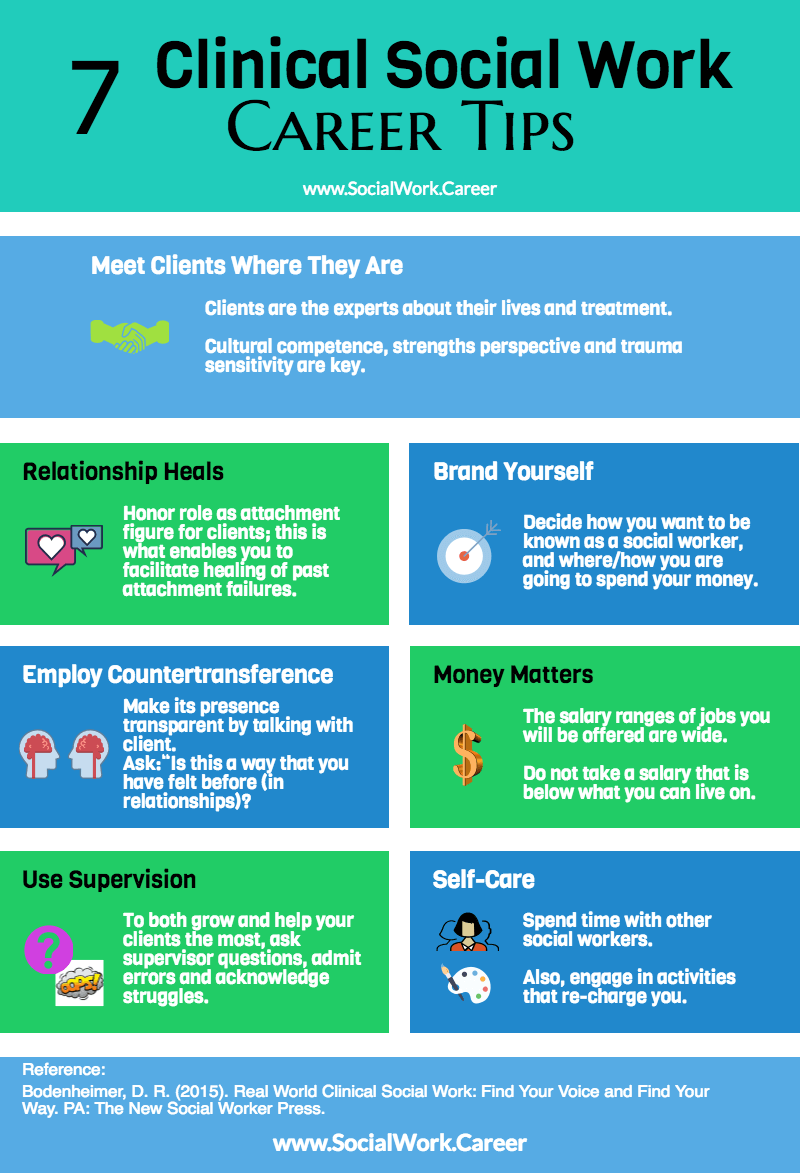
Below are seven main learnings provided by the author. Lastly, remember to check out the author interview at the end of this post!
Essential Clinical Social Work Career Guidance for New Graduates
Dr. Bodenheimer’s book provides comprehensive clinical social work career advice covering nearly every topic new practitioners need to know. Below are seven main learnings that will help you navigate your early clinical social work career successfully.
7 Key Take-Aways:
Meet Clients Where They Are
Your clients are the experts about their lives and their treatment. Cultural competence, strengths perspective and trauma sensitivity are key.
- It is by listening and engaging with your clients from a respectful, empathic, not-knowing stance that you are able to see them and their experiences as they are. This is where and how change takes place.
- Racism and oppression are part of the macro environment that plays a significant role in how your clients feel and the symptoms they are suffering from. According to the NASW Code of Ethics (2008), social workers must practice without discrimination and with respect for others, as well as take action as social change agents.
Relationship Heals
Honor role as attachment figure for your clients; this is what enables you to facilitate the healing of clients’ past misattunements and attachment failures.
- Acknowledging the impact and depth of the attachments that you form with your clients will increase the effectiveness of your work.
Employ Countertransference
Make the presence of countertransference known by asking your client “I wonder if something familiar is coming up for you right now, or Is this a way that you have felt in relationships before?”
- Transference refers to material (such as feelings and templates of behavior) that clients bring from earlier relationships and transpose onto current interactions with the therapist and other individuals.
- Countertransference, on the other hand, is everything you feel when you are with the client. This includes your current feelings and reactions to content shared, as well as any past feelings/thoughts evoked.
- The denial of transference and countertransference hinders the progress of client treatment. Conversely, being transparent with your clients about their presence enables your clients to have emotionally corrective experiences.
Use Supervision
To grow and help your clients benefit the most, ask questions, admit mistakes and acknowledge your struggles.
- Supervision is how the social work field passes on its wisdom between generations. It serves different needs at various career stages. At the beginning, it is more problem-focused and helpful in establishing your therapeutic voice.
- Mid-career, you learn to master your blind spots. Later, supervision is more process-focused and helps build your own supervisory skills, as well as broaden your style and technique.
- Supervision is critical because it helps you look at yourself and examine your own countertransference reactions, thereby enabling you to grow and you to help your clients heal.
Brand Yourself
Decide how you want to be known as a social worker, and how/where you are going to spend your continuing education money.
- By choosing an area of specialization soon after you graduate, you are ensuring that the financial investment you are making with your money in terms of the journals, conferences, continuing education courses you are taking are all in alignment with a goal of your choosing vs. that of the agency that you are working.
- In this way, you are solidifying and building up your own identity as a social worker who may do additional interesting things in her career such as writing and consulting.
Money Matters
The salary ranges of jobs you will be offered are wide. Do not take a salary that is below what you can live on.
- Social workers are hard-working professionals. You are entitled to a salary that enables you to cover your expenses, school loans and family obligations.
- When you first graduate, it may be tempting to accept the first job you offered. If that job is offering to pay you less than what you can live on, do not take it. That first job/salary also sets the bar for subsequent salaries and/or pay increases.
Self-Care
Spend time with other social workers (inexpensively). Do low-cost activities that help you feel re-charged.
- Spending time with a community of peers with whom you can talk openly and honestly about the work is one way to engage in self-care. Journaling, making art or exercising are other examples of self-activities that may help you re-charge.
- An important caveat to note is that sometimes it is hard for us to engage in self-care. If you find this to be true, please be compassionate with yourself. It takes time to develop a self-care practice that works.
Building Your Clinical Social Work Career: Author Insights
Author Interview
SWC: In your book, you state that there are “themes of abundance and scarcity [material possessions, availability of love and affection vs neglect or compromised access to caregivers, amount of dialogue around difficult subjects] that make themselves known throughout our lives. There is something about our early relationships with these amounts that sets the stage for our understanding of what is available to us in the present.”
The way in which we may interpret the impacts of abundance and scarcity on an individual’s life sound very potent. Could you give an example of how this may play out?
Danna: An example of this is growing up as the grandchild of a Holocaust survivor. I grew up with enough material resources, but my parents (specifically my father) never had the psychological or literal experience of feeling like there was enough.
As a result, despite literally having enough, he imparted to me the belief that there was scarcity every where and that somehow our security was always at stake. Now, even in my own life, when I have enough material resources I make poor decisions with them. On an intergenerational and ancestral level, it is hard to shake the imprint of deep psychological wounds of emptiness and scarcity.
SWC: You mention that “Finding financial freedom as a social worker is the very painful reality of having to invest in one’s career beyond the cost of tuition.”
Based upon your research, do you have any specific recommendations (in terms of investment/paths to follow) to maximize the chances of a secure financial future?
Danna: This is a difficult question to answer because the answer really varies geographically. In New York City, for example, receiving analytic training can truly advance someone’s financial future. In other parts of the country, this doesn’t hold the same value. In California there is certainly a focus on post graduate training institutes, but becoming an analyst does not hold the same level of import. In Philadelphia, it is almost impossible to teach without your doctorate, in other parts of the country this is not true. This is a question that must be studied and assessed by speaking to other local social workers.
SWC: You note that “It is very hard to find an agency culture that mirrors our internal values.”
Why is this? Is this due to the inevitable constraints that agencies have vis a vis budgets? What types of questions do you recommend that social workers ask during their interviews to figure out the agency’s real vs. stated values?
Danna: This is largely because social workers do not typically run the agencies that they are working for. Locally, for me, several of the most powerful agencies are run by psychologists. This means that the focus on diagnosis is asymmetrical with social work’s thinking on holistic conceptualization. Other agencies are forced to run in ways that defend against litigiousness, again creating barriers to how social workers believe in working spontaneously and closely with their clients.
Thanks so much, Danna!
Your Clinical Social Work Career Success
Implementing these seven strategies will help you build a strong foundation for your clinical social work career. Remember: you’re entitled to fair compensation, quality supervision, and work that aligns with your values.
For more of Dr. Bodenheimer’s pearls of wisdom, please check out her book “Real World Clinical Social Work.” You may also listen to the wonderful interview that Jonathan Singer conducted with her titled Becoming a Clinical Social Worker.
Like this post? Please share it!
More Clinical Social Work Career Resources
Continue building your career foundation:
For New Practitioners
Online Toolkit for New Social Workers
Curated collection of 10 essential posts covering interview preparation, LMSW exam strategies, clinical skills development, macro practice tips, and building professional online presence.
Career Advice from a Dean of Social Work
Dean Nancy Smyth shares comprehensive career guidance including the 10 essential clinical skills every social worker must develop, from screening for substance abuse to strong record-keeping practices.
Specialized Clinical Skills
Dialectical Behavior Therapy: A Mindfulness-Based Behavioral Therapy
Develop advanced clinical skills with DBT’s four core modules and wise mind concept—particularly effective for clients with BPD and emotion dysregulation.
Play Therapy: Healing Through Play
Learn child-centered therapy techniques including the Inside Out feelings activity and playroom setup guidance from Registered Play Therapist Jennifer Taylor.
If You’re Considering Private Practice
Complete Guide to Starting Your Private Practice
Comprehensive interviews with two successful practitioners covering clinical preparation, getting first clients, marketing strategies, and business fundamentals.
How Every Social Worker Can Succeed in Private Practice
Lynn Grodzki’s strategies for navigating today’s competitive therapy marketplace including marketing essentials and persuasive communication.
Looking for more professional development resources? Browse our complete Professional Development category for career guidance, book reviews, and expert interviews.
Disclosure of Material Connection: I received one copy of the book mentioned above for free in the hope that I would mention it on my blog. In addition, the link to this book is an “affiliate link.” Regardless, I only recommend products or services I use personally and believe will be good for my readers. I am disclosing this in accordance with the Federal Trade Commission’s 16 CFR, Part 255: “Guides Concerning the Use of Endorsements and Testimonials in Advertising.”
Last updated: January 1, 2026



Dorlee! Thank you so much for this book review and interview with Dr Danna!
I appreciate your questions related to the importance of values and “fit” in our work setting as well as the many ways our personal histories can impact our livelihoods and abilities to practice in the field.
Her insights – especially those related to geographic differences as well as “the painful reality of having to invest in one’s career beyond the cost of tuition” – are truths that I find are rarely, if ever, stated in public or privately to those new to the field.
Instead, it’s as if there is a bunch of secret success steps that we stay silent about and then expect others with less experience to quietly figure out on their own!
It’s maddening to see this pattern perpetuated year after year as new graduates are churned out; and, it’s encouraging to know that you and Dr. Danna have enough integrity to let new grads know what they are in for and how to navigate the systems that they are entering in to!
Thank you, Dorlee and Dr. Danna, for having the backs of
Thanks so much for your kind and thoughtful feedback, Tamara!
I’m so glad that you found the review and follow-up questions helpful. It is quite evident that these are indeed critical pieces of career advice in light of all of the questions you have seen come up in your consulting practice and supervision work you do!
Thanks again for taking the time to share your wisdom and reactions from the field!
Best,
Dorlee