Financial self-care leads to greater financial health and overall wellbeing. Would you like to improve your financial self-care? This post will provide you with a brief introduction to Financial Social Work, and how to begin to engage in better financial self-care.
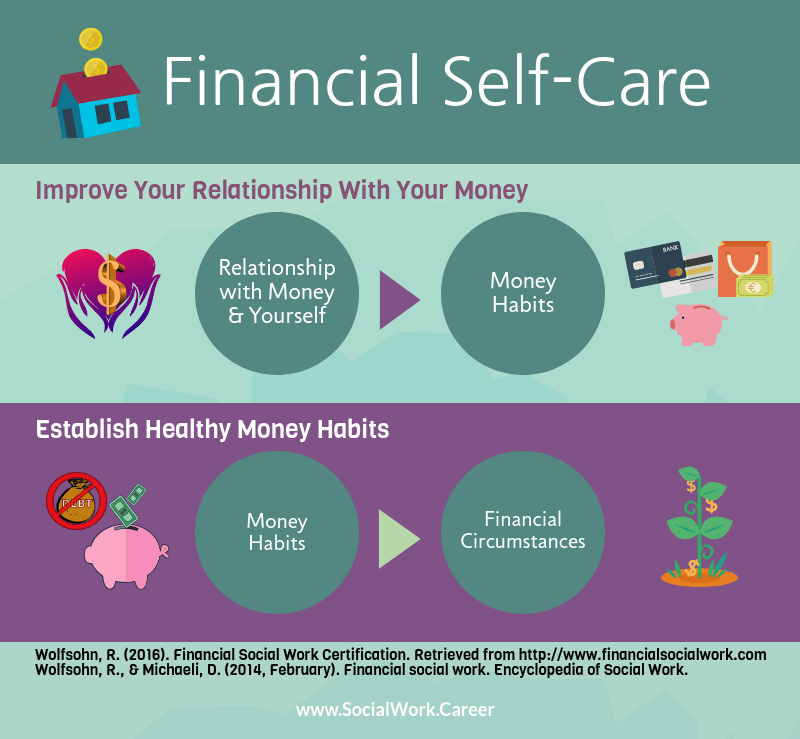
Financial Social Work is an interactive and introspective psychosocial behavioral model developed by Reeta Wolfsohn, CMSW, that helps individuals explore and address their unconscious feelings, thoughts and attitudes about money. This process, in turn, helps people improve their relationship with their money and thus establish healthier money habits that lead to improved financial circumstances.
Unfortunately, due to increasing costs of healthcare, housing, education, food and other costs of living, many of us are financially and emotionally stressed. Furthermore, the wide variety of digital and automatic forms of payment make it easy for us to spend money in ways that make knowing how much money we actually have more challenging.
People tend to spend more when they use credit cards and other electronic means of payment because of the greater ease in payment, not fully knowing how much money they have at any one time, and the greater distance that they experience between the purchase of an object and the pain of actually paying for it.
As per the Financial Social Work approach, each one of us has a particular relationship with our money that impacts our money habits. It is our money habits, or how we choose to spend, earn, save, share or borrow that determines our financial circumstances.
Achieving greater financial health requires identifying and improving your relationship with your money. Some of us have a stable and/or hopeful relationship. Others have a pessimistic and/or hopeless relationship. Individuals with a poor relationship with their money are less likely to engage in healthy money habits. Your relationship with your money is largely influenced by the money lessons you learned from your primary caregivers and mentors, as you were growing up.
Wondering How to Use Your Money Story to Improve Your Overall Well-Being ? Click on the link that will take you to a pdf of my post that had been published on PsychCentral.com (and was subsequently removed when they were bought) . It will walk you through some questions to help you and your clients discover your money stories and establish healthier money habits for greater financial self-care.
Like this post? Please share it!
References:
Gallup. (n.d.). Americans’ financial well-being is lowest, social highest.
Main, E. (2010, March 2). Why financial stress is the costliest for your health. Rodale News.
Prelec, D. & Loewenstein, G. (1998). The red and the black: Mental accounting of savings and debt. Marketing Science, 17(1), 4-28.
Soman, D. (2003). The effect of payment transparency on consumption: Quasi experiments from the field. Marketing Letters, 14, 173–183.
Wolfsohn, R. (2016). Financial social work certification.
Wolfsohn, R., & Michaeli, D. (2014, February). Financial social work. Encyclopedia of Social Work.
You may also enjoy:
Financial Stress Social Workers Face: Why Low Pay Isn’t the Whole Story
What Every Social Worker Needs to Know About Financial Self-Care



NOTE: If you’re curious, you can find Dorlee Michaeli’s article here, and more about her and her social work blog here.
Thanks so much, Ronnie, for referring to my PsychCentral post in your post about learning how to make friends with your money! Nice elaboration on the topic 🙂
Best, Dorlee