TL;DR
- Forensic social work is where clinical practice meets the legal system – courtrooms, corrections, child welfare, and reentry
- The forensic role is fundamentally different from the therapeutic one: the court is your primary client, not the individual
- Objectivity and compassion are not opposites; the best forensic practitioners bring both
- Trauma-informed practice matters even more in settings that can retraumatize
- A forensic social work career path requires deliberate preparation: field placements, assessment tools, documentation skills, and strong supervision
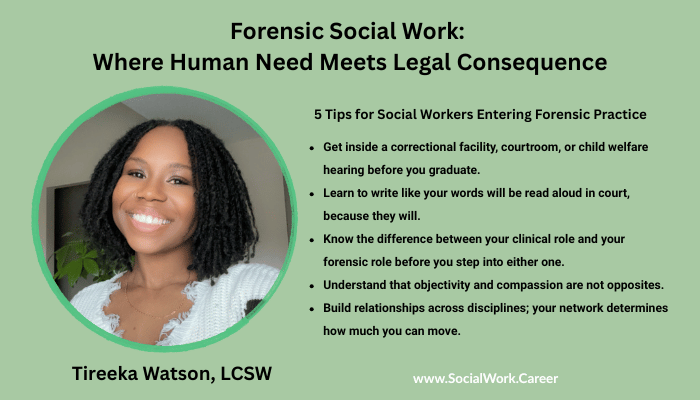
A forensic social work career sits at one of the most demanding intersections in the profession, where clinical skill meets courtroom, where compassion must coexist with rigorous objectivity, and where the stakes for clients are rarely higher. To help social workers better understand this field, and whether it might be right for them, I spoke with Tireeka Watson, LCSW, a forensic social worker, reentry consultant, and owner of a forensic private practice in Oregon. Tireeka also provides training and consultation for clinicians looking to pivot into forensic practice. What follows is a conversation about the work itself, the misconceptions that surround it, and what it truly takes to show up effectively in these rooms.
Entering the Field of Forensic Social Work
How did you personally enter forensic social work, and how would you describe the field to someone encountering it for the first time?
I entered by chance, through my aunt’s residential facility. At the time I was a manager there with a BA in sociology, and I had the opportunity to witness what it looked like when a client was connected to various legal entities and attending court. I knew then that I wanted to understand more about social work and how it intersected with court systems. I did not actually realize I was adjacent to forensics until I started working in a correctional facility.
I would describe forensic social work as the space where people and the law meet, and where human need runs headfirst into legal consequence. It is not glamorous the way television makes it look. It is sitting across from someone who is scared, or angry, or completely shut down, and understanding that your job is to see the whole person when the system is only looking at the charge. Forensic social workers show up in courtrooms, jails, prisons, psychiatric hospitals, child welfare hearings, and reentry programs. If you want to do social work in the places where the margin for error is smallest and the stakes are highest, this is where that work lives.
For a deeper look at social work inside correctional settings, see an earlier interview on prison social work and sex offender treatment.
The Work Itself
What does a typical day look like, and what do you find most meaningful, and most challenging, about this work?
There is no typical day, and honestly that is part of what keeps me in it. Some mornings I am deep in a case file before I have finished my tea, reviewing criminal history, prior evaluations, and medical records, trying to understand who this person was before the moment that brought them into the system. Some afternoons I am inside a correctional facility meeting with a client face to face. Between those things I am coordinating with attorneys, writing assessments, returning calls from probation officers, or calling a client to make sure he makes it to the detox appointment I scheduled.
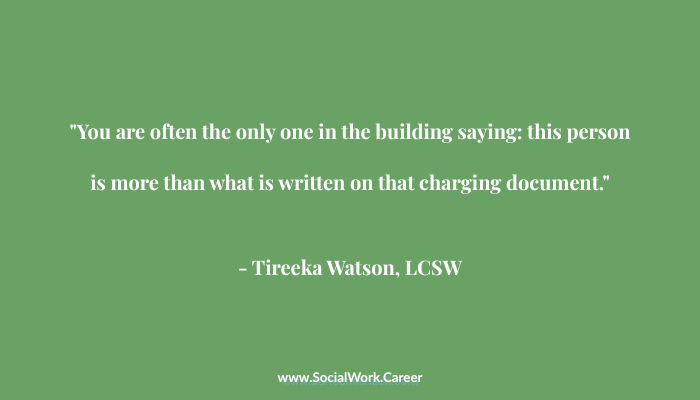
What I find most meaningful is being the person who brings context into a room that often has none. When I can show a judge or a court that someone’s behavior did not happen in a vacuum, that there is a history of trauma, untreated mental illness, or housing instability underneath what they are seeing, and that context actually shifts how that person is treated, that is when this work feels like it matters most. You are often the only one in the building saying: this person is more than what is written on that charging document.
The most challenging part is the cumulative weight. You make sound decisions, you write careful assessments, you advocate with everything you have, and sometimes someone still goes back to prison or loses their children or ends up back on the street. Learning to hold that without becoming numb or becoming consumed is ongoing. I do not think it ever gets easy. You just get better at carrying it without letting it break you.
Walk me through how you conduct a forensic assessment. What frameworks or tools guide your process, and how do you ensure objectivity when the legal stakes are high?
The first thing I do before I ever sit down with someone is get clear on why I am there and who I am actually serving. That sounds simple but it is the foundation of everything. A forensic assessment is not the same as a clinical one. The court or the legal entity is the primary client, not the person sitting across from me, and being honest about that from the start shapes how I approach every piece of the work.
I start with a thorough review of everything that exists before the interview happens: prior evaluations, medical and psychiatric records, criminal history, school records, family history if it is available. I want to understand who I am meeting before I walk in the room. Then I conduct structured interviews and use validated tools that fit the referral question, which might include trauma screening instruments or other measures depending on what the court actually needs to know.
Objectivity comes from discipline and honesty, not from pretending you are a machine. I ask myself throughout the process whether my conclusions follow from what the evidence actually shows, or from what I expected to find. I document the basis for every conclusion I reach. I include the limitations of my findings in my report, because a forensic evaluator who overstates certainty does real damage. And I use peer consultation on anything complex, because you cannot always see your own blind spots.
How do you navigate the tension between your therapeutic instincts and your forensic role, particularly when a client’s wellbeing and the legal outcome may be in conflict?
This tension lives in the work and I do not think it ever fully resolves. My training is built around relationship, around meeting people where they are and supporting healing. But in a forensic context I am not the client’s therapist, and if I start acting like I am, I create problems that can genuinely harm the person I want to help.
The way I hold that is through radical transparency at the beginning of every engagement. I tell people clearly and directly before we start: I am not here as your counselor. What you share with me may appear in my report. My job is to be accurate, not to produce a particular outcome for you or against you. Once that is named out loud, I can still bring genuine care and human decency to the interaction. I just do it within boundaries that protect both of us.
The hardest moments are when I can see clearly what someone needs and the legal process is moving toward something that will make all of it harder to access. In those moments I write down what I see, I make referrals where I appropriately can, and I remind myself that my role is to give the most honest and humane picture I am capable of giving. The court makes the decision. I do not control that. What I control is whether I showed up fully and honestly.
Can you describe a situation where your assessment was challenged in court, and what you learned from it?
Cross-examination in a forensic context is designed to find the places where your work is vulnerable, where you made a judgment call that can be reframed, where a conclusion can be made to look like bias. The most important thing I learned early is that preparation is what keeps you grounded on the stand. You have to know your own report better than anyone else in the room, and you have to be able to explain every conclusion in plain language, without getting defensive or rattled.
What opposing counsel usually goes after is the suggestion that you came in with an outcome already in mind and built the assessment around it. The best answer to that is not a counterargument. It is the documentation. Here is what the record showed. Here is what the person reported to me. Here is the framework I used to weigh those factors. Here is how my conclusion follows from that process. When you have done the work honestly and documented it carefully, that is what you return to every time.
What I took away from being challenged on the stand is that challenge is not the same as being wrong. You are operating inside an adversarial system. Your job is not to come out the winner of an argument. Your job is to be a credible, consistent witness to what you actually found, and to stay in that role no matter what pressure is applied.
Ethics and Professional Identity
How do you maintain your ethical grounding when working within systems, criminal justice, child welfare, family court, that may not always reflect social work’s core values?
The honest answer is that I have to work at it continuously. Staying grounded inside systems that can compromise your values requires more than good intentions. It requires structure. For me that structure is the NASW Code of Ethics, supervision that I take seriously rather than treat as a formality, and peer relationships with people who will tell me when they see something in my work that concerns them. When something sits wrong I name it out loud in supervision rather than reasoning my way around the discomfort. That discomfort usually means something.
I have also learned over time to distinguish between the values of a system and the values of the people operating within it. I have worked alongside corrections officers, attorneys, and judges who hold genuine commitments to justice and human dignity. The system’s failures do not mean everyone inside it has surrendered their ethics. Finding those people and building real working relationships with them is part of how I stay oriented toward the work I actually came to do.
Forensic social workers frequently intersect with domestic violence cases; our guide on helping victims of intimate partner violence offers complementary perspective.
Training the Next Generation for Forensic Social Work
What common misconceptions do trainees bring into forensic work, and how do you address them?
The biggest one is that forensic social work is primarily about the courtroom. People come in expecting drama and cross-examination, and they find that most of the work happens in assessment rooms, correctional facilities, file reviews, and conversations with collateral contacts that nobody in the general public ever sees. The courtroom is the tip of the iceberg.
A related misconception is that objectivity means detachment. I work hard to help trainees understand that those are not the same thing. You can care deeply about the person in front of you and still let the evidence lead. You can be warm and human and also rigorously disciplined about not letting your instincts override what the data shows. In fact, those things have to coexist. If you are detached you miss things. If you are not disciplined you compromise your findings.
I also encounter trainees who believe the forensic assessment itself is an intervention, that they can change someone through the encounter. I redirect that gently, because the impulse comes from a real place of care. But the forensic role is not treatment, and conflating the two ultimately puts both the practitioner and the client in a difficult position.
What has been most effective in your training approach, and how do you help trainees manage the vicarious trauma and moral injury specific to forensic settings?
The most effective thing I have found is putting people into realistic practice situations before they ever face them in real life. Reading about cross-examination in a textbook is nothing like sitting in a simulated one where someone is actively trying to discredit your work. Reading a sample assessment is nothing like writing your own and having it reviewed line by line for every conclusion you drew and every place your language revealed more than you intended. Forensic competency is built through practice that has real complexity and real feedback attached to it.
For vicarious trauma I try to get ahead of it before it lands. I tell trainees directly, early, and more than once: this work is going to get inside you. The question is not whether it will affect you but whether you have something in place to process it when it does. I build reflection into every training, and not just clinical reflection. At the end of a simulation I want to know what the person felt, not just what they assessed. That emotional material is data too, and learning to read it without being flooded by it is a skill that needs to be developed.
Moral injury is harder to address because it builds slowly. It comes from the accumulation of moments where you did your job correctly and the outcome was still unjust. I try to help trainees find the line between their responsibility, which is to do their role with full integrity, and the outcome, which the system controls. That distinction is not a way to avoid accountability. It is how you stay in this work long enough to actually make a difference.
The Future of the Field
Where do you see forensic social work heading in the next 5–10 years?
The field is moving into spaces it has always belonged in but was never fully resourced to occupy. Mental health courts, diversion programs, and co-responder models are creating real demand for forensic social workers in places that previously defaulted entirely to law enforcement or the courts. That is a shift that has been a long time coming, and I think we are only at the beginning of understanding how significant it is.
Restorative justice is also creating new roles for practitioners who can hold the intersection of accountability and healing at the same time. That intersection is where social work has always lived, even if the language has been different. The practitioners who will be positioned to lead in those spaces are the ones building rigorous assessment skills and trauma-informed practice now, before the formal structures that will house that work are fully built.
The challenge is whether training programs and licensing bodies move fast enough to support workers entering these emerging roles. Policy is shifting faster than infrastructure in a lot of jurisdictions. The people who will have the most impact are the ones who are not waiting for the field to catch up before they start developing the skills that will be needed.
Is a Forensic Social Work Career Right for You?
What would you say to a social worker seriously considering forensic practice?
Get honest with yourself about what is drawing you here. If it is the desire to be present in the places where the stakes are highest, where your presence as someone who sees the whole person can genuinely shift what happens to someone, this path will give you that. It is hard, and it is meaningful in a way that is difficult to explain to people who have not been in those rooms.
Practically: go into your MSW with forensic coursework if your program offers it. Fight for field placements in correctional settings, courts, or child welfare. Get comfortable with writing that is detailed, defensible, and ethically grounded, because documentation is the core skill of this field and nobody tells you that early enough. Build a real supervisory relationship with someone who has done this work, not just managed it from the outside, because you will need somewhere to put what you encounter.
On salary: Tireeka noted that published salary statistics for forensic social workers have been a consistent source of frustration, as they rarely reflect the variation across states and settings. For current data, we recommend consulting the BLS Occupational Outlook Handbook or the NASW Workforce Center.
Not sure where to start building your foundation? See our guide to essential social work skills every practitioner needs.
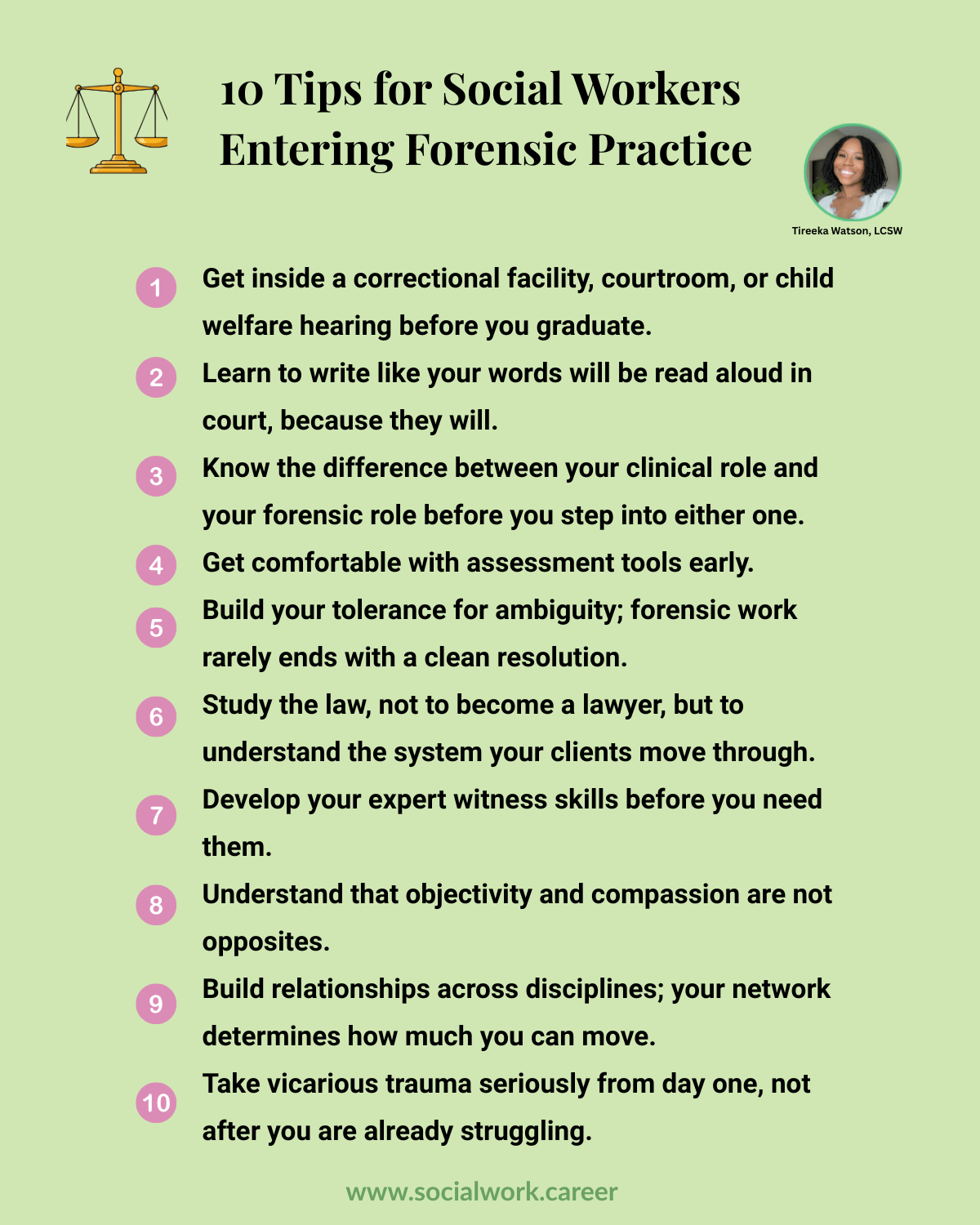
10 Tips for Social Workers Entering Forensic Practice
[INSERT TIPS GRAPHIC HERE] Filename: forensic-social-work-career-tips-tireeka-watson.png Alt text: 10 tips for entering a forensic social work career by Tireeka Watson LCSW
1. Get inside a correctional facility, a courtroom, or a child welfare hearing before you graduate. Observation hours in forensic settings teach you more than any textbook chapter ever will.
2. Learn to write like your words will be read aloud in court — because they will. Every assessment, every note, every recommendation needs to be clear, defensible, and grounded in evidence.
3. Know the difference between your clinical role and your forensic role before you step into either one. Blurring that line does not help your client. It harms them.
4. Get comfortable with assessment tools early. Forensic evaluations are not impressionistic. The court needs to know that your conclusions are grounded in validated instruments, not just clinical intuition. The earlier you familiarize yourself with structured assessment tools — trauma screening measures, risk assessment instruments, and other validated frameworks — the more credible and defensible your work will be. Knowing which tool fits which referral question, and why, is a skill that takes time to develop. Do not wait until you are sitting across from a client in a correctional facility to start building it.
5. Build your tolerance for ambiguity. Forensic work rarely ends with a clean resolution. You will do excellent work and still not know how the story ends.
6. Study the law — not to become a lawyer, but to understand the system your clients are moving through.Knowing how courts work, what rights people hold, and how decisions get made makes you a far more effective advocate. When you understand the difference between a competency evaluation and a risk assessment, or what a judge is actually able to consider at sentencing, you can position your work where it will have the most impact. You do not need a law degree. You need enough fluency to speak the language of the system you are operating inside.
7. Develop your expert witness skills before you need them. The stand is not the place to figure out how to do this for the first time. Practice explaining your clinical reasoning out loud, in plain language, under pressure. Find a supervisor or colleague who will push back on your conclusions the way opposing counsel will. Learn to stay grounded when your methodology is challenged without becoming defensive or losing the thread of what you actually found. Credibility on the stand is built in preparation, not in the moment.
8. Understand that objectivity and compassion are not opposites. The best forensic practitioners bring both. Detachment makes you miss things. Undisciplined empathy compromises your findings.
9. Build relationships across disciplines — with attorneys, prosecutors, corrections officers, judges, and case managers. Forensic social work does not happen in isolation, and your network determines how much you can actually move.
10. Take vicarious trauma seriously from day one — not after you are already struggling. This field will get inside you. The question is not whether it will affect you but whether you have something in place to process it when it does. Build your supervision structure, your peer relationships, and your personal processing habits before the weight accumulates — not after you notice you have stopped feeling things, or started feeling everything at once. The practitioners who stay in this work longest are not the ones who are toughest. They are the ones who took their own wellbeing seriously early enough that it never became a crisis.
Social workers in high-stakes settings also face physical safety considerations; see our resource on workplace violence prevention for social workers.
Frequently Asked Questions About Forensic Social Work
What is forensic social work? Forensic social work is the area of practice where social work and the legal system intersect. It includes work in correctional facilities, courts, psychiatric hospitals, child welfare systems, and reentry programs. Forensic social workers conduct assessments, provide expert testimony, advocate for clients navigating legal processes, and connect people to services at every stage of contact with the justice system.
How do I get into forensic social work? Start by pursuing forensic coursework within your MSW program if it is available. Seek field placements in correctional settings, courts, or child welfare agencies. Build competency in forensic assessment tools and documentation early. Find a supervisor who has direct forensic experience, not just administrative oversight of the work, and consider training programs like those offered by Tireeka Watson at anchoredinessence.com that are specifically designed to help clinicians pivot into forensic practice.
What is the difference between a forensic social worker and a clinical social worker? The primary difference is in who the client is. In clinical social work, the individual receiving services is the client, and the relationship is built around their wellbeing and healing. In forensic social work, the court or legal entity is the primary client. The forensic social worker’s role is to provide accurate, objective information to the legal system, not to advocate for a particular outcome for the individual. Both roles require clinical skill, but they operate within fundamentally different frameworks and ethical obligations.
Do forensic social workers go to court? Yes, though courtroom appearances represent a small fraction of the overall work. Much of forensic social work happens in assessment rooms, correctional facilities, file reviews, and coordination with legal and clinical teams. When forensic social workers do appear in court, it is typically as expert witnesses to present their findings and withstand cross-examination on their methodology and conclusions.
Can a forensic social worker have a private practice? Yes. As Tireeka Watson demonstrates, forensic private practice is a viable and growing career path. Forensic private practitioners typically conduct evaluations on referral from attorneys or courts, provide consultation and training, and may offer expert witness services. Building a forensic private practice requires strong assessment credentials, clear documentation skills, and a robust professional network across legal and clinical disciplines.
What degree do you need to become a forensic social worker? Most forensic social work roles require a Master of Social Work (MSW) degree from a CSWE-accredited program, along with state licensure (typically LCSW or equivalent). Some positions may accept an LMSW with supervision, particularly in entry-level roles within correctional or child welfare settings. Specialized certifications in forensic social work are available through organizations such as the National Organization of Forensic Social Work (NOFSW) and can strengthen your credentials and credibility in the field.
About Tireeka Watson, LCSW
Tireeka Watson is a Licensed Clinical Social Worker, Forensic Social Worker, and Reentry Consultant based in Oregon, where she owns and operates a forensic private practice. She provides consultation and training for clinicians and social workers looking to pivot into forensic social work career, covering areas including forensic evaluations, building a forensic private practice, and the full versatility of sustainable forensic careers.
You can find Tireeka at anchoredinessence.com or follow her on all platforms at @socialworkguru. To inquire about training or consultation, reach out via her website.
Are you working in or considering a move into forensic social work? Share your questions or experiences in the comments below.



How can I get more information on how to apply to be a Forensic Social Worker
Thank you for your question, Sarika!
Tireeka Watson, LCSW, who was interviewed for this post, offers training and consultation specifically designed for social workers looking to pivot into forensic practice. You can reach her at anchoredinessence.com or find her on all platforms at @socialworkguru.
In terms of general steps, the post covers this in some detail, but briefly: pursue forensic coursework within your MSW program if available, seek field placements in correctional settings, courts, or child welfare agencies, and build competency in forensic assessment tools and documentation early. The 10 tips section toward the bottom of the post is a good practical starting point.
Feel free to ask any follow-up questions, Dorlee