 If you’re wondering why social workers are underpaid, really underpaid, not just “the salary isn’t great” underpaid—this post examines the structural forces responsible.
In the first two posts in this series, we looked inward. We explored the financial stress social workers carry, and why it lives in your nervous system, not just your bank account. We examined the money beliefs you developed in childhood and how those scripts shape your financial behavior today.
But there’s a question that deserves its own honest answer: What about the system?
If you’ve been doing the inner work, examining your money story, noticing your patterns, trying to build a healthier relationship with your finances, you may have hit a wall. Not a psychological wall, but a concrete one. The kind built by policy decisions, funding structures, and cultural assumptions that have been in place for decades.
The social worker pay gap is real. It is structural. And it is not your fault.
This post is about that wall. Not to leave you feeling hopeless in front of it, but because you cannot advocate for what you don’t fully understand. Knowing why social workers are systematically underpaid is the first step toward doing something about it, at both the personal and collective level.
Quick Answer: Why Social Workers Are Underpaid
Why social workers are underpaid isn’t about individual choices or market forces. It’s about four interconnected structural forces that systematically suppress wages across the profession:
- Care work devaluation – Work historically done by women is systematically undervalued (30% pay gap even with equivalent education)
- Nonprofit funding model – Fee-for-service reimbursement and grant restrictions create artificial wage ceilings
- Inadequate public investment – Government underfunds social services while expecting nonprofits to absorb the gap
- Professional culture of sacrifice – The field romanticizes financial struggle as proof of commitment, discouraging advocacy for better pay
Understanding why social workers are underpaid is the first step toward changing it—through both individual navigation and collective action.
The Numbers First: What Social Workers Actually Earn
Before examining causes, let’s be clear about the scale of the problem.
According to the U.S. Bureau of Labor Statistics, the median annual wage for social workers was $61,330 in May 2024. That figure masks significant variation: child, family, and school social workers earn a median of $53,940, while healthcare social workers earn closer to $62,940. Mental health and substance abuse social workers earn a median of $57,750.
These numbers look modest on their own. They look alarming in context.
A 2023 University of Washington study led by researchers Jennifer Romich and Kim England at the UW School of Social Work examined nonprofit human services workers and found pay gaps of 30% or more compared to workers in non-care industries performing tasks of comparable complexity and responsibility. The researchers used multiple econometric models and a systematic job evaluation process, and arrived at the same conclusion every time: social services workers are paid substantially less than the work warrants.
This is not a gap explained by education level, years of experience, or geographic cost of living alone. It is a gap produced by the specific nature of the work, and who has historically done it.
What the Gap Looks Like in Practice
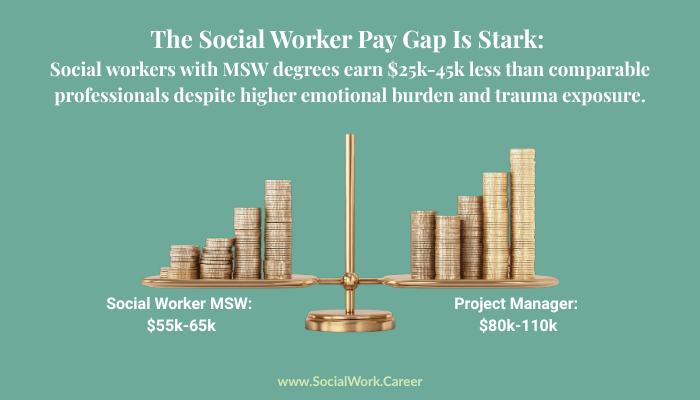
To make this concrete, consider:
- A social worker with an MSW and 5 years of experience managing complex trauma cases may earn $55,000-$65,000 annually
- A project manager with a comparable degree and similar years of experience in a corporate setting typically earns $80,000-$110,000
The social worker carries a higher emotional burden, faces greater risk of secondary trauma, and often works with the most vulnerable populations in society.
The comparison isn’t made to diminish other professions. It’s made to name the disparity clearly: the skills, credentials, and emotional demands of social work are not reflected in social worker pay.
Why Social Workers Are Underpaid: Four Structural Forces Explained
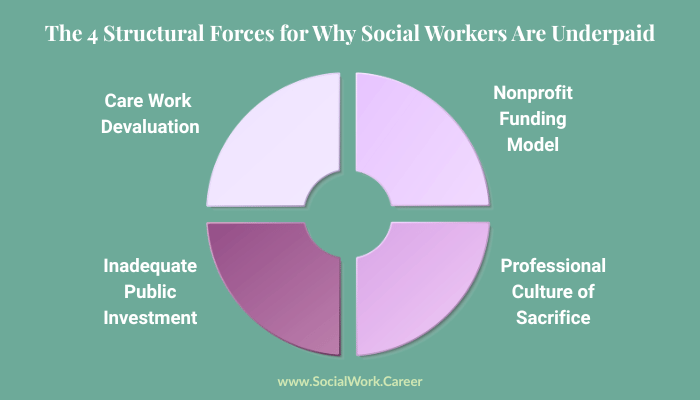
The pay gap is not the result of one problem. It is the product of four interlocking forces, each of which would suppress wages on its own. Together, they create a system that is remarkably resistant to change.
Force #1: The Devaluation of Care Work
The single most powerful structural force behind social worker pay is one that predates the profession itself: the systematic devaluation of care work.
Care work, the labor of nurturing, supporting, healing, and protecting human beings, has historically been done by women, and historically been underpaid. This is not coincidence. It is the product of a cultural and economic framework that assigned care labor to the domestic sphere, treated it as an extension of women’s “natural” roles, and then failed to compensate it fairly when it moved into the formal economy.
Social work is a female-dominated profession: approximately 80% of social workers in the United States are women. Research consistently shows that occupations become lower-paid as they become more female-dominated, a phenomenon economists call “occupational devaluation.” England, Budig, and Folbre (2002) demonstrated in their landmark study Wages of Virtue that care workers face a measurable wage penalty even after controlling for education, experience, and job characteristics — and that both men and women in care occupations pay this penalty, though women disproportionately so. This is not about individual women being paid less than individual men in the same job (though that gap also exists). It is about entire professions being structurally undervalued because of who performs them.
The care penalty is real and measurable. The Institute for Women’s Policy Research documented in their 2024 fact sheet Gender and Racial Wage Gaps Worsened in 2023 that care jobs remain among the lowest-paid occupations in the country, even as demand for care workers grows. The UW study cited earlier specifically identified “wage penalties for caring labor” as a primary driver of pay suppression in human services — separate from and in addition to gender and race discrimination.
What this means for you: your paycheck reflects not just the value your employer assigns to your work, but the value a society built on gendered assumptions assigns to care itself. That is a systemic problem. It requires systemic solutions.
Force #2: The Nonprofit Funding Model
Most social workers in the United States are employed by nonprofit organizations. And the nonprofit sector operates under a funding logic that actively suppresses wages — often with the best of intentions.
Here is how the trap works:
- Nonprofits depend on grants and donations from foundations, government contracts, and individual donors.
- Funders evaluate “efficiency” by looking at how much of each dollar goes to “programs” versus “overhead.”
- Salaries are classified as overhead, even when those salaries are the program, because the service being delivered is human care.
Organizations respond by minimizing staff compensation to appear more efficient to funders, even at the cost of workforce stability and quality.
This model has been widely critiqued within the nonprofit sector itself. Dan Pallotta, in his book Uncharitable: How Restraints on Nonprofits Undermine Their Potential (2008) and his widely-viewed 2013 TED Talk, argued that the obsession with low overhead is one of the most destructive forces in the sector — actively preventing organizations from investing in the talent and infrastructure needed to achieve meaningful impact. By 2013, GuideStar, Charity Navigator, and the Better Business Bureau Wise Giving Alliance jointly denounced the overhead ratio as a “poor measure of a charity’s performance.”
The consequences for social workers are direct:
- Wages are kept artificially low to satisfy funder expectations
- Benefits packages are thin or nonexistent
- Professional development budgets are minimal
Turnover is high, which paradoxically increases costs, but those costs are hidden from funders
You may have experienced this as a personal problem: “I just need to find a better-paying organization.” But the funding structure follows most social workers across employers, because it is built into the sector’s economic model, not just individual organizations.
Force #3: Inadequate Public Investment
Social work exists at the intersection of public need and public funding, and public funding for human services has been chronically insufficient for decades.
The majority of social work funding flows through government contracts and grants, which means that social worker salaries are ultimately a political decision. When legislatures underfund child welfare, mental health services, or community social programs, those cuts land directly on the people doing the work. Agencies cannot pay competitive wages when their government contracts don’t cover competitive wages.
This is not an abstract policy problem. It plays out in concrete ways:
Reimbursement rates for Medicaid-funded mental health services have not kept pace with inflation in most states, meaning agencies receive less in real dollars for the same services year after year
Government contracts often specify maximum allowable administrative costs that include staff salaries, effectively capping what agencies can pay
Public sector social work positions, in child protective services, public hospitals, and government agencies, are subject to civil service pay scales that frequently lag behind inflation and private-sector alternatives
The result is a sector that cannot compete for talent on compensation, which accelerates the workforce crisis it is already experiencing. According to BLS projections, approximately 74,000 social worker job openings are expected each year through 2034, many driven by workers leaving the field rather than new positions being created. The pay structure is a significant reason why.
The workforce shortage and the pay gap are not separate problems. They are the same problem viewed from different angles.
Force #4: The Professional Culture of Sacrifice
The previous three forces are external. This one is internal to the profession, and it is arguably the most insidious, because it makes the other three easier to sustain.
Social work has a deeply embedded cultural narrative: that financial sacrifice is evidence of genuine commitment. That wanting fair pay is somehow at odds with caring about clients. That the “real” social workers are the ones who stay despite the pay, not the ones who leave because of it.
You may have heard versions of this directly:
“If you were in it for the money, you wouldn’t have chosen social work.”
“We’re not here for the paycheck; we’re here to make a difference.”
“You knew what you were signing up for.”
These messages do not come only from outside the profession. They are reproduced inside it, in graduate school curricula that emphasize service and sacrifice, in supervision cultures that treat boundary-setting as suspect, and in peer dynamics that can shame colleagues for negotiating salaries or leaving underpaying positions.
This internalization serves the system. When social workers believe that accepting low pay is a moral virtue, they are less likely to organize, negotiate, or advocate for structural change. The professional culture of sacrifice functions as a mechanism that keeps wages suppressed, not through coercion, but through the workers’ own belief systems.
Naming this is not an attack on the values that draw people to social work. Caring deeply about the people you serve is a strength. The problem arises when that care is weaponized, used to justify paying you less than your work is worth.
Wanting fair compensation is not incompatible with your values. It is an expression of them. Advocating for your own financial wellbeing is the same skill set as advocating for your clients’ wellbeing. The profession needs you to use it.
Why This Matters for Your Personal Financial Work
Here is where the series comes full circle.
In the first two posts, we explored the psychological and relational dimensions of financial stress in social work: the money scripts formed in childhood, the professional conditioning that reinforces financial sacrifice, the ways your relationship with money shapes your financial behavior and circumstances.
Some readers pushed back, rightly, on whether that framing lets the system off the hook. It doesn’t. And this post is the evidence.
But here is what is also true: understanding the structural forces that suppress social worker pay does not make the personal work irrelevant. It makes it more urgent.
Consider what happens when you only focus on systemic change without doing the inner work:
- You may correctly identify that the system is unjust, but still feel unable to negotiate your own salary
- You may advocate powerfully for policy change, but self-sabotage when a raise is offered
- You may organize collectively for better pay, but individually accept conditions that reinforce the very culture you’re fighting
And consider what happens when you only focus on inner work without understanding the system:
- You may improve your money mindset, but keep bumping into structural ceilings that no amount of mindset work can move
- You may blame yourself for financial struggles that are, in significant part, structural
- You may feel isolated in your financial stress, rather than recognizing it as a shared, political condition
Both are true. Both need attention. And confusing the two keeps social workers stuck in both directions.
The structural forces described in this post are real. They are not excuses. They are the terrain. And you need to understand the terrain before you can navigate it, or change it.
In the next post, we will explore exactly that: how personal financial work and systemic advocacy must coexist, and what it looks like to navigate the pay gap while also working to close it, both for yourself and for the profession.
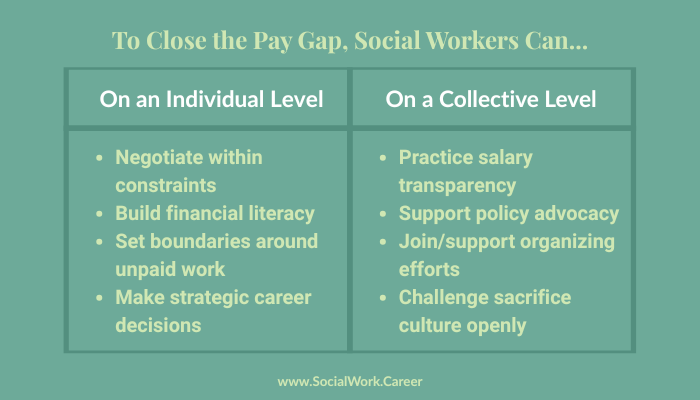
Because understanding why social workers are underpaid is not the same as accepting it.
You can examine your money beliefs and organize for better pay. You can work on your relationship with money and demand systemic change. You can advocate for yourself and advocate for the profession.
Both/and. Always both.
Frequently Asked Questions About Why Social Workers Are Underpaid
Why are social workers paid less than other master’s-level professionals?
Social workers are underpaid due to four overlapping structural forces: the historical devaluation of care work (particularly work done predominantly by women), a nonprofit funding model that treats staff salaries as overhead rather than program investment, chronically inadequate public funding for human services, and a professional culture that has internalized financial sacrifice as evidence of commitment. These forces create wage suppression that operates independently of individual qualifications, experience, or job performance.
How much do social workers actually earn compared to similar professions?
According to the U.S. Bureau of Labor Statistics (2024), the median annual wage for social workers is $61,330, with variation by specialty. Research shows social workers earn 30% or more less than workers in non-care industries performing tasks of comparable complexity and responsibility. A social worker with an MSW and 5 years of experience managing complex trauma cases typically earns $55,000-$65,000, while a project manager with comparable education and experience in a corporate setting earns $80,000-$110,000 — despite the social worker carrying higher emotional burden and risk of secondary trauma.
Is the social worker pay gap just about working in nonprofits?
No. While most social workers are employed by nonprofits that operate under funding constraints, the pay gap extends beyond the nonprofit sector. Public sector social work positions — in child protective services, public hospitals, and government agencies — are subject to civil service pay scales that frequently lag behind inflation. Even social workers in for-profit healthcare settings often face compensation structures shaped by inadequate Medicaid reimbursement rates and systemic undervaluation of care work. The nonprofit funding model is one structural force among several that suppress social worker wages across settings.
What is the “overhead myth” and how does it affect social worker salaries?
The overhead myth is the widespread but false belief that nonprofit organizations should minimize administrative costs — including staff salaries — to maximize program impact. Funders evaluate nonprofit efficiency by looking at what percentage of each dollar goes to “programs” versus “overhead.” Because salaries are classified as overhead, even when those salaries are the program (since social work services are delivered through human care), organizations suppress staff compensation to appear more efficient to funders. This creates a paradox: underpaying skilled workers actually reduces organizational effectiveness, but those costs remain hidden from funders while low overhead appears as a positive metric.
How does gender discrimination contribute to low social worker pay?
Social work is approximately 80% women, and research shows that occupations become systematically lower-paid as they become more female-dominated — a phenomenon called “occupational devaluation.” This isn’t about individual women being paid less than men in the same role (though that gap also exists); it’s about entire professions being structurally undervalued because of who performs them. Care work has historically been done by women, treated as an extension of “natural” nurturing roles, and undercompensated when it moved from the domestic sphere into the formal economy. The wage penalty for caring labor is measurable and operates separately from, and in addition to, individual discrimination.
Why doesn’t government funding cover competitive social worker salaries?
Government funding for human services has been chronically insufficient for decades. The majority of social work funding flows through government contracts and grants, meaning social worker salaries are ultimately a political decision. When legislatures underfund child welfare, mental health services, or community programs, agencies cannot pay competitive wages. Additionally, Medicaid reimbursement rates for mental health services haven’t kept pace with inflation in most states, and government contracts often specify maximum allowable administrative costs — including salaries — effectively capping what agencies can pay regardless of market rates or workforce needs.
How does social work’s culture of sacrifice keep wages low?
Social work has internalized a narrative that financial sacrifice proves genuine commitment — that wanting fair pay contradicts caring about clients. This belief is reinforced in graduate programs that emphasize service over compensation, supervision cultures that treat boundary-setting as suspect, and peer dynamics that can shame colleagues for negotiating or leaving underpaying positions. When social workers believe accepting low pay is virtuous, they are less likely to organize, negotiate, or advocate for structural change. This internalization serves the system by suppressing wages without coercion — through workers’ own belief systems.
Can individual social workers do anything about systemic underpayment?
Yes, but individual action must be paired with systemic advocacy. Understanding why social workers are underpaid helps you navigate the current reality more effectively: you can negotiate within constraints, make strategic career decisions, set boundaries around unpaid work, and build financial literacy. But individual coping strategies don’t change the underlying structure. Collective action — salary transparency conversations, supporting professional organizations advocating for better funding, organizing for policy change, and openly challenging the culture of sacrifice — is essential for addressing root causes. Both personal navigation and collective advocacy are necessary.
Is the social worker pay gap getting better or worse?
The workforce shortage is intensifying. BLS projects approximately 74,000 social worker job openings per year through 2034, many driven by workers leaving the field. Yet the structural forces suppressing pay — care work devaluation, inadequate public investment, problematic nonprofit funding models — have not fundamentally shifted. Some localized improvements have occurred through union organizing, targeted policy changes, and employer-specific adjustments, but the systemic pattern persists. The pay gap and the workforce crisis are not separate problems; they are the same problem, and addressing one requires addressing the other.
What would it take to actually close the social worker pay gap?
Closing the pay gap requires simultaneous action on multiple fronts: increased public investment in human services with reimbursement rates that reflect actual costs (including competitive salaries), reform of nonprofit funding models that currently penalize staff compensation, challenging the gendered devaluation of care work through policy and cultural change, and transforming social work’s internal culture to reject financial sacrifice as professional virtue. This is both a political and a professional challenge. Individual social workers can contribute by advocating for policy change, supporting collective organizing, practicing salary transparency, and refusing to internalize the narrative that low pay is noble.
References
Bureau of Labor Statistics, U.S. Department of Labor. (2024). Social workers: Occupational outlook handbook. https://www.bls.gov/ooh/community-and-social-service/social-workers.htm
England, P., Budig, M., & Folbre, N. (2002). Wages of virtue: The relative pay of care work. Social Problems, 49(4), 455-473. https://doi.org/10.1525/sp.2002.49.4.455
Institute for Women’s Policy Research. (2024). Gender and racial wage gaps worsened in 2023 and pay equity still decades away (Fact Sheet IWPR #C527). https://iwpr.org/wp-content/uploads/2024/09/IWPR-National-Wage-Gap-Fact-Sheet-2024.pdf
GuideStar, Charity Navigator, & BBB Wise Giving Alliance. (2013). The overhead myth: Moving toward an overhead solution [Open letter to the donors of America]. https://overheadmyth.com/
Pallotta, D. (2008). Uncharitable: How restraints on nonprofits undermine their potential. Tufts University Press.
Romich, J., & England, K. (2023). Wage equity among social services workers: A report on pay gaps in the nonprofit human services sector. University of Washington Harry Bridges Center for Labor Studies. https://labor.washington.edu/news/2023-03/new-report-uw-labor-studies-associates-examines-wage-equity-among-social-services


