• About
    • About Blog
    • Dorlee Michaeli, MBA, LCSW
    • Privacy Policy
    • Disclaimer
  • Praise
    • Testimonials from Clients and Supervisors
    • What Readers Say
  • Blog
    • Social Work Career
    • Clinical Practice
    • LMSW Exam
    • Professional Development
    • Personal Growth
    • Blog Index
  • Contact

SocialWork.Career

Social Work Career Development Resources and More

  • Social Work Career
    • Job Seeking
    • Career Guidance
    • Grad School
  • Clinical Practice
    • Clinical Skills
    • Macro Practice
  • LMSW Exam Guide
  • Professional Development
    • Expert Interviews
    • Book Reviews
  • Free Mental Health Webinars
  • Personal Growth
    • Motivational
    • Self Care
    • Therapy

Dialectical Behavior Therapy – A Mindfulness-Based Behavioral Therapy

By Dorlee

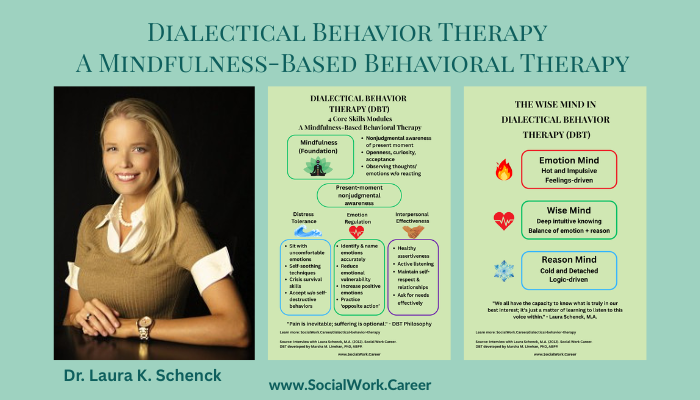
Dr Laura K Schenck dialectical behavior therapy DBT expert with infographics showing four core skills modules mindfulness distress tolerance emotion regulation interpersonal effectiveness and wise mind concept balancing emotion and reason

Comprehensive interview on dialectical behavior therapy (DBT) with Laura Schenck, M.A., Ph.D. student and psychotherapist specializing in mindfulness-based behavioral therapies. Learn what dialectical behavior therapy is, how it differs from traditional CBT, and why it’s particularly effective for borderline personality disorder (BPD) and emotion regulation challenges. Discover DBT’s foundation in mindfulness—directing nonjudgmental, open, accepting, and curious attention to the present moment. Understand the four core DBT skills modules: mindfulness (present-moment awareness), distress tolerance (sitting with uncomfortable emotions without self-destructive behaviors), emotion regulation (identifying and managing emotional states), and interpersonal effectiveness (communicating and relating to others effectively). Explore the “wise mind” concept—accessing deep intuitive knowing that balances emotion mind and reason mind. Laura explains how DBT teaches that “in order to move through painful experiences, we must be willing to identify them, accept their presence, refrain from judgment, and ultimately release them.” Includes guidance on DBT training resources and applications for clients beyond BPD diagnosis.

Filed Under: Clinical Practice, Expert Interviews Tagged With: DBT, Dialectical Behavior Therapy, Laura Schenck, Marsha Linehan

Dialectical Behavior Therapy (DBT): Acceptance and Change
By Dorlee

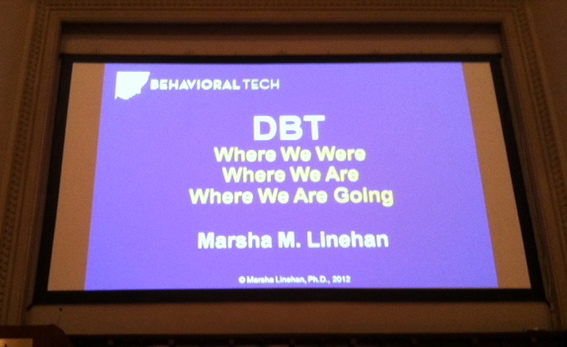
Marsha Linehan had a wonderful half-day training on dialectical behavior therapy (DBT) “Where We Were, Where We Are, and Where We Are Going.” Below are some key take-aways: * Dialectical Behavior Therapy (DBT) is a treatment that was developed by Marsha Linehan in order to help people with high suicide risk and multiple suicide attempts […]

Filed Under: Workshop Learnings Tagged With: Back from the Edge, conference, Dialectical Behavior Therapy (DBT), Marsha Linehan

Subscribe


Dorlee Michaeli, MBA, LCSW

Featured

Interviewed

inSocialWork

Let’s Also Connect

Recent Posts

  • Imposter Syndrome in Social Work: Why It Shows Up & What Helps
  • Free Mental Health Webinars, December 2025
  • #StandWithAAPI: Anti-Asian Racism Resources for Social Workers and Therapists
  • Best in Mental Health for Sept and Oct 2020
  • Best in Mental Health for August 2020

Copyright

All material on this website is copyrighted by Social Work Career. All rights reserved. Please contact the editor for permission to reproduce or reprint any materials on this site.

Recent Comments

  • Dorlee on Imposter Syndrome in Social Work: Why It Shows Up & What Helps
  • Cheryl Edwards on Imposter Syndrome in Social Work: Why It Shows Up & What Helps
  • Dorlee on Imposter Syndrome in Social Work: Why It Shows Up & What Helps
  • Jonathan Singer on Imposter Syndrome in Social Work: Why It Shows Up & What Helps
  • Dorlee on Imposter Syndrome in Social Work: Why It Shows Up & What Helps

National Hotline

Social Work Career does not provide crisis or counseling services. If you need to talk or are concerned about someone else, please call 988. If someone is in immediate crisis, dial 911.

Search

Archives

Categories

Social Work Career · Copyright © 2026 · WordPress · Log in