The conversation around AI tools for therapists has never been more urgent, or more complicated. In the span of just a few years, artificial intelligence has moved from a distant abstraction to a daily presence in clinical practice: drafting notes, generating treatment plan language, powering chatbots that millions of people are already using for emotional support between, and instead of, therapy sessions.
For most clinicians, the questions are coming faster than the answers. Is this HIPAA-compliant? Is it ethical? What do I tell clients? And underneath all of it, the question nobody wants to say out loud: am I going to be replaced?
Kym Tolson, LCSW, has been sitting with these questions longer than most, and building answers in real time. A former nomadic therapist who ran a fully location-independent practice from Airbnbs around the world, Kym pivoted to AI education for clinicians when she realized that the bottleneck in her own practice wasn’t clients or caseload. It was time. When ChatGPT arrived and therapists started reporting that their nightly notes time had dropped from 90 minutes to 10, she leaned all the way in.
Today Kym runs two monthly AI training memberships for mental health professionals: the Clinical AI Club, a done-with-you community where members build AI systems together, and the Thera AI Hub, a done-for-you platform where she builds the tools so members can simply plug them in. She is also the Clinical Consultant for HeyBerries, an AI scribe built specifically for therapists.
In this interview, Kym addresses the questions she hears most from clinicians across the country, including the Talkspace data scandal that should concern every therapist using digital tools with clients, what the Dartmouth Therabot trial actually means for the profession, and the AI tools for therapists that her members keep coming back to. She also offers a blunt assessment of where the profession is falling dangerously short.
TL;DR
- AI tools for therapists are no longer optional – they’re reshaping documentation, marketing, and clinical practice right now
- The Talkspace scandal is a wake-up call: therapy session transcripts can be subpoenaed, and most consent forms don’t address this
- Clients are already using AI between sessions – therapists who ask about it and use it clinically will have an advantage
- The Dartmouth Therabot trial showed real results, but most consumer AI therapy tools have none of that clinical scaffolding
- Three states have already banned AI therapy bots; the profession needs to show up at the policy table now
- The biggest gap isn’t tools – it’s training clinicians to think critically with AI, not just use it
From Nomadic Therapist to AI Educator: How Kym Found Her Focus
How did you develop this focus on AI in mental health? Was there a moment or experience that convinced you this was where the field was heading?
Honestly? I was burnt out. I’d been a clinician for years, then a biller, then a course creator, then a podcaster, and I was doing it all from Airbnbs around the world because I’d built a fully nomadic business. The bottleneck was always me. My time, my brain, my hands. So when ChatGPT came out, and I started playing with it for content and admin, the lightbulb wasn’t “this will replace therapists.” It was “this will give therapists their lives back.”
The moment I knew this was where the field was heading was when I started getting DMs from therapists telling me they’d cut their notes time from 90 minutes a night to 10. That wasn’t a productivity hack. That was somebody getting Tuesday evenings with their kid back. When something can do that for an entire profession of helpers who are already running on fumes, you can’t ignore it. So I leaned all the way in and built Clinical AI Club and Thera AI Hub around it.
What AI Actually Looks Like in a Therapist’s Daily Practice
How are you currently using AI in your clinical work or training, and what does that actually look like on a typical day?
My typical day looks like a clinician-turned-business-owner who lives inside Claude and ChatGPT. I’m not seeing a full caseload anymore. I do consultations, and I run my businesses, but here’s what AI looks like across my work:
Documentation: I am the Clinical Consultant for product development and a partner with HeyBerries.com/therapists, an AI scribe built specifically for therapists, and I recommend it constantly because it’s HIPAA-secure and built by people who actually understand the clinical workflow. For solo practice questions about notes and documentation efficiency, that’s my first stop.
Content creation: I have custom Claude skills I’ve built for my own brand voice – one for podcast show notes, one for emails, one for sales pages. Instead of starting from a blank page, I start from a 70%-there draft that already sounds like me.
Strategy and decision-making: This is the underrated one. I use Claude as a thinking partner. Pricing decisions, partnership decisions, awkward customer service messages, content for my Facebook groups, hard conversations with team members. I work it out with AI first.
Training therapists: The skills I build, I package and share with my Thera AI Hub members so they can plug them into their own practices. That’s the whole model: done-with-you and done-for-you AI for therapists who don’t have time to figure it out alone.
Can you walk us through a specific example of using Claude as a thinking partner for a business or clinical decision? What did you bring to it, and what did you get back that was useful?
Sure, here’s a real one. A brand reached out wanting to do a sponsored podcast post and they offered a flat fee that was, in my opinion, way under what my audience access is worth. My podcast is a hyper-targeted niche with around 90K listeners who are exactly the buyer this brand wants. I didn’t want to lowball myself, but I also didn’t want to come off as greedy or blow up a relationship that could be good long-term.
What I brought to Claude: the brand’s initial offer, my podcast stats, what I’d charged similar brands in the past, the type of post they were asking for, and my honest read on the relationship dynamics. Then I said something like, “Help me think through this. I want to counter without being aggressive. What’s a fair range and how should I frame the ask?”
What I got back that was useful: First, a sanity check on my own pricing. Claude pushed back and said the offer was actually low for that audience size and that niche, and gave me a defensible range with reasoning I could repeat to the brand. Second, three different framings for the counter-offer, from gentle to firm. Third, a flag I hadn’t considered — I was about to lock in a per-post rate that would set a ceiling for any future work with them, so I should be careful what number I anchored. That last one was the most valuable thing in the whole conversation, because I would not have thought about it on my own.
I ended up countering at the higher end of the range Claude suggested, used a version of the firmer framing, and they accepted without pushback. The whole thing took me 20 minutes instead of three days of stewing and asking three friends what they thought.
The pattern I use every time: bring the full context, ask for the thinking not just an answer, and treat the response like advice from a smart colleague. You take what’s useful and discard what isn’t. The AI doesn’t know my business as well as I do. But it can spot things I’m too close to see.
The Questions Therapists Are Really Asking About AI
Through your AI clubs, you hear from therapists across the country about their questions and concerns. What are the most pressing questions practitioners are bringing to you right now about AI in mental health, the ones that keep coming up?
The questions cluster into about four buckets, and they keep coming up week after week:
1. “Is this HIPAA-compliant?”
This is THE question. And the honest answer is: it depends on the tool, the BAA, and what you’re putting into it. Most therapists assume ChatGPT and Claude on the consumer plans are not appropriate for PHI, and they’re right to be cautious. There are HIPAA-compliant options, and that’s part of why I work with HeyBerries.
2. “Is it ethical?”
Therapists want to know if they’re crossing a line by using AI to help with notes, treatment planning, or psychoeducation handouts. My take: AI as a support tool with you in the driver’s seat is ethical. AI making clinical decisions for you is not. The line isn’t actually that blurry once you name it.
3. “What about my clients using ChatGPT as a therapist?”
Social Worker Salary Guide 2026: What You Should Really Be EarningSocial Worker Salary Guide 2026: What You Should Really Be EarningThis one has exploded in the last six months. Therapists are walking into sessions and clients are saying “I asked ChatGPT and it said…” and clinicians don’t know how to respond.
4. “Am I going to lose my job?”
The Kaiser strike made this go from background anxiety to active fear. Therapists want to know if they should be learning AI to stay relevant or fighting it to protect the profession. My answer is yes to both — and I’ll get to that.
When a client comes into session and references something ChatGPT told them, “I asked ChatGPT and it said…,” what do you recommend therapists actually say in that moment?
Yes, and I love that you’re asking this because most therapists’ instinct in that moment is one of two extremes. Either they dismiss it (“well, AI isn’t a real therapist”) or they over-validate it (“oh, that’s a great insight!”). Both miss the clinical opportunity.
The response I recommend is genuine, curious, and slows the moment down. Something like:
“Tell me more. What were you working through when you went to it, and what did it say back?”
That single question does three things at once. It signals to the client that you’re not threatened or judgmental. It gets them to articulate what they were actually struggling with, which is often more clinically useful than the AI’s response. And it gives you the actual content of what the AI said, so you can work with it instead of around it.
From there, depending on what they share:
If the AI’s response was sycophantic: “That’s interesting. How did it feel to read that? Did it land as true, or did it land as comfortable?” This opens up a useful conversation about the difference between feeling supported and being challenged.
If the AI actually said something useful: “That’s a fair point. What would it look like to take that seriously?” Don’t compete with the chatbot. Build on it.
If the AI gave them something clinically off: “I want to slow down on that piece, because that’s not quite how I’d think about it. Can I share what I’m seeing?” Be direct but not defensive.
The meta-message you want to send across all of these is: I’m not afraid of the tool, I’m not competing with the tool, and I’m the person who can help you make sense of what it gives you. That’s the positioning that keeps you relevant.
The Talkspace Scandal and the Informed Consent Gap Every Therapist Needs to Close
Proof News investigation revealed that a woman’s Talkspace therapy sessions were subpoenaed and used against her in court, and that Talkspace has been mining 140 million message exchanges to train an AI therapy bot.
When you think about informed consent for AI tools in clinical practice, how far short does the current standard fall, and what should therapists actually be telling clients about data ownership and risk?
That story is gutting, and it should be required reading for every clinician in the country. A nurse practitioner went to a text-based therapy app during one of the most vulnerable times of her life, and her own employer, the one she was suing, got every single message produced in court. Two years later. That’s not a glitch. That’s the architecture working as designed.
The current informed consent standard in our field falls embarrassingly short. We were trained to explain the limits of confidentiality – duty to warn, mandated reporting, court orders – but most of our consent forms still treat “the record” as if it’s a paper file in a locked cabinet. The reality now is that the record might be a transcript, an AI-generated summary, a chat log, training data for a model, or all of the above. Clients have no idea.
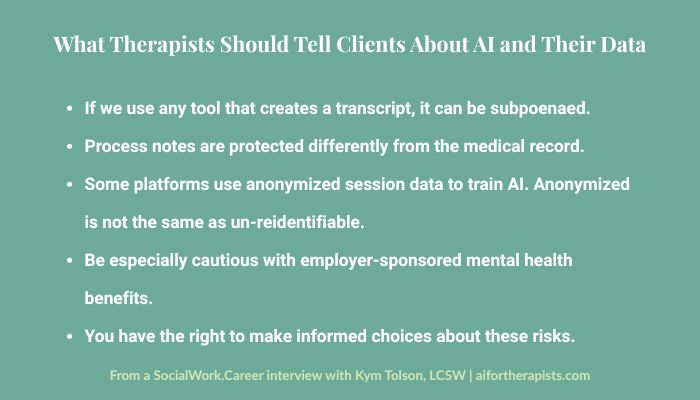
Here’s what I think therapists should be telling clients, in plain language:
- If we use any tool that creates a transcript of what you say, that transcript can be subpoenaed.
- Process notes – your therapist’s private clinical thinking – are protected differently from the medical record itself. Anything saved in the record is potentially discoverable.
- Some platforms reserve the right to use anonymized session data to train AI. “Anonymized” is not the same as “un-reidentifiable.”
- Be especially cautious with employer-sponsored mental health benefits, where the employer paying for the therapy may also be a future legal adversary.
- You have the right to make informed choices about these risks.
This isn’t about scaring clients. It’s about treating them like the adults they are and letting them make informed choices.
What the Dartmouth Therabot Trial Actually Means for Therapists
The Dartmouth Therabot study found a 51% reduction in depression symptoms, with participants reporting a level of trust comparable to working with a human therapist. What’s your honest reaction to that, and how should therapists be positioning themselves in response?
My honest reaction is: okay, two things at once. First, that’s a real outcome and we should take it seriously. A 51% reduction in depression symptoms in a randomized trial is not nothing, and the population in that study mostly wasn’t getting any other care. Pretending it didn’t happen makes us look like we’re protecting our turf instead of caring about clients.
AND. The Dartmouth team themselves said this is not ready to operate autonomously. They consulted with psychologists and psychiatrists for years to build it, they monitored every conversation in the trial, and they were very clear that high-risk situations are where the wheels come off. Therabot is not ChatGPT. The vast majority of “AI therapy” being marketed to consumers right now has none of that scaffolding.
So how should we position ourselves? Stop arguing about whether AI works at all and start being the experts on when it works, when it doesn’t, and what good integration looks like. The therapists who win in the next five years aren’t going to be the ones who refused to learn AI or the ones who handed everything over to it. They’re going to be the ones who can sit with a client and say, “yeah, that chatbot helped you on a hard night at 3am, AND here’s what it can’t see that I can.” That’s positioning.
Which tools or categories of tools concern you most right now, and what should consumers be looking for to tell the difference between a responsible tool and a dangerous one?
This is the question I wish more journalists were asking. I’m not going to name specific apps because the landscape changes fast and I don’t want to make claims that could be outdated by next quarter. But I can describe the categories that worry me and the red flags consumers should watch for.
The categories that concern me most:
- Companion chatbots marketed as “AI therapy” or “AI therapist.” These are often built on top of general-purpose models with a friendly persona slapped on top. No clinical training data that’s been validated. No oversight. No crisis protocols beyond a 988 link. Some of them have been documented giving dangerous advice in mental health crises. The Illinois ban specifically targeted apps using language like this.
- “Wellness” apps that quietly drift into clinical territory. These market themselves as journaling or mood tracking, which is fine, but then the AI starts offering interpretations, suggesting diagnoses, or pushing back on user feelings in ways that are functionally therapy without any of the safeguards.
- Apps that aggregate session content for AI training without meaningful consent. The Talkspace situation is the obvious example, but it’s not the only one.
- “Free” tools where the user is the product. If you’re not paying, your data is paying. With mental health content, that’s a different category of risk than it is with, say, music recommendations.
Red flags to watch for:
- No named clinical advisory board, or a board that looks decorative rather than active
- No published research, or research that’s only company-funded with no independent replication
- Vague or aggressive language about “replacing” therapists or being “just as good as” a human clinician
- Crisis handling that’s a single line of text at the bottom of the screen
- Data and privacy policies that are deliberately hard to find or read
- Marketing aimed at minors without verifiable parental consent flows and specific clinical safeguards
- Acquisition by entities whose business model is something other than care
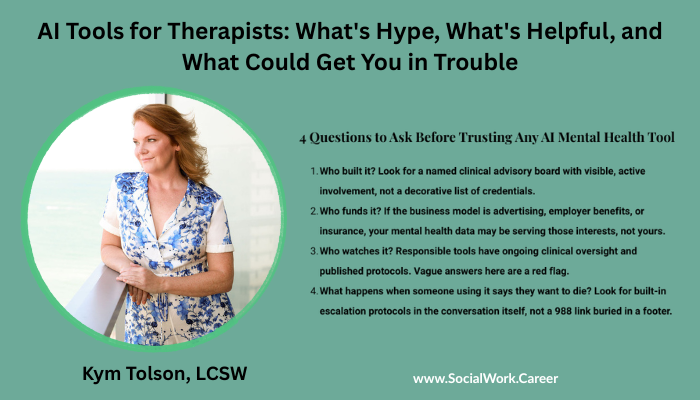
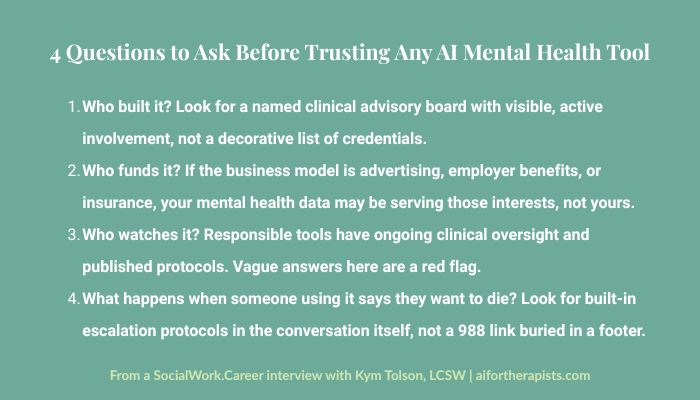
The shorthand I give therapists in my memberships: look at who built it, who funds it, who watches it, and what happens when somebody on it says they want to die. If you can’t get clean answers to those four questions, it’s not a responsible tool.
The Silent Empathy Effect, and What It Means for Clinical Training
A Northwestern and Stanford study found that people often feel empathy but consistently fail to express it effectively, what the researchers call a “silent empathy effect,” and that brief AI coaching sessions significantly improved participants’ empathic communication skills. What’s your reaction to that as a clinician, and do you see AI having a role in helping therapists themselves become better at communicating empathy with clients?
I love this study and I think it’s one of the most underrated findings of the year. The “silent empathy effect” – feeling it but failing to express it – is something every clinical supervisor I’ve ever known has tried to coach trainees through. We just usually call it something fancier like “affective attunement” or “reflective listening skill development.”
As a clinician, my reaction is: of course AI can help with this, and we should let it. Not because the AI is more empathic than a human therapist – it isn’t, especially in real time with a real person – but because deliberate practice with feedback is how skill is built, and most therapists don’t get nearly enough of it after grad school. After your last supervised hour, when’s the next time someone gives you specific, structured feedback on a reflection you offered? For most clinicians, the honest answer is never.
So yes, I see a real role for AI in clinician training.
- Practicing reframes.
- Workshopping how to respond to a client’s expression of shame.
- Rehearsing a difficult termination.
- Getting feedback on whether your reflection actually mirrored what the client said versus what you assumed they meant.
None of this replaces supervision or consultation, but it could be the cheapest, most accessible skill-building tool our profession has ever had.
Are Your Clients Already Using AI? Why You Should Be Asking
A paper just published in JAMA Psychiatry by an LCSW and a public health researcher argues that therapists should routinely ask clients whether they’re using AI for emotional support, and that clinicians already have the skills to have that conversation. Are you recommending this, and what are you and the therapists you consult finding?
100% yes, I’m recommending it, and the JAMA Psychiatry paper is exactly right that we already have the skills. We ask about sleep. We ask about substances. We ask about how someone slept and what they ate and whether they’re moving their body.
“Are you using AI to talk things through?” is the same kind of question. It’s a window into how someone is coping.
What therapists in my clubs are finding when they actually ask:
- Way more clients are using it than therapists assumed. The default assumption is “my client wouldn’t do that.” The data is showing us they would, and probably are.
- Clients use it for things they’re embarrassed to bring to a human. Sometimes that’s useful — it gets them in the door. Sometimes it’s avoidance — the AI never challenges them, so the hard work never happens.
- A lot of clients are bringing AI “insights” into session as if they were therapeutic interpretations. Therapists are reporting that they’re now spending part of their session unwinding sycophantic AI responses.
My recommendation: ask the question without judgment, get curious about what the AI is doing for them and what it isn’t, and use the answer clinically. If a client is processing big stuff with a chatbot at 2am, that’s information about attachment, support systems, and self-soothing. Don’t waste it.
How to Turn Your Clients’ Between-Session AI Use Into Clinical Material
Some clients are already using AI chatbots between sessions — journaling with them, processing difficult moments, even practicing conversations they want to have with their therapist. How can clinicians turn that into useful clinical material rather than ignoring it or feeling threatened by it?
This is one of my favorite questions because the answer is so therapist-friendly: treat it like a journal. We’ve been working with clients’ between-session writing, dreams, and reflections for as long as we’ve had a profession. AI conversations are just the newest version of that, except they talk back.
Some practical ways to use it as clinical material:
- “What did you bring to the chatbot this week that you didn’t bring here?” The gap between what gets shared with AI and what gets shared in session is full of clinical gold
- “Read me what it said back to you.” If it was sycophantic and validated everything, that’s a chance to talk about what real support looks like versus what just feels good. If it actually said something useful, build on it
- “Want to practice the conversation here, with me?” If a client is rehearsing a hard conversation with AI, you have the actual relationship to work it through. Use that
- Notice what the AI can’t do that you can. The AI can’t see the tear they almost cried. It can’t hold space across years of a relationship. It can’t notice the pattern between what they said today and what they said in March. You can. Name that, gently
Feeling threatened by it is understandable, but it’s also the worst clinical posture for the work. Curiosity beats fear every time.
Therapy Bots, State Bans, and the Kaiser Strike: Is the Profession Moving Fast Enough?
Illinois has become the third state to ban therapy bots, and a union of Kaiser Permanente therapists just went on strike over AI replacing clinical roles. Do you think the profession is moving fast enough to protect both clients and practitioners, and what should social workers be doing right now to have a voice in how this unfolds?
Short answer: no, we are not moving fast enough, and the gap between where the technology is and where our policy and ethics conversations are is widening every quarter.
The Illinois law — the Wellness and Oversight for Psychological Resources Act, passed in August 2025 — is actually a really thoughtful piece of legislation. It bans AI from making independent therapeutic decisions or directly delivering therapy without licensed oversight, while still allowing AI for admin and supplementary support. NASW-Illinois drove that bill, which is exactly the model I want social workers everywhere to study. That’s social workers showing up at the table instead of waiting to see what gets handed down to them. Nevada and Utah have similar laws. Other states are moving.
The Kaiser strike is the other side of the same coin. When a major health system starts replacing clinical triage with telephone operators following an AI-generated script, that’s not a hypothetical anymore. That’s clinicians being squeezed out of decisions about patient care.
What social workers should be doing right now:
- Get involved in your state NASW chapter on AI policy. The Illinois playbook works
- Learn the tools. You cannot regulate or advocate around something you don’t understand. This is not optional anymore
- Push back on employers who roll out AI without clinician input. The Kaiser therapists’ demand was “don’t keep us out of the human process of engaging with our patients.” That’s reasonable and every clinician should be making it
- Ask your professional organizations the hard questions about position statements, scope of practice updates, and CE requirements around AI literacy
AI Tools for Therapists: Where to Start If You Haven’t Yet
For social workers or mental health providers who haven’t touched AI yet and don’t know where to start, what are your top 3 to 5 concrete first steps for getting comfortable with tools like ChatGPT or Claude, before they consider any paid training or membership?
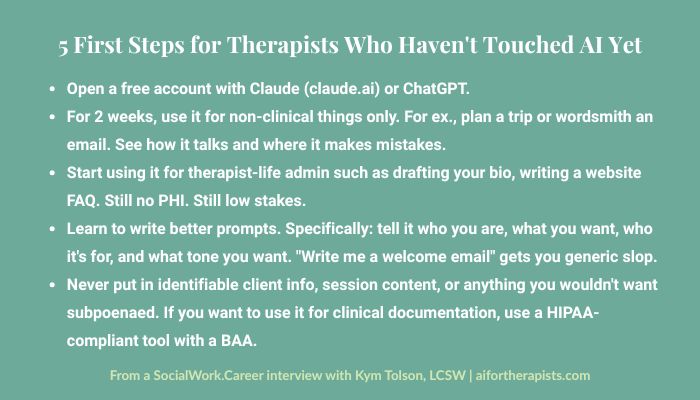
Okay, deep breath. You don’t need to read a book or buy a course. Here’s what I’d do, in order:
- Open a free account with Claude (claude.ai) or ChatGPT. Just one. Not both. You can pick the other later
- For two weeks, use it for non-clinical things only. Plan a trip. Workshop a tough email to your landlord. Brainstorm a birthday gift. Get a recipe for what’s in your fridge. The goal is to build intuition for how it talks and where it gets stuff wrong, with zero stakes
- Then start using it for therapist-life admin: drafting your bio, writing a website FAQ, summarizing a long article, creating a packing list for a conference. Still no PHI. Still low stakes
- Learn to write better prompts. Specifically: tell it who you are, what you want, who it’s for, and what tone you want. “Write me a welcome email” gets you generic slop. “I’m a trauma therapist welcoming a new client to my practice; warm, not clinical; 150 words; focus on what to expect in the first session” gets you something usable
- Get clear on what you would never put in: identifiable client info, session content, anything you wouldn’t want subpoenaed. If you want to use it for clinical documentation, that’s where you graduate to a HIPAA-compliant tool with a BAA
That’s it. That’s free. Then, if you want to go deeper, that’s when you look at training.
The Question About AI in Mental Health Nobody Is Asking
Is there a question about AI in mental health that you wish more people were asking, something you think is critically important that isn’t getting enough attention yet?
Yes, and it’s not a flashy one. The question I wish people were asking is: who is going to teach the next generation of clinicians how to think with AI, not just how to use it?
Right now, almost every conversation about AI in our field is either fear — it’ll replace us, it’ll harm clients — or hype — it’ll save us, it’ll democratize care. What’s missing is the slow, unsexy middle: actual training, integrated into clinical education, on how to evaluate an AI output the way you’d evaluate a research article. How to spot when a tool is sycophantic. How to know when an AI summary has missed something clinically important. How to teach a client to use AI well between sessions. How to write a good prompt, the way we used to teach people to write a good case formulation.
None of that is in our graduate programs yet. None of it is in continuing education requirements. And it should be. The clinicians coming out of school in 2030 will have grown up using AI for everything, and they will need help applying critical clinical thinking to a tool that talks back. We’re going to have to build that curriculum, because nobody is going to build it for us.
If you were designing that graduate-level curriculum today, what would the first three sessions cover?
Oh, I have thought about this so much. If I were running it, the first three sessions would not touch a tool. The goal of the first three sessions is to build the clinical thinking that makes tool use safe, because if we go straight to “here’s how to use ChatGPT,” we just create a generation of clinicians who will use AI confidently and badly.
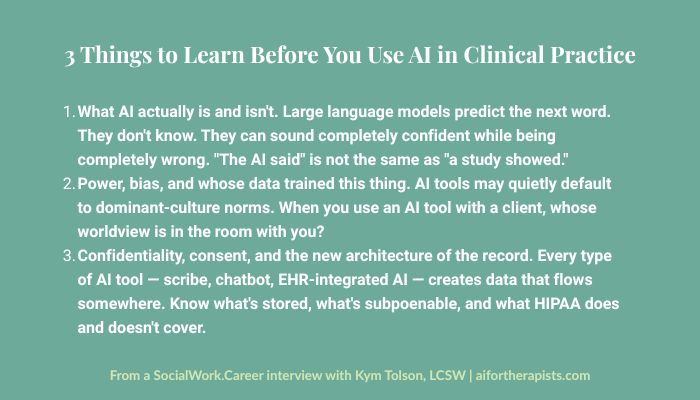
Session 1: What AI actually is — and what it isn’t.
A plain-language overview of large language models. How they’re trained, what “prediction” actually means, why they hallucinate, why they can sound completely confident while being completely wrong, and why “the AI said” is not the same as “a study showed.” No coding, no math, just an honest mental model. By the end of this session, every student should be able to articulate why “the AI told me” is not evidence.
Session 2: Power, bias, and whose data trained this thing.
This is the social work session. Who built the models. Who’s represented in the training data and who isn’t. How bias shows up in mental health AI specifically — around race, gender, sexuality, disability, language, class, religion. We’d connect it to the NASW Code of Ethics, especially the parts about cultural humility, self-determination, and competence. The clinical question we’d end on: when you use an AI tool with a client, whose worldview is in the room with you?
Session 3: Confidentiality, consent, and the new architecture of “the record.”
The practical legal and ethical session. We’d walk through every type of AI tool a clinician might use and map exactly what data flows where, what gets stored, what’s subpoenable, and what HIPAA does and doesn’t cover. We’d do case studies on the Talkspace situation. We’d write actual informed consent language that takes AI into account. And we’d end with a values exercise where students articulate their own personal lines — what they will and won’t put into a tool, regardless of what the tool is technically capable of. Because the technology will keep changing. The values have to be steady.
After those three foundation sessions, then I’d start teaching the tools. But not before. Without the foundation, we just turn out fast, confident, and dangerous clinicians — and we already have enough sources of harm in this field.
The AI Tools for Therapists Kym’s Members Keep Coming Back To
You run two monthly AI training clubs for therapists — the Clinical AI Club and the Thera AI Hub. What are 5 to 7 of the tools or workflows your members have been most excited about for productivity, documentation, and marketing, and where can social workers who want to go deeper find you?
Here’s what’s been on fire in both communities right now:
- HeyBerries.com/therapists for documentation. Built specifically for therapists, HIPAA-compliant, and the team behind it actually understands clinical workflow. This is the one I recommend first when therapists ask about AI scribes
- Custom Claude Skills and ChatGPT Custom GPTs trained on your own brand voice and clinical philosophy. My members are using these for show notes, emails, social posts, and intake materials. Once you build it once, it’s there forever
- AI for marketing copy that actually sounds human. Sales pages, opt-in pages, podcast show notes, email sequences. The therapists who’ve nailed prompt-writing are saving hours per week and getting better-converting copy than they wrote on their own
- AI-assisted course and content creation. The therapists who are scaling beyond 1:1 — building courses, memberships, group programs — are using AI as a co-creator, not a ghostwriter. It speeds up everything
- Strategy and decision-making with AI. The most underrated workflow. Pricing decisions, partnership decisions, client communication, hard team conversations — using a model like Claude as a thinking partner before you act. This one quietly changes how clinicians run their businesses.
Kym’s Bottom Line
The field is moving fast, and the gap between where the technology is and where our training, ethics standards, and policy conversations are is widening every quarter. But Kym’s message isn’t one of alarm; it’s one of agency.
“The therapists who win in the next five years aren’t going to be the ones who refused to learn AI or the ones who handed everything over to it. They’re going to be the ones who can sit with a client and say, ‘yeah, that chatbot helped you on a hard night at 3am, AND here’s what it can’t see that I can.’ That’s positioning.”
The profession built on human connection, systemic thinking, and ethical practice is uniquely equipped to lead this conversation, if it chooses to show up for it.
Want to Go Deeper?
Kym Tolson offers two monthly AI training memberships for mental health professionals:
- Clinical AI Club – a done-with-you community where members build AI systems together each month
- Thera AI Hub – a done-for-you platform where Kym builds the tools so members can plug them directly into their practice
- Explore the AI tools for therapists she recommends most
- She also hosts two podcasts – The Traveling Therapist and Run Your Private Practice with AI – available wherever you listen.
- To explore her work or book a consultation, visit aifortherapists.com
About Kym Tolson, LCSW
Kym Tolson is a licensed clinical social worker, AI educator, and entrepreneur who has spent the last several years at the intersection of mental health practice and artificial intelligence. After building a fully nomadic private practice, running her clinical and business work from Airbnbs around the world, she pivoted to helping therapists harness AI tools to reclaim their time, reduce burnout, and build more sustainable practices.
She is the founder of Clinical AI Club and Thera AI Hub, two membership communities serving mental health professionals across the country, and serves as Clinical Consultant for HeyBerries, an AI scribe built specifically for therapists. Her work focuses on practical, ethical AI integration – helping clinicians move from overwhelmed to empowered without sacrificing the human core of their work.
You can find her at aifortherapists.com and on her podcasts The Traveling Therapist and Run Your Private Practice with AI.
About the Interviewer
Dorlee Michaeli, MBA, LCSW, is the founder of SocialWork.Career, a professional development platform for social workers running since 2009. She is also a certified EMDR therapist in private practice, specializing in high-achieving professionals navigating imposter syndrome, perfectionism, and financial anxiety. Find her at dorleemichaeli.com.
Related Posts You May Enjoy:
- Guide to Starting Your Private Practice
- How Every Social Worker Can Succeed in Private Practice
- HIPAA Compliance: Private Practice Security Tips
- Real World Clinical Social Work: 7 Career Tips
- Social Worker Salary Guide 2026: What You Should Really Be Earning
Frequently Asked Questions
Is it ethical for therapists to use AI in their clinical work?
According to Kym Tolson, LCSW, AI as a support tool with the clinician in the driver’s seat is ethical. AI making independent clinical decisions is not. The distinction is clearer than it might seem once you name it explicitly.
Are therapy sessions private if conducted through an app like Talkspace?
Not necessarily. A Proof News investigation revealed that one woman’s Talkspace therapy sessions were subpoenaed and used against her in a legal case two years after the sessions took place. Any tool that creates a transcript of session content can potentially be subpoenaed. Clients should be informed of this risk as part of the consent process.
Should therapists ask clients if they are using AI for emotional support?
Yes. A 2026 paper in JAMA Psychiatry recommends that therapists ask clients routinely about their AI use for emotional support, the same way they ask about sleep or substance use. Kym Tolson confirms she recommends this practice and that therapists in her clubs are finding that far more clients are using AI between sessions than they assumed.
Will AI replace therapists?
The evidence suggests no, but the profession needs to engage actively rather than passively. The Dartmouth Therabot study showed meaningful reductions in depression symptoms, but the tool was built with years of clinical scaffolding and monitored supervision. Most AI therapy tools on the market today have none of that infrastructure. Therapists who learn to work alongside AI and articulate what they offer that AI cannot will be best positioned for the future.
Which AI tools are safe for therapists to use with client information?
Only tools that offer a Business Associate Agreement (BAA) and are specifically designed for HIPAA compliance. Consumer versions of ChatGPT and Claude are not appropriate for protected health information. Kym Tolson recommends HeyBerries as a HIPAA-compliant AI scribe built specifically for therapists.
What states have banned AI therapy bots?
As of 2025, three states have enacted laws prohibiting AI from independently delivering therapy: Illinois (the WOPR Act, signed August 2025), Nevada (AB 406, effective July 2025), and Utah (HB 452, effective May 2025). All three still allow AI for administrative support under licensed oversight.
How should therapists respond when a client references something ChatGPT told them?
Kym Tolson recommends slowing the moment down with genuine curiosity: “Tell me more. What were you working through when you went to it, and what did it say back?” This response avoids dismissing or over-validating the AI’s input and opens clinical material about what the client is seeking outside the therapeutic relationship.
What are the first steps for therapists who want to start using AI?
Kym recommends starting with a free account on Claude or ChatGPT and using it for non-clinical tasks only for the first two weeks: planning, drafting personal emails, brainstorming, to build intuition before introducing it to any professional context. Never input identifiable client information into a consumer AI tool.


