 In the first two posts in this series, we explored why financial stress in social work goes deeper than low pay, and how the money beliefs we developed in childhood shape our financial behavior through the Relationship → Behavior → Circumstances chain.
Today, I want to focus on one of the most common behavioral expressions of those beliefs: difficulty setting financial boundaries.
In my clinical work and in conversations with colleagues, I notice something striking: social workers often have a sophisticated understanding of boundaries in theory. We teach them, model them for clients, and write case notes about them.
But when it comes to money, the boundary often collapses. The financial boundaries social workers struggle to set aren’t about willpower. They’re rooted in deeply held beliefs about money, worth, and professional identity.
We stay late without pay. We undercharge. We avoid the salary conversation. We say yes when every part of us knows we should say no.
This isn’t a willpower problem. It’s a belief problem that shows up as a behavior problem.
And until we name the specific patterns, we can’t change them.
Quick check: Do any of these sound familiar?
- You’ve never negotiated a salary
- Your private practice fee hasn’t changed in two or more years
- You regularly work hours you don’t log or bill
- You feel anxious bringing up money with clients
- You know you should raise your fees but can’t bring yourself to do it
If you said yes to two or more, this post is for you.
Quick Answer: Why Financial Boundaries Social Workers Need Are So Hard to Set
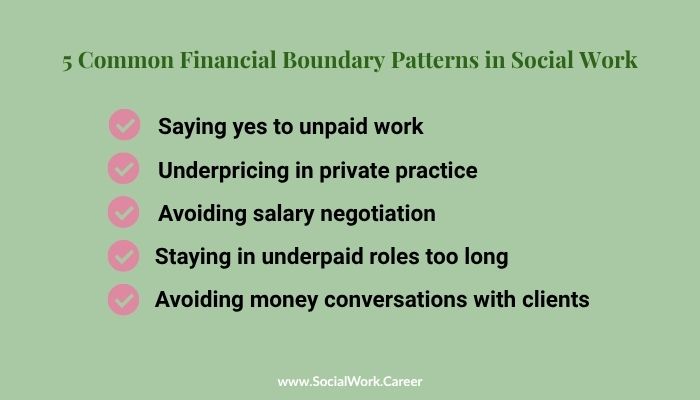
Financial boundaries social workers struggle to set aren’t about willpower; they’re rooted in deeply held beliefs about money, worth, and professional identity. These patterns show up in five common ways:
- Saying yes to unpaid work – Staying late, covering shifts, taking calls off-hours without compensation
- Underpricing in private practice – Charging significantly below market rate ($120 when the range is $150-$250)
- Avoiding salary negotiation – Accepting first offers, costing an estimated $500,000+ over a career
- Staying in underpaid roles too long – Loyalty becomes a financial trap
- Avoiding money conversations with clients – Your own financial discomfort shows up in clinical work
Why Financial Boundaries Are Uniquely Hard for Social Workers
Most social workers I know are excellent at holding clinical boundaries. We understand why they matter, we enforce them consistently, and we can articulate the theory behind them fluently.
But financial boundaries? That’s a different conversation entirely.
The reason isn’t laziness or lack of professionalism. It’s that financial boundaries require something that runs counter to the professional identity many of us built: the willingness to put your own financial needs on equal footing with others’ needs.
Social work training doesn’t just teach us skills. It socializes us into a particular relationship with self-sacrifice. The message, often implicit, is that financial ambition and genuine care for others are in tension. That good social workers prioritize service over salary. That wanting to be well-compensated somehow makes you less committed to the work.
When that belief is operating in the background, setting a financial boundary doesn’t just feel uncomfortable. It feels like a betrayal of your professional identity. This explains why financial boundaries social workers need to maintain feel particularly challenging compared to clinical boundaries.
Add to that the money scripts from childhood (explored in the previous post), and you have a layered system working against you. Research by Klontz et al. (2011) established that these unconscious scripts, absorbed before age 7, continue to drive adult financial decisions automatically. If you absorbed messages like “I should always put others first” or “wanting security is selfish,” then every financial boundary you try to set will trigger an internal alarm: This is wrong. This is selfish. Real helpers don’t do this.
That alarm isn’t evidence that the boundary is wrong. It’s evidence that the old belief is still running.
Financial Boundaries Social Workers Struggle to Set: Common Patterns
Before we talk about what to do differently, it helps to recognize where the patterns actually show up. These aren’t hypothetical. They’re conversations I’ve had, situations I’ve witnessed, and in some cases, patterns I’ve navigated myself.
Saying yes to unpaid work
Staying late to finish documentation. Taking calls outside of scheduled hours. Attending meetings that aren’t in your job description. Covering a colleague’s caseload without compensation. Each individual instance feels small, even reasonable. But accumulated over months and years, unpaid labor becomes a significant financial loss, and a signal to yourself and your employer about what your time is worth. Hochschild’s (1983) foundational work on emotional labor in helping professions documented how this pattern of uncompensated work becomes normalized precisely because it is framed as care rather than cost.
Underpricing in private practice
This one is particularly common among social workers who transition to private practice. Charging below market rate “just to get clients,” then never raising fees. Offering sliding scale to nearly everyone, including clients who could pay full fee. Feeling guilty charging for phone calls, late cancellations, or consultation time.
The average fee for a therapy session in most U.S. markets now ranges from $150 to $250. Many social workers in private practice are charging significantly less, not because the market requires it, but because charging market rate feels like it conflicts with their values.
Avoiding salary negotiation
Research consistently shows that people who negotiate their starting salary earn significantly more over the course of their careers, because raises are typically calculated as a percentage of current salary. Babcock and Laschever (2003) found that failing to negotiate a first salary costs the average professional over $500,000 in lost earnings by retirement — research now over two decades old, and a figure that has likely grown. Yet many social workers accept the first offer without negotiating, often because asking for more feels presumptuous, greedy, or incompatible with the “helper” identity.
Staying in underpaid roles too long
There’s a particular kind of loyalty that social workers develop to their agencies, their clients, their teams. That loyalty is often genuine and admirable. But it can also function as a financial trap: staying in a role that underpays you because leaving feels like abandonment, because you don’t believe you’ll find something better, or because the mission feels more important than your compensation.
Avoiding money conversations with clients
This one is less obvious, but worth naming. Many social workers feel uncomfortable discussing finances with clients, whether that’s addressing unpaid balances, discussing fees directly, or helping clients navigate financial decisions. When we carry our own financial shame and discomfort, it shows up in our clinical work. We avoid the conversations our clients most need to have.
Do any of these feel familiar? If so, you’re not alone, and you’re not broken. These patterns make complete sense given everything we’ve explored in this series. But they do have real consequences, for your finances, your clinical work, and your longevity in the profession.
How Financial Boundary Failures Fuel Burnout
In the first post in this series, I made the argument that financial stress is one of the most significant and underacknowledged contributors to social worker burnout. Financial boundary failures are the behavioral mechanism that keeps that stress in place.
Here’s the direct line:
- You say yes to unpaid overtime → you feel resentful and depleted
- You undercharge in private practice → you need more clients to make ends meet → you’re overextended
- You don’t negotiate your salary → your financial stress compounds year over year
- You stay in an underpaid role → you bring financial anxiety into every session
- You can’t have money conversations with clients → your clinical work is incomplete
None of these are dramatic, singular events. They’re slow accumulations. But over time, the financial strain they create erodes your capacity to do the work you care about. It’s not that you stop caring. It’s that you’re running on empty, and the financial piece is one of the reasons why. Maslach and Leiter (2016) identified resource depletion, including financial strain, as a core driver of burnout, noting that exhaustion sets in not from a single event but from the steady erosion of resources that never get replenished.
The research on this is consistent: approximately 75% of social workers experience burnout, with financial stress as a significant contributing factor. Financial boundaries aren’t a luxury or a nice-to-have. They’re a professional sustainability essential.
How Social Workers Can Start Building Financial Boundaries
This is where I want to be careful not to offer generic advice that doesn’t account for the psychological weight behind these patterns. “Just charge your worth” is not useful guidance for someone whose nervous system is wired to equate financial self-advocacy with selfishness.
What follows are concrete shifts, but the internal work has to accompany the external action. If you haven’t yet worked through the money beliefs driving these patterns, I’d encourage you to start there first (the reflection questions in the previous post are a good entry point).
Charge market rate in private practice (and hold it)
Research your local market. Find out what licensed therapists in your area are charging. If your fee is significantly below that range, you have a financial boundary problem, not a values problem.
Start by raising your fee for new clients. You don’t have to change existing clients’ rates immediately. But stop accepting new clients at a rate that doesn’t reflect your training, your licensure, and your expertise. Practice saying the number out loud before you say it in a session. Notice what comes up. That discomfort is data about the belief, not about the fee.
Negotiate salary, every time
Whether you’re accepting a new position or asking for a raise, negotiation is not optional if financial wellbeing matters to you. A few things that help:
- Research before you negotiate. Know the salary range for your role, setting, and geographic area. The Bureau of Labor Statistics publishes social worker salary data by specialty and state.
- Ask for 10-15% above what you’d accept. This is standard negotiation practice, not greed. Employers typically expect negotiation and often have room built into their initial offer.
- Separate the ask from your identity. Negotiating doesn’t mean you care less about the mission. It means you understand that financial sustainability is what allows you to stay in the mission.
Set a limit on unpaid labor
This doesn’t mean refusing to be a good colleague or a committed practitioner. It means getting clear about what unpaid work you’re willing to do, and where the line is.
One practical step: for one month, track every hour of unpaid work you do. Documentation outside contracted hours, informal supervision, administrative tasks that fall outside your job description. Look at the total. Then decide, with that information in front of you, what you want to continue and what you want to stop.
Build a financial safety buffer
Financial boundaries are much harder to hold when you’re financially precarious. When you have no savings, you can’t afford to turn down extra work. When you’re dependent on every client, you can’t afford to enforce a cancellation policy. Financial safety creates the conditions in which boundaries become possible.
Start small. Even $25 per paycheck into a separate savings account creates a psychological buffer, a signal to yourself that your financial security matters. Over time, that buffer becomes the foundation from which you can make bolder choices: negotiating, leaving underpaid roles, saying no to unpaid work.
Practice the money conversation with clients
If you’re avoidant around money discussions with clients, start small. Bring up the topic of financial stress in an intake. Ask about financial stressors as part of your biopsychosocial assessment. Address an outstanding balance directly rather than avoiding it. Each time you do this, you’re practicing something your clients need and building your own capacity to hold money conversations with confidence.
Example: A client owes three sessions and you haven’t mentioned it in two months. You’re avoiding the conversation not because it’s clinically irrelevant, but because your own financial discomfort makes the topic feel loaded.

The Both/And, Again
I want to close with the same frame I’ve used throughout this series, because it’s the one that matters most.
Financial boundaries aren’t about caring less about your clients. They’re about staying in the profession long enough to help them.
- You can be deeply committed to social justice and charge market rate.
- You can love your clients and enforce a cancellation policy.
- You can be mission-driven and negotiate your salary.
- You can value equity and build financial security for yourself.
The belief that these are in conflict is the belief that keeps social workers financially depleted, burned out, and eventually gone from the field. The profession loses experienced, committed practitioners not because they stopped caring, but because the financial conditions became unsustainable.
Financial boundaries are how social workers stay in the profession long enough to do the work they care about.
Financial boundaries are how social workers stay in the profession.
If you’re finding that the internal work, shifting the beliefs that make financial boundaries feel impossible, is harder to do alone, that’s not a character flaw. It’s the nature of beliefs that are wired into the nervous system rather than held consciously. Trauma-informed therapy, including approaches like EMDR, can help you process the experiences where these patterns formed and build new responses from the ground up.
If that kind of support feels relevant to where you are, I’d be glad to talk. You can learn more about working with me here.
This is the third post in a series on financial wellbeing for social workers. Start with Financial Stress Social Workers Face: Why Low Pay Isn’t the Whole Story, then Your Money Story: How Childhood Messages Shape Your Financial Life as a Social Worker.
Frequently Asked Questions About Financial Boundaries in Social Work
What are financial boundaries in social work?
Financial boundaries refer to the limits social workers set around compensation, unpaid labor, fees, and financial conversations with clients. They help ensure that professionals can maintain financial stability while continuing to provide ethical and sustainable care.
Why do social workers struggle with financial boundaries specifically?
Financial boundaries require prioritizing your own financial needs alongside others,’ which runs directly counter to the self-sacrifice socialization embedded in social work training. When professional identity is built around putting others first, financial self-advocacy triggers an internal alarm that feels like a values violation. It isn’t, but that alarm is real, and it’s rooted in beliefs absorbed long before you entered the profession. Understanding where those beliefs came from is the first step toward changing the behaviors they drive.
Is it ethical to charge market rate as a social worker in private practice?
Yes. Charging market rate is both ethical and sustainable. Chronically undercharging creates financial precarity that ultimately compromises your clinical presence, your longevity in the field, and your ability to serve clients well. Many social workers conflate accessibility with undercharging, but there are other ways to increase access (designated sliding scale slots, group therapy, community partnerships) that don’t require pricing yourself out of financial stability.
How do I raise my fees without losing clients?
Give existing clients adequate notice, typically 30 to 60 days. Frame the increase professionally and without over-explanation. Most clients who are genuinely invested in the work will stay. A common transition strategy is raising fees for new clients while grandfathering existing clients at their current rate, then adjusting gradually over time.
What’s the connection between my own financial boundaries and my clinical work with clients?
When you carry unresolved financial discomfort, it shows up in the room. You may avoid discussing money with clients, minimize their financial stressors, or bring your own financial anxiety into the clinical space without realizing it. Doing your own financial boundary work isn’t separate from clinical competence — it directly supports it. Social workers who have worked through their own money patterns are better equipped to address financial stress as part of holistic clinical care.
How do I handle the guilt when I enforce a financial boundary?
Guilt is data about the old belief system, not evidence that the boundary is wrong. When you feel guilty charging your fee, saying no to unpaid work, or addressing an unpaid balance, your nervous system is signaling: “This violates the helper identity.” That alarm is normal; it’s how beliefs rooted in childhood and professional conditioning show up. The goal isn’t to eliminate the guilt before you act; it’s to recognize it as old programming and set the boundary anyway. Over time, as you practice holding financial boundaries and see that the world doesn’t end, the guilt typically decreases. If it doesn’t, that’s when therapeutic support can help process the deeper patterns driving it.
How do I know if my financial boundary struggles are belief-based or circumstance-based?
Both can be true simultaneously. If you’re in a genuinely underpaid role with limited negotiating leverage, that’s a structural issue worth addressing. But if you have opportunities to negotiate, raise fees, or decline unpaid work and consistently don’t, that pattern points to belief-based barriers. The distinction matters because the interventions are different: structural problems require external action, while belief-based patterns typically require internal work, ideally with therapeutic support.
What if setting financial boundaries damages my relationships with colleagues or clients?
Some discomfort in the short term is normal when you begin shifting long-standing patterns. Colleagues accustomed to you saying yes to unpaid work may initially push back. Clients may express disappointment about fee increases. That discomfort is not evidence that the boundary is wrong; it’s evidence that a pattern is changing. Most professional relationships can accommodate financial boundaries when they’re communicated clearly and consistently.
Can therapy help with financial boundary difficulties?
Yes. When financial boundary struggles are rooted in childhood money beliefs or professional conditioning, insight alone rarely produces lasting change, because those patterns are stored in the nervous system, not just the intellect. Trauma-informed approaches like EMDR can help process the experiences where these beliefs formed and build new responses from the ground up. This kind of work addresses the emotional charge underneath the boundary failure, not just the behavior itself.
References
Babcock, L., & Laschever, S. (2003). Women don’t ask: Negotiation and the gender divide. Princeton University Press.
Bureau of Labor Statistics, U.S. Department of Labor. (2024). Social workers: Occupational outlook handbook. https://www.bls.gov/ooh/community-and-social-service/social-workers.htm
Hochschild, A. R. (1983). The managed heart: Commercialization of human feeling. University of California Press.
Klontz, B., Britt, S. L., Mentzer, J., & Klontz, T. (2011). Money beliefs and financial behaviors: Development of the Klontz Money Script Inventory. Journal of Financial Therapy, 2(1), 1–22.
Maslach, C., & Leiter, M. P. (2016). Burnout. In G. Fink (Ed.), Stress: Concepts, cognition, emotion, and behavior (pp. 351–357). Academic Press.
Wolfsohn, R., & Michaeli, D. (2014). Financial social work. Encyclopedia of Social Work. National Association of Social Workers and Oxford University Press.


