STRUCTURAL AND PSYCHOLOGICAL FINANCIAL GUIDANCE
Financial Wellness for Social Workers
The structural pay gap, the money beliefs that compound it, and the practical steps toward financial stability on a social worker’s income. This hub is your starting point for financial wellness for social workers, whether you’re a student, a new graduate, or years into practice.
Financial wellbeing is not a luxury for social workers, it is a professional sustainability issue. The field trains practitioners to prioritize others’ needs, minimize personal wants, and treat financial hardship as evidence of commitment. That conditioning has a real cost.
The core insight: financial stress in social work is not primarily a salary problem. It’s a relationship-with-money problem, shaped by childhood, professional training, and daily exposure to financial trauma. Solving it requires addressing both the practical and the psychological.
WHERE TO START
| Feel chronic anxiety about money despite being employed? | Start with Part 1 |
| Know your money beliefs are holding you back? | Go to Part 2 |
| Want the structural, not-your-fault explanation? | Go to Part 3 |
| About to negotiate a salary or set a private practice fee? | Go straight to Part 4 |
START HERE
The Financial Wellness Series for Social Workers
Written specifically for social workers navigating the intersection of systemic underpay and internalized money beliefs. Read in order for the full picture, or jump to what’s most relevant right now.
The five unique financial burdens social workers carry beyond salary, including vicarious financial trauma and financial imposter syndrome.
How unconscious money scripts formed in childhood drive your current financial behavior, with a step-by-step process for rewriting them.
The systemic reasons the pay gap exists and what it would take to close it, so you stop blaming yourself for a structural problem.
The five most common financial boundary failures in social work, and concrete steps to address each one.
THE LANDSCAPE
The Core Problem, in Three Numbers
Social work requires a master’s degree, clinical licensure involving hundreds of supervised hours, and sustained emotional labor. These figures explain why that investment often doesn’t pay off the way it should.
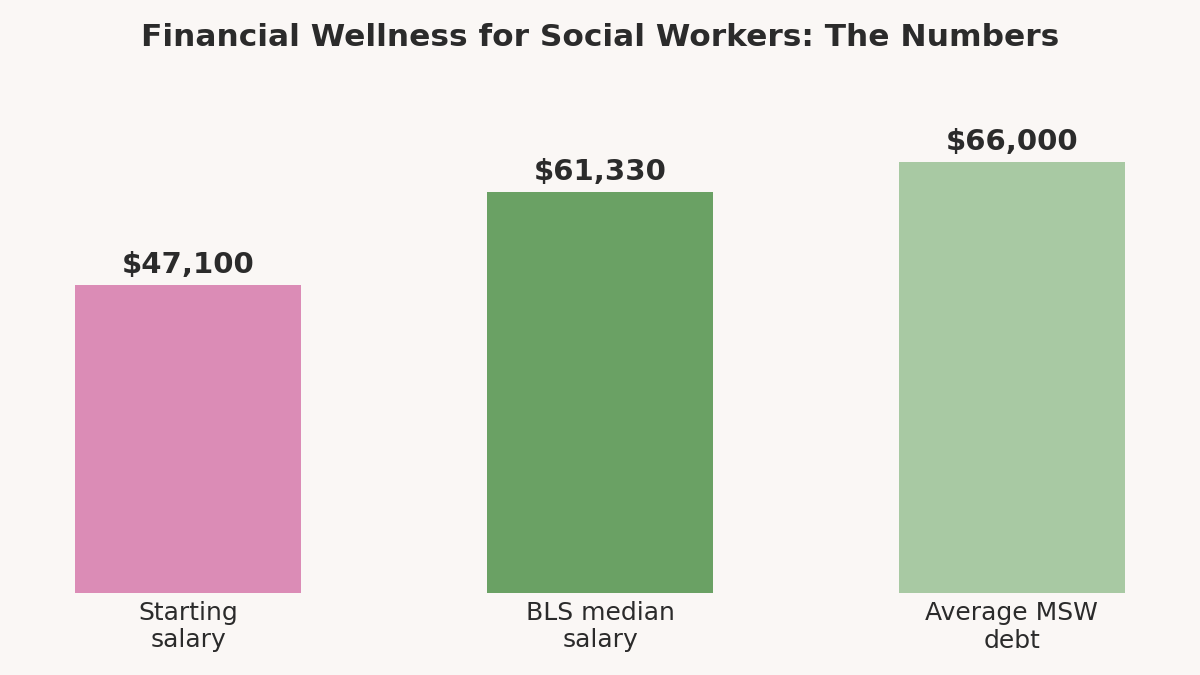
Why this matters: comparable roles in adjacent fields with similar graduate-level education often pay significantly more. Over a career, that gap compounds into a real difference in retirement savings, financial security, and life choices. Financial wellness for social workers can’t be solved by budgeting tips alone, it requires addressing both the structural underpay and the internalized beliefs that make it hard to advocate for what you’re worth. The Bureau of Labor Statistics tracks these wage figures nationally each year, so the numbers above will stay current as long as they’re periodically rechecked against that source.
ADDITIONAL READING
More Resources on This Topic
Introduces the Financial Social Work model: a behavioral approach focused on the thoughts, feelings, and attitudes that drive financial behavior, including how to open money conversations with clients.
Pay broken down by setting, specialization, and geography. Use this before any salary negotiation or when evaluating a job offer.
FREQUENTLY ASKED QUESTIONS
Common Questions About Financial Wellness
It’s a structural issue, not a reflection of the work’s value: historical undervaluing of caregiving labor, funding models tied to government and nonprofit budgets, and a lack of collective bargaining power all play a role. Part 3 of the series breaks down the four specific forces behind it.
On average, $66,000, rising to $92,000 for Black graduates. That’s weighed against a starting salary that averages $47,100, a debt-to-income ratio that’s difficult to sustain compared to other master’s-level professions.
Both, and they compound each other. Low pay is a real structural fact. But the field also selects for and reinforces people who minimize their own financial needs, which can make it harder to negotiate, set boundaries, or even notice when something needs to change. Addressing only one side leaves the other in place.
Money scripts are unconscious beliefs about money formed in childhood, often from watching how caregivers handled financial stress, scarcity, or conflict. Social workers can carry scripts that equate low pay with virtue, or that make it feel wrong to charge what their work is worth. Part 2 walks through identifying and rewriting these.
Common patterns include underpricing private practice fees, taking on unpaid extra work out of guilt, avoiding salary negotiation, lending money to clients or colleagues, and not saying no to scope creep. Part 4 covers all five in detail, with concrete scripts for each.
Yes. Starting salary differences compound over a career through raises, promotions, and retirement contributions calculated as a percentage of base pay. Even a modest increase at the start is worth more over time than the same increase later.
It’s different from budgeting advice. The Financial Social Work model, introduced in our 2012 interview, focuses on the thoughts, feelings, and attitudes that drive financial behavior, not just the numbers. It’s the same behavioral lens social workers already use with clients, applied to their own relationship with money.
Start with Part 1 if the anxiety feels bigger than your actual numbers explain. Start with Part 3 if you want the structural, not-your-fault framing first. There’s no wrong order, the four parts of this financial wellness for social workers series are designed to stand alone as well as build on each other.

