• About
    • About Blog
    • Dorlee Michaeli, MBA, LCSW
    • Privacy Policy
    • Disclaimer
  • Praise
    • Testimonials from Clients and Supervisors
    • What Readers Say
  • Blog
    • Social Work Career
    • Clinical Practice
    • LMSW Exam
    • Professional Development
    • Personal Growth
    • Social Work Career Guide: Resources, Tools & Expert Interviews
  • Contact

SocialWork.Career

SocialWork.Career provides essential resources for social workers seeking career development, job guidance, and professional growth.

  • Social Work Career Hub
  • Clinical Practice Hub
  • LMSW Exam Guide
  • Free Mental Health Webinars
  • Financial Wellness
  • Self-Care Hub
You are here: Home / Clinical Practice Hub

Clinical Practice Hub

EVIDENCE-BASED PRACTICE

Clinical Practice Hub

This Clinical Practice Hub brings together therapeutic approaches and clinical competencies that transform lives—from trauma-informed care to specialized modalities

80+
Expert Guides
7,000+
Monthly Visitors
180K+
Total Shares
Jump to Section
Trauma-Informed
Therapy Approaches
Creative Arts Therapies
Documentation
Traditional Modalities
Specialized Populations
Cultural Competence

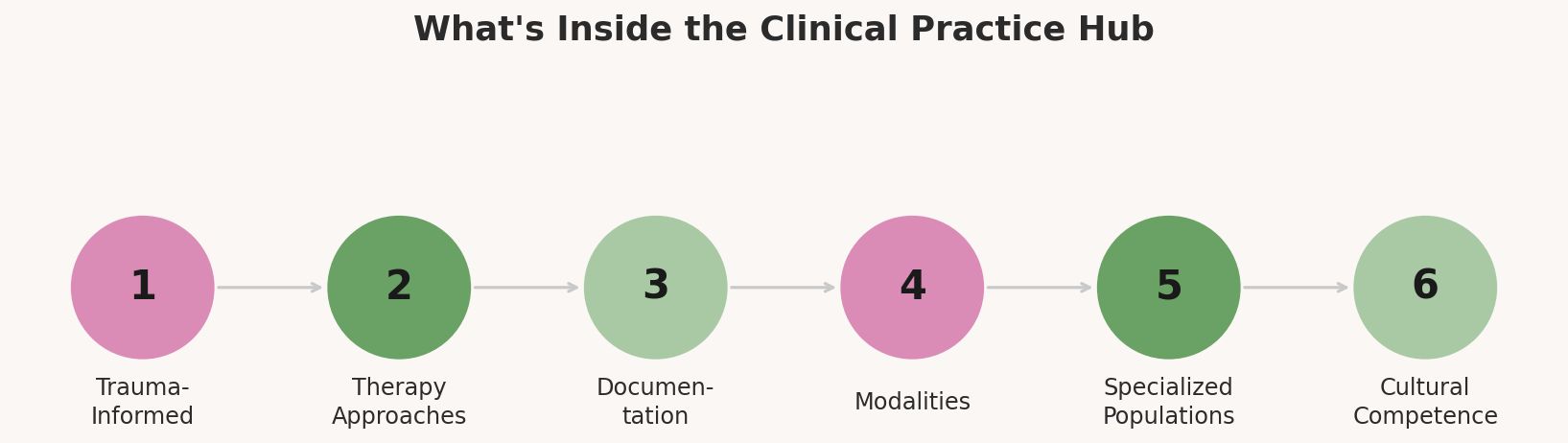
Clinical Practice Hub: six-section guide covering trauma-informed care, therapy approaches, documentation, modalities, specialized populations, and cultural competence

🔥 Most Shared Resource

Core Principles of Trauma-Informed Care

The foundational framework every clinician needs to understand. Part 2 of a 3-part series, featuring Carol Tosone, Ph.D., Associate Professor at NYU’s Silver School of Social Work, on evidence-based trauma treatments including Narrative Exposure Therapy and EMDR.

📊 63.1K shares
⏱ 12 min read
📚 Part 2 of 3
FOUNDATION

Trauma-Informed Care

Essential frameworks for understanding and treating trauma across all clinical settings, drawing on the same principles outlined by SAMHSA’s National Center for Trauma-Informed Care. This Clinical Practice Hub keeps that guidance current as the field evolves.

CORE FRAMEWORK

Trauma Treatment: Talking Is Not Enough

A guest post by Amy Knitzer, LCSW, sharing key insights from Dr. Bessel van der Kolk’s “Trauma, Attachment and Neuroscience” training. Explores why traditional talk therapy falls short with trauma survivors, and what approaches actually create lasting healing.

📊 15.2K shares
⏱ 10 min
PART 1 OF 3

Core Principles of Trauma-Informed Care: Key Learnings

Featuring Cheryl S. Sharp, MSW, ALWF, of the National Council for Behavioral Health, on the foundations of trauma-informed care, and a keynote from advocate Nelba Marquez-Greene, LMFT.

📊 8.6K
⏱ 8 min
PART 3 OF 3

The Neurobiology of Trauma: Core Principles, Part 3

Featuring Judith P. Siegel, Ph.D., LCSW, Associate Professor at NYU’s Silver School of Social Work, on the neuroscience underpinning trauma-informed care and the mind/body connection.

📊 2.8K
⏱ 9 min
EVIDENCE-BASED TECHNIQUES

Therapy Approaches & Techniques

Master the most effective therapeutic interventions and when to use them, curated for this Clinical Practice Hub

SOLUTION-FOCUSED

Solution-Focused Therapy: Key Principles and Case Example

Featuring Denise J. Krause, MSSW, Clinical Professor and Associate Dean for Community Engagement and Alumni Relations at the University at Buffalo School of Social Work. Covers the miracle question, scaling questions, exception finding, and a real session example.

📊 53.4K shares
⏱ 15 min
MOTIVATIONAL INTERVIEWING

Complete Guide to Motivational Interviewing

Featuring Kathleen Sciacca, a trainer and pioneer in integrated treatment for co-occurring disorders. Covers OARS (Open questions, Affirmations, Reflections, Summaries) through the Stages of Change.

📊 10.9K
⏱ 11 min
DRAMA THERAPY

Drama Therapy: Healing Through Role-Playing and Storytelling

Expert interview with Noel McDermott, a licensed drama therapist and psychotherapist. See also Drama Therapy in Action for a follow-up look at the approach applied in practice.

📊 91
⏱ 10 min
THERAPEUTIC RELATIONSHIP

The Art of Self-Disclosure in Therapy

Key takeaways from Janine Roberts, Ed.D.’s talk on “Therapist Self-Disclosure” at the Psychotherapy Symposium 2013. When, how, and why self-disclosure can deepen therapeutic alliance, and when it becomes harmful.

⏱ 13 min read
FIRST SESSION

4 First Session Strategies Every Therapist Should Know

Drawn from Robert Taibbi, LCSW’s talk on “Making First Sessions Count” at the 2013 Psychotherapy Networker Symposium. See also our review of Alfred and Goldie Kadushin’s The Social Work Interview, on building a strong foundation for client interviewing.

📊 7.5K
⏱ 7 min
ASSESSMENT · BOOK REVIEW

Genograms: A Powerful Therapy Tool

A review of Monica McGoldrick’s “The Genogram Casebook,” for understanding family patterns, relationships, and intergenerational dynamics.

📊 540
⏱ 9 min
THERAPIST SELF-CARE

Got Triggered by a Client? Use These Coping Tools

Lisa Schwarz, M.Ed., developer of the Comprehensive Resource Model (CRM), and Ron Schwenkler, LMFT, LPC, on releasing traumatic material from the nervous system so you’re not triggered or dissociated with clients.

📊 672 shares
PROFESSIONAL PRACTICE

Clinical Documentation

Navigate the complexities of ethical, legal, and effective note-taking, a practical anchor of this Clinical Practice Hub

RISK MANAGEMENT

Suicidal Ideation: How to Document Properly

Featuring Maelisa Hall, Psy.D., who specializes in teaching therapists how to connect with their paperwork so it’s more simple and more meaningful. Covers documentation of suicide risk assessment, safety planning, and clinical decision-making.

📊 6.8K
⏱ 10 min
BEST PRACTICES

Therapy Notes: How to Document the Gray Areas

Featuring Maelisa Hall, Psy.D., who specializes in teaching therapists how to connect with their paperwork so it’s more simple and more meaningful. What to write when clinical situations don’t fit into neat boxes.

📊 4.3K
⏱ 8 min
ETHICS

Manage Your Energy for Optimal, Ethical Therapy

An infographic on Mary Jo Barrett, MSW’s talk “Shhh! The Ethical Dilemmas No One Talks About,” from the 2013 Psychotherapy Networker Symposium.

📊 1.4K
⏱ 7 min
SPECIALIZED TRAINING

Therapy Modalities

Explore specialized therapeutic approaches and when to apply them, drawn from across this Clinical Practice Hub

What Is EMDR?

Expert interview with Andrea B. Goldberg, LCSW, on Eye Movement Desensitization and Reprocessing for trauma treatment.

🧠 442 shares

Dialectical Behavior Therapy (DBT)

Expert interview with Laura K. Schenck, Ph.D., on mindfulness, distress tolerance, emotion regulation, and interpersonal effectiveness skills.

🎯 487 shares

Gestalt Therapy and Dream Analysis

Drawn from a Gestalt therapy graduate class at NYU, applying present-moment awareness and the here-and-now approach to interpreting dreams in session.

🎭 350 shares

Parts Work

Interview with Jay Noricks, PhD, MFT, who developed Parts Psychology, on working with the inner system—understanding protectors, exiles, and the Self.

🧩 Parts Work

Play Therapy: Healing Through Play

Interview with Jennifer Taylor, LCSW, RPT, a Registered Play Therapist, on using play as the child’s natural language to process experiences and heal from trauma.

🧸 3.2K shares

🎨 Art Therapy: Featured Reading

An expert interview on the field, plus a complete 5-part personal series from a postgraduate art therapy class taken at NYU, exploring how visual expression opens up feelings that talk alone often can’t reach.

  1. The Power of Art in Healing — expert interview with board-certified art therapist Pamela Hayes
  2. Art Therapy and Social Work — part 1 of 5, 332 shares
  3. Children’s Growth Through Art — part 2 of 5
  4. 11 Tips for Employing Art Therapy Techniques — part 3 of 5, 668 shares
  5. The “Ugly” in Art Therapy — part 4 of 5
  6. The Box in Art Therapy: Inside and Outside of Self — part 5 of 5, 337 shares

Social Work and Music Therapy

Interview with Linda Grobman, MSW, LSW, CMP, founder, publisher, and editor of The New Social Worker, on pursuing music therapy as a career path.

🎵 Creative Arts

Drama Therapy in Action

Based on a graduate class Dorlee took in expressive arts at NYU, with drama therapist M. Beauregard, MA, RDT, LCAT, as guest lecturer, demonstrating role play, sculpture, story-making, and monologue exercises.

🎭 142 shares

How Therapeutic Journaling Can Empower You/Your Client

A guest post by Amy Knitzer, LCSW, reviewing and interviewing the author of Dima Dupéré’s “Feeling, Writing, Empowering,” on integrating therapeutic writing into practice with groups and individuals.

✍️ 799 shares

Can Hypnosis Be Used as a Therapeutic Tool?

Dan Short, Ph.D., on therapeutic hypnosis as a “collaborative exploration of possibility,” bringing previously unrecognized resources to awareness for the client’s benefit.

🌀 Therapeutic Hypnosis

4 Ways to Use Digital Tools to Engage Clients

Practical strategies for incorporating technology into client engagement and clinical practice.

💻 Therapy & Tech

Got Anger? Try HEArt

Key takeaways from the HEArt program, based on Dr. Howard Lipke’s book for preventing destructive anger, with Dr. Lipke answering reader questions directly.

😤 183 shares
CLINICAL EXPERTISE

Working with Specialized Populations

Develop competency with specific client populations and presenting concerns

INTIMATE PARTNER VIOLENCE

How to Help Victims of Intimate Partner Violence

Featuring Casey Keene, Director of Capacity Building and Education at the National Resource Center on Domestic Violence. Covers recognizing abuse patterns, safety planning, and trauma-informed intervention strategies. See also our review of Sherry Hamby’s Battered Women’s Protective Strategies, a strengths-based approach to safety planning.

📊 860 shares
⏱ 14 min
COMMUNITY & DISASTER RESPONSE

How to Promote Community Resilience Outside Therapy

Based on Jack Saul, PhD’s talk “Outside the Four Walls,” on the role mental health professionals can play in non-therapeutic environments, post-disaster and post-war.

📊 685
⏱ 11 min
DEMENTIA & AGING

Using Mind Mapping to Improve Quality of Life with Dementia

Dr. Huba, a psychologist diagnosed with a neurodegenerative disorder, shares how he uses mind mapping to fight cognitive decline and maintain quality of life. See also David Treadway, Ph.D.’s talk on Aging Well, on helping clients navigate the challenges of growing older.

⏱ 9 min read
GANG INTERVENTION

Gang Membership Prevention

Featuring Dr. Shadeiyah Edwards, a psychologist who specializes in working with individuals associated with gangs.

⏱ 10 min
DISSOCIATION & DEFENSES

Facing Repression

An original poem explaining repression and dissociation as childhood survival mechanisms, useful for helping clients and yourself understand why these defenses form.

📊 147 shares
CHILD SEXUAL ABUSE

50 Shades of Pain

An original poem built around a fictional composite case, illustrating how dissociation and repression protect a child through sexual abuse, and how shame gets misdirected onto survivors as adults.

📊 47 shares

🩹 Mind-Body Pain: Featured Reading

A 5-part series based on the “When Stress Causes Pain: Innovative Treatments for Psychophysiologic Disorders” conference (NYU Postdoctoral Program and Psychophysiologic Disorders Association), on chronic pain with no structural cause.

  1. Can Emotional Stress Cause Pain? [1 of 5] — Howard Schubiner, MD, on how psychophysiologic disorders develop, 38 shares
  2. Can Emotional Stress Cause Pain? [2 of 5] — Dr. David Clarke’s stress check-up framework and a recovering patient’s perspective
  3. Can Emotional Stress Cause Pain? [3 of 5] — an original poem on the mind-body pain cycle
  4. Can Emotional Stress Cause Pain? [4 of 5] — Alan Gordon, LCSW, applying CBT to mind-body pain
  5. Can Emotional Stress Cause Pain? [5 of 5] — Dr. Raja Selvam’s Integral Somatic Psychotherapy approach, 57 shares
CULTURALLY RESPONSIVE PRACTICE

Cultural Competence

Develop awareness and skills for working effectively across cultural differences, a core focus of this Clinical Practice Hub

FOUNDATION

Race Matters: How to Talk Effectively About Race

Kenneth Hardy, Ph.D.’s model for having difficult conversations about race, from his talk “Race Inside and Outside the Therapy Room” at the 2015 Psychotherapy Networker Symposium.

📊 278
⏱ 9 min
RACIAL TRAUMA

Black Lives Matter: Anti-Racism Resources for Social Workers

A curated roundup of free anti-racism webinars, racial wound healing resources for people of color, and recommended anti-racism books, articles, and toolkits for clinicians.

📊 2.2K
⏱ 45 min
LATINO CLIENTS

How to Be Culturally Competent with Latino Clients

Dr. Parra-Cardona’s ecological and culturally relevant framework, covering macrosystem risk and protective factors and transgenerational cultural identity formation for foreign-born and U.S.-born Latino clients.

📊 101
⏱ 3 min
EXPERT INTERVIEW

How to Build Cultural Competence

Interview with Raquel Ferrell Crowley, a school administrator with expertise in cultural competency, on NASW’s definition, self-assessment tools, and free online training resources.

📊 106
⏱ 14 min

FREQUENTLY ASKED QUESTIONS

Common Questions About Clinical Practice

Trauma-informed care goes beyond recognizing that a client has experienced trauma. It means restructuring how services are delivered, prioritizing physical and emotional safety, transparency, peer support, collaboration, and empowerment at every stage, so the environment itself doesn’t inadvertently re-traumatize.

It depends on the presenting concern, the client’s preferences, and your own training. Solution-Focused and Motivational Interviewing work well for goal-oriented, shorter-term work; EMDR and Parts Work are suited to trauma processing; Play and Drama Therapy fit clients, often children, who communicate more easily through action than words. Many clinicians integrate several approaches rather than relying on one exclusively.

Document the specific risk assessment you conducted, the client’s own words where possible, the safety plan agreed upon, and your clinical reasoning for the level of care chosen. Vague language protects no one; specific, contemporaneous documentation protects both the client and your license.

Sometimes, and carefully. Self-disclosure can deepen the therapeutic alliance when it’s brief, clearly in service of the client’s goals, and doesn’t shift focus onto the therapist. It becomes harmful when it meets the therapist’s needs rather than the client’s, or when it happens without clear clinical reasoning.

This is common, not a sign you’re doing something wrong. Document the ambiguity itself: what you observed, what you ruled in or out, and your clinical reasoning for the working formulation you’re using. Consult with a supervisor when the picture stays unclear, and revisit your formulation as more information emerges.

This is a real occupational hazard, not a personal failing. Approaches like the Comprehensive Resource Model focus on releasing traumatic material from your own nervous system so you can stay present with clients. Regular supervision, your own therapy, and nervous-system regulation practices all help build this capacity over time.

Share
Tweet
Pin
Share

Subscribe


Dorlee Michaeli, MBA, LCSW

Featured

Interviewed

inSocialWork

Let’s Also Connect

Recent Posts

  • Social Work Futurist: Strategic Foresight for the Future of Social Work
  • Financial Boundaries Social Workers Struggle to Set (and How to Build Them)
  • AI Tools for Therapists: 12 Questions with Kym Tolson, LCSW
  • Forensic Social Work: Where Human Need Meets Legal Consequence – An Interview with Tireeka Watson, LCSW
  • Social Worker Salary Guide 2026: What You Should Really Be Earning

Copyright

All material on this website is copyrighted by Social Work Career. All rights reserved. Please contact the editor for permission to reproduce or reprint any materials on this site.

Recent Comments

  • Dorlee on Social Work Futurist: Strategic Foresight for the Future of Social Work
  • St. Clare McFarlane on Social Work Futurist: Strategic Foresight for the Future of Social Work
  • Dorlee on Forensic Social Work: Where Human Need Meets Legal Consequence – An Interview with Tireeka Watson, LCSW
  • Sarika Carey on Forensic Social Work: Where Human Need Meets Legal Consequence – An Interview with Tireeka Watson, LCSW
  • Dorlee on Social Worker Salary Guide 2026: What You Should Really Be Earning

National Hotline

Social Work Career does not provide crisis or counseling services. If you need to talk or are concerned about someone else, please call 988. If someone is in immediate crisis, dial 911.

Search

Archives

Categories

Social Work Career · Copyright © 2026 · WordPress · Log in