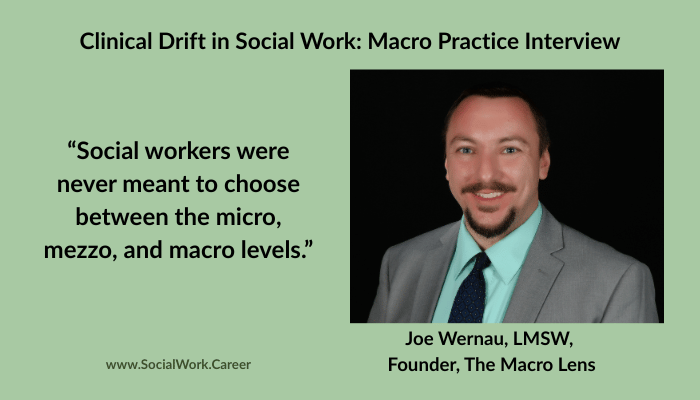
Clinical drift in social work is the slow, structural narrowing of a profession founded on social justice into one that defaults to clinical practice. Joe Wernau, LMSW, founder of The Macro Lens, has built his career around documenting how it happens and what it costs.
In this interview, he explains why 54% of MSW students who entered wanting macro careers graduated in clinical concentrations, how licensure and accreditation quietly filter out lived experience, and the concrete steps any social worker can take toward macro practice without quitting their job or going back to school.
Key takeaways:
- Clinical drift is structural, not a matter of student preference: fewer than 8% of MSW students are enrolled in macro-focused specializations.
- Clinical skills transfer directly to macro practice. The skills stay the same; the scale changes.
- Lived experience is genuinely centered only when it carries authority over budgets, hiring, and program direction.
- You can begin macro work from your current role: audit your skills, join an internal committee, and publish what you observe.
How Family Experience With Child Welfare Shaped a Macro Social Worker
Q: You came to social work through your own family’s experience of systemic harm. How did that shape the kind of practitioner and advocate you became, and how does it inform the work you do now?
I came to social work through a door opened by harm. My family navigated Iowa’s child welfare system several times, and I watched institutions meant to protect people I love fail them in ways that were systemic, predictable, and avoidable.
The greatest harm wasn’t any single decision, but the revolving door of caseworkers and service coordinators. Each transition felt like starting over from scratch. All of the progress, plans, and rapport that had been painstakingly built over months lost overnight. New faces asking old questions, forcing my loved ones to repeatedly perform their trauma for their new audience. Each time we began to heal, a new caseworker would come along and reopen the wound.
Few things are more devastating than watching those you love endure harm while you stand powerless to stop it. That profound sense of helplessness nearly broke me. However, it also provided a specific kind of clarity.
Though deeply personal, my family’s story is not unique. Millions know the same sense of powerlessness in the face of institutions meant to protect them. While I couldn’t undo what had happened to my loved ones, I could build a career focused on preventing similar harm for others.
The greatest takeaway was the desperate need for lived experience leadership. All too often, our societal systems prioritize data, compliance, and liability reduction over the knowledge of those who have lived the consequences of their failures. I believe, wholeheartedly, these systems must be rebuilt by the hands of those closest to the harms they perpetuate. That belief has shaped every decision I’ve made in this field since.
It’s also why I chose a macro concentration in my MSW rather than a clinical one. I wasn’t drawn to working one-on-one to address the symptoms of system failure. I was drawn to identifying and addressing root causes of those harms within policies, programs, and systems.
The Macro Lens is the professional expression of that commitment. It equips others to transform trauma into purpose and healing. By guiding leaders with lived experience onto the path of systemic change, I honor the resilience of my loved ones and ensure their suffering was not in vain.
Clinical Drift in Social Work: Why 54% of Macro-Minded MSW Students Graduate Clinical
Q: Your research documents that 54% of MSW students who entered wanting to pursue macro work graduated in clinical concentrations instead, not because they changed their minds, but because the infrastructure to support them didn’t exist. How widespread is this problem, and why isn’t the profession talking about it more openly?
The data is stark, and it isn’t isolated to one study. That particular statistic is from a national survey of 474 MSW students and graduates, which found that 54% of respondents who entered graduate school intending to pursue management, administration, policy, or community practice ultimately graduated in clinical concentrations.
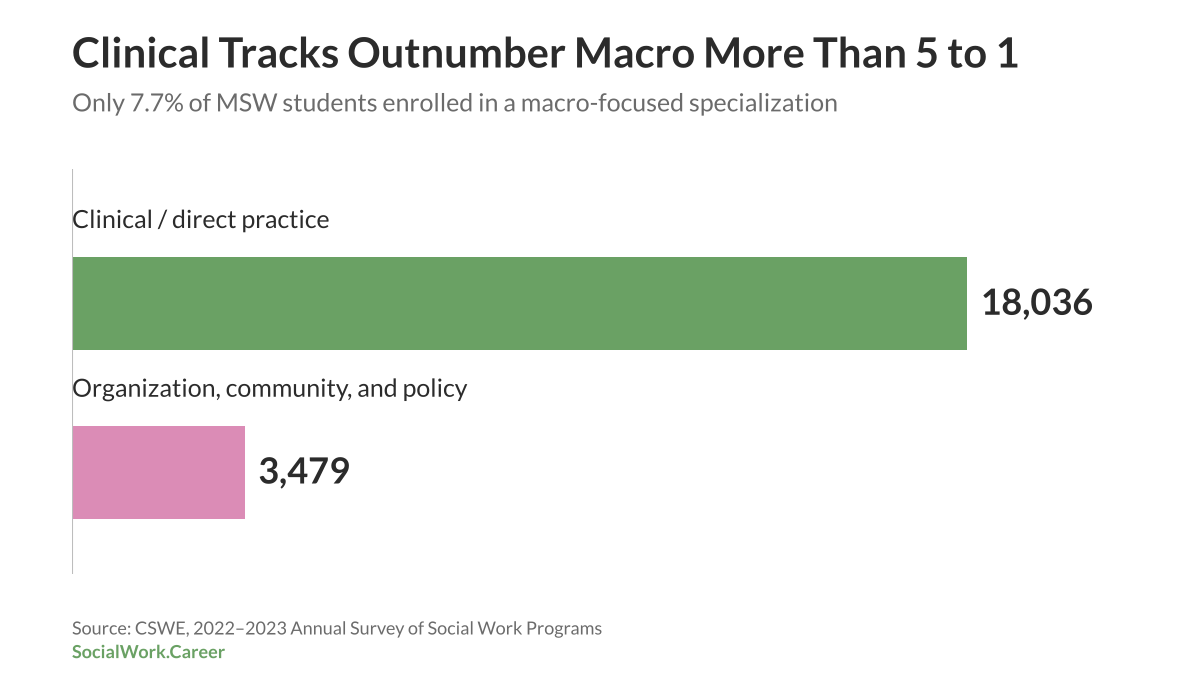
That number sits inside a larger national pattern. CSWE enrollment data from 2022 to 2023 show that only about 7.7% of master’s students were enrolled in a macro-focused specialization. Among programs reporting specialization data, students in clinical or direct practice tracks outnumbered those in organization, community, and policy-oriented tracks by more than five to one, 18,036 compared to 3,479. Nearly a third of MSW programs don’t offer a macro specialization at all.
The profession isn’t talking about it openly for a few reasons. The clearest is financial. Clinical services can be billed to insurance and Medicaid. Systems-level work cannot. That single fact means clinical practice is directly financially incentivized for the practitioner, the supervisor, and the institution employing them. The pathway with a clear reimbursement and licensure framework is the pathway programs build infrastructure around.
Clinical work also has a clearer public identity. When you tell someone you’re a therapist, they understand what that means. “Macro social worker” still generates blank stares in many rooms. Job boards reinforce this, with clinical positions dominating social work-specific listings. In contrast, roles in policy, advocacy, and leadership often don’t mention social work at all, forcing macro practitioners to argue for qualifications the degree should already confer. Students and early practitioners learn quickly which path looks employable and which one looks risky.
The social work profession has gradually stopped telling its own story accurately. Specht and Courtney warned us of the harmful pattern of “clinical drift” within the profession more than 30 years ago, and the issue has only compounded since. Program missions still invoke social justice and systemic change, but course structures, faculty hiring, and field placement infrastructure have quietly built clinical practice as the default and macro practice as the elective. The profession was founded on the premise that individual suffering is inseparable from structural conditions, and somewhere along the way, the clinical model became the unspoken default identity of the field.
But the deepest issue isn’t narrative, infrastructure, or reimbursement. It’s the false dichotomy our profession has created between levels of practice. The skills used in direct practice are the same skills macro practice requires, just applied at a different scale. Social workers were never meant to choose between the micro, mezzo, and macro levels. We were trained to move across all three, because that’s what the work actually requires.
Direct practice gives you something macro practice cannot manufacture on its own: a ground-level understanding of how policies and systems actually land on real people. Systems level thinking gives direct practitioners something clinical training alone cannot provide: the ability to look past individual diagnosis and see the structural conditions producing the pattern in front of them. Most clinical disciplines stop at individual pathology. Social work was built to go further. That breadth, the ability to hold the person and the system in the same frame, is what makes this profession uniquely positioned to address harm at every level. Segregating clinical and macro practice into separate tracks doesn’t protect either one. It undermines the core value that makes social work distinct from every adjacent profession.
Is It Too Late to Move From Clinical to Macro Practice?
Q: For a social worker reading this who recognizes themselves in that 54% – someone who wanted macro work but ended up in a clinical role – what’s the honest conversation they need to have with themselves about whether it’s too late to course correct?
The honest conversation starts with a question: Is this what you wanted, or is this just what was available?
There’s a difference between someone who discovered a genuine love for clinical work along the way and someone who defaulted into it because the macro pathway wasn’t visible or accessible. Both outcomes are valid. But if you’re sitting in a clinical role feeling like your work is managing symptoms while the structures producing those symptoms go untouched, that is worth taking seriously.
The second question is equally important: What does “course correcting” actually require? For most people, it doesn’t require quitting a job or returning to school. It starts with reframing what counts as macro practice. Advocating for a policy change inside your agency is macro work. Organizing with your colleagues around a structural issue is macro work. Writing and publishing about systemic patterns you observe in your caseload is macro work. The transition is often less about finding a new position and more about expanding the scope of what you’re already doing.
It is never too late to begin positioning yourself as someone who thinks and acts systemically. That identity is built through consistent action over time. It’s not granted by a credential or a job title. The skills are usually already there. What’s missing is the language to make them visible to the people doing the hiring, and a clear sense of where to look. I recently wrote a full guide on the platform walking through exactly that, including translating clinical experience into macro language, building a portfolio, and finding macro practice roles that are hidden when searching for “social work.”
Related reading on SocialWork.Career: 3 Secrets Every Macro Social Worker Must Know and 7 Career Tips for Macro Social Workers
The Epistemic Erosion Spiral, Explained
Q: You’ve developed a theoretical framework you call the epistemic erosion spiral to explain clinical drift. Can you describe what that spiral actually looks like in practice, and at what point in the process does a social worker typically realize it’s happening to them?
That’s a great question to dig into, and I think it’s worth clarifying one thing up front. The epistemic erosion spiral isn’t something that happens to an individual social worker, but a pattern operating at the level of the profession as a whole. That distinction matters for understanding how it actually works.
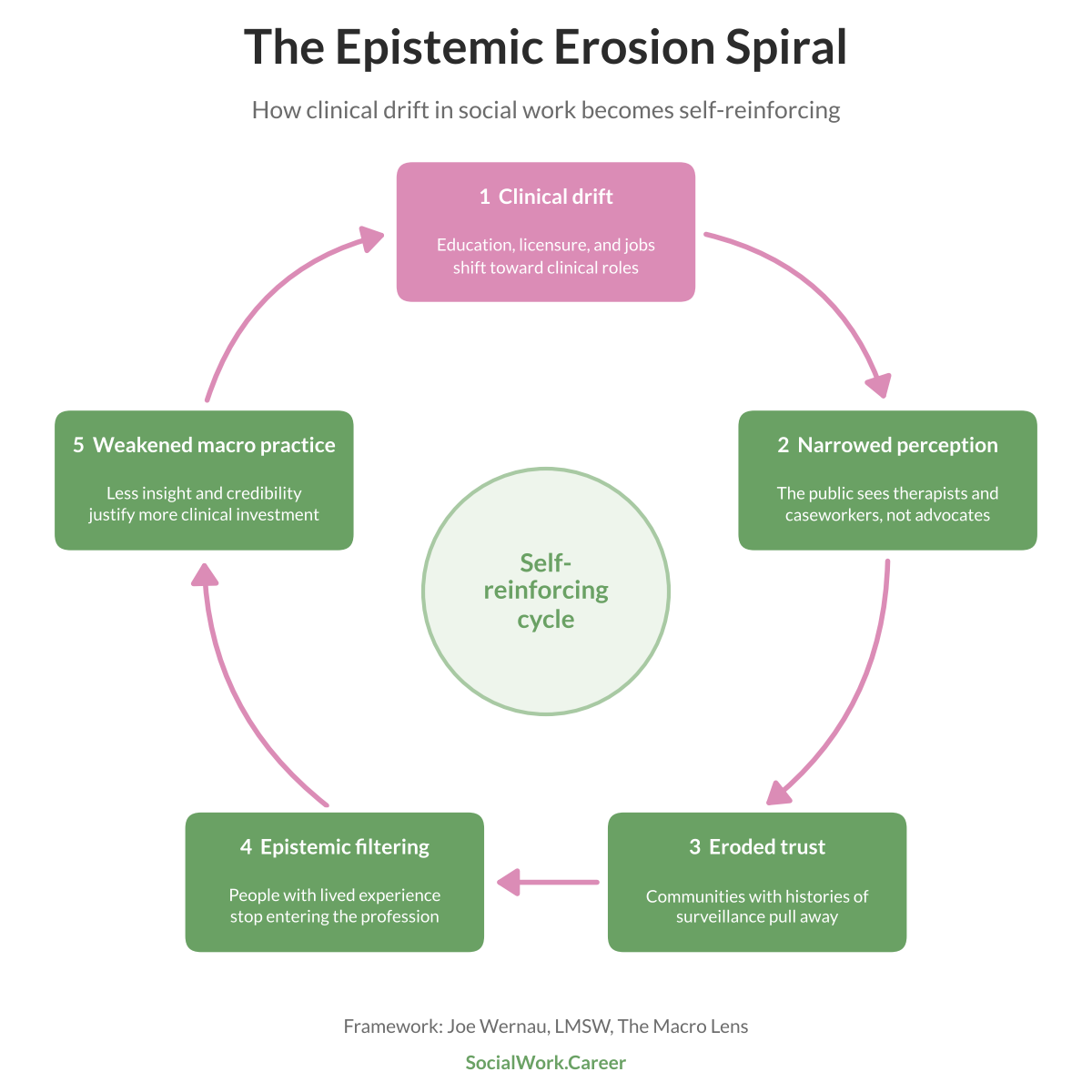
In practice, the spiral functions as a self-reinforcing process that progressively weakens the profession’s capacity for structural reform and erodes trust between the profession and the communities it serves. It moves through five connected stages.
- Clinical drift structurally shifts education, licensure, and labor markets toward therapeutic and compliance-oriented roles, while marginalizing macro practice.
- That drift narrows public perception. As macro work becomes less visible, the public increasingly sees social workers as therapists, case managers, or agents of child welfare intervention, rather than as advocates or organizers.
- That narrowed identity doesn’t land neutrally. Communities with their own histories of child welfare surveillance and cultural stigma around mental health interpret that narrowed identity through those histories. Encountering social workers primarily in coercive or stigmatized roles erodes trust and drives people away from services rather than toward them. These communities increasingly see us as agents of harmful systems rather than allies to the vulnerable.
- That erosion of trust produces epistemic filtering. System-impacted individuals, the people who carry firsthand knowledge of how these systems actually cause harm, stop seeing macro social work as a viable path toward creating positive change in their community. Their lived experience knowledge, which can never be replicated through academic training or professional socialization, is filtered out of the profession itself.
- That loss of lived experience knowledge erodes macro efficacy. Without it, macro practice loses the credibility and the insight needed to do structural work well. This weakened macro capacity ultimately justifies further institutional investment in clinical infrastructure, closing the loop and accelerating the spiral.
What an individual practitioner can notice is not the spiral itself, but its symptoms. A school social worker or a caseworker might feel a persistent dissonance: they’re doing competent work, but that work feels disconnected from the conditions producing the problems they’re managing. They’re responding to an ever-growing intake list without ever being positioned to ask why the list keeps growing. That feeling often gets misread as a personal or clinical inadequacy, something more training is supposed to fix. It isn’t. The discomfort is a downstream signal of a structural pattern, not a deficit in the practitioner.
I call it “epistemic” rather than “professional” or “organizational” because what’s actually being lost is a form of knowledge. Lived experience of coercive systems can’t be manufactured through coursework. Once the people who carry that knowledge are filtered out, it erodes from the profession’s collective understanding. That erosion is gradual, cumulative, and gets harder to reverse the longer it goes unaddressed.
Transferable Skills: How Clinical Strengths Become Macro Practice Skills
Q: You argue that clinical skills are actually systemic strengths, that individual rapport building translates into coalition building, and case planning translates into program design. For a clinician who feels like they’d have to start over to move into macro work, what transferable skills are they undervaluing?
The clinician who thinks they’d have to start over is underestimating themselves significantly. This is one of the most persistent myths in the profession, and it’s false. The skills aren’t different. The scale is.
Starting with the pairs you named. Rapport building is coalition building. The ability to enter a relationship with someone who’s guarded, who has every reason to distrust institutions, and earn enough trust that they engage with you honestly, that is the exact skill community organizing requires. Case planning is program design. Setting goals and steps for one person is the same cognitive work as designing a strategy for a community. Client advocacy is policy advocacy. Speaking up for one person is the foundation for speaking up on behalf of a population.
The pattern holds beyond those three. Case conceptualization, the ability to see someone’s situation as a system of interacting factors rather than a single presenting problem, is already systems thinking. A clinician who can map how a client’s housing instability, employment history, and family structure interact is doing the same analytical work macro practice asks for, just at a different altitude. Motivational interviewing and meeting people where they are translate into facilitation and participatory planning. Eliciting values and priorities from one person in a session is the same skill as doing it in a room full of stakeholders. Documentation and case planning translate into grant writing, program evaluation, and logic model design. The skill underneath all of it is the same: taking a complicated human situation and making it legible to an audience that wasn’t in the room.
Here’s what that looks like in motion. Picture a clinician doing in-home behavioral health work, full days of client visits and paperwork. Over time they start noticing patterns; the same resource gaps and disconnected systems showing up across cases. Instead of treating that as background noise, they start naming it out loud in team meetings, backing it up with both data and client stories. Colleagues start noticing they can connect the dots between individual cases and bigger structural questions. They get pulled into a policy workgroup. Once they’re there, none of their skills disappear. Assessment becomes system analysis. The collaboration they used to coordinate case conferences now builds consensus among agencies with competing agendas. The ethical judgment they used to navigate hard conversations with families now guides decisions about equity and resource allocation. A year in, they’re not just contributing in that room. They’re drafting the recommendations.
That’s not a hypothetical. It’s the actual shape the transition takes for most people. Nobody hands you a new toolkit. You bring the one you already have into a bigger room. Social workers need to hone and practice applying these tools at a different scale, but the foundational skills are the same at all levels of practice.
Empowered or Tokenized? How to Tell If Lived Experience Is Really Centered
Q: You write about the difference between lived experience being genuinely empowered versus tokenized within human service systems. For a social worker sitting inside an organization that claims to center lived experience, how do they tell the difference, and what do they do when they realize it’s the latter?
The simplest test is a power question. Who defines the problem? Who holds the budget? Who can say no?
Organizations that genuinely center lived experience involve people with that expertise at the framing stage, not just the feedback stage. They don’t bring community members in to validate decisions that have already been made. They don’t limit lived experience participation to panels, advisory committees, and focus groups with no formal authority. The difference isn’t whether lived experience is present in the room. It’s whether that experience carries decision-making weight once it’s there.
Tokenization has a few recognizable signatures. Timing: input gets solicited after strategy has already been set. Constraint: the role is defined narrowly enough that it can’t challenge the institution’s core assumptions. Aesthetics: the organization can point to lived experience leaders in its materials, website, and grant applications, while those same leaders have no real influence over funding, hiring, or program direction. There’s also a structural tell that’s easy to miss: tokenized roles are often grant funded rather than built into the core budget, which makes them the first positions cut when funding tightens, and credential requirements sometimes quietly cap how far someone with lived experience but no formal degree can ever advance.
There’s a second failure mode that gets less attention, and it’s just as damaging even though it isn’t tokenization in the classic sense. Organizations can sincerely want lived experience in the room and still hire people into roles without building the infrastructure to support them. Job qualifications and pay grades get sorted out after someone’s already hired. Supervisors who’ve never managed a peer role are left to guess what good supervision looks like. Caseloads start before policies on scope, boundaries, and secondary trauma exposure exist. The worker gets praised for “using their lived experience well” while no one checks whether the work is retraumatizing them. The organization may genuinely value the person’s perspective. The outcome can still be extraction: their experience generates real value for the institution without the institution investing adequately in the person carrying it.
A social worker can usually tell which pattern, or both, they’re inside by asking a few questions. Do lived experience leaders have real authority over budget, hiring, or program direction, or only a seat at the table? Were policies on scope, supervision, boundaries, and compensation in place before people were hired, or are they being figured out in real time? Is there a clear path for advancement and fair pay, or is the role treated as an entry point with no ceiling? When lived experience leaders disagree with leadership, does the organization change course, or just document that they were consulted?
What a social worker does next depends on their role and institutional standing. Some people can name the issue directly, asking in a meeting why lived experience leaders are consulted but never vote, or why a peer worker was hired without a trained supervisor in place. For people without that standing yet, the leverage is usually collective. Document the pattern. Compare notes with colleagues who’ve noticed the same thing. One person raising a concern is easy to dismiss. Several people independently describing the same gap is harder to ignore, and it spreads the risk instead of leaving one person exposed.
But everyone can start by refusing to confuse representation with power. An organization isn’t lived experience centered because it says so in a grant application. It’s lived experience centered when the people closest to the harm have the authority, support, and compensation to shape what happens next.
Professional Gatekeeping: The Licensure Exam and Other Filters
Q: Your research also examines professional gatekeeping and epistemic authority in social work. Can you give a concrete example of what that looks like in practice, and what it costs the people those systems are supposed to serve?
The clearest example is the social work licensure exam.
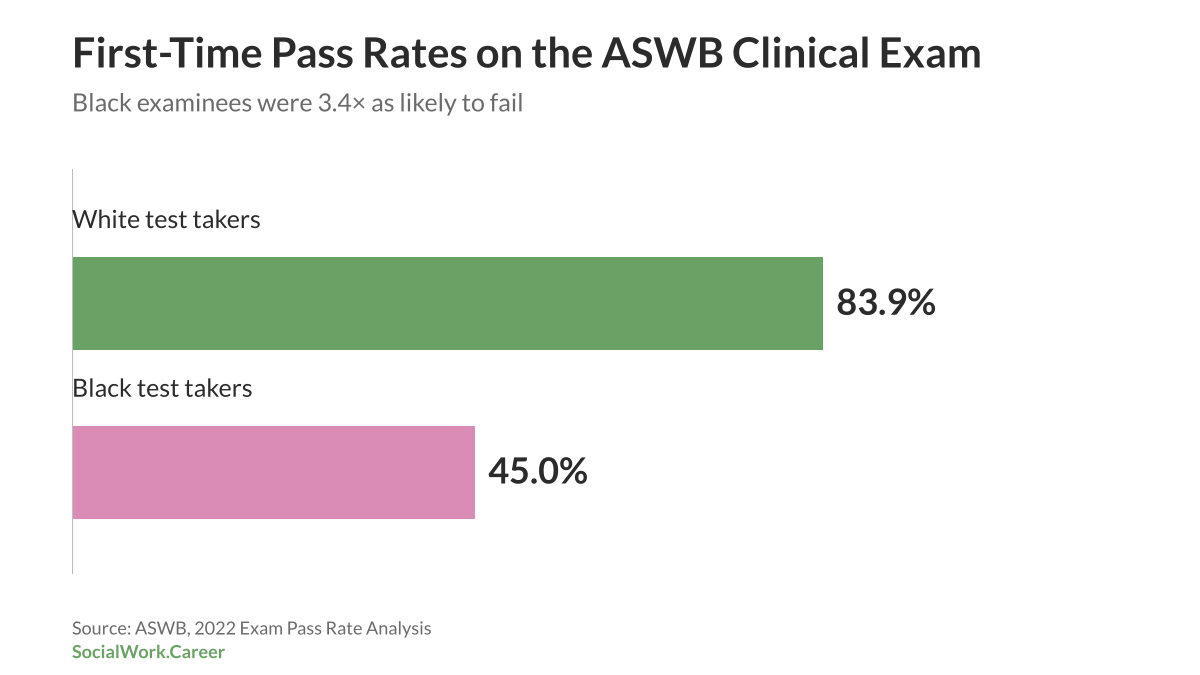
In 2022, the Association of Social Work Boards released more than a decade of pass rate data disaggregated by race. On the clinical exam, a key requirement for clinical licensure and independent practice in most jurisdictions, white first-time test takers passed at 83.9 percent. Black first-time test takers passed at 45.0 percent.
We usually describe that as a 39 point gap, but the failure rate makes the mechanism clearer. White candidates failed at 16.1 percent. Black candidates failed at 55 percent. First-time Black examinees were more than 3.4 times as likely to fail as their white peers, on the single exam that determines who gets to practice independently in this profession.
What that costs is straightforward. A license isn’t just a credential. It shapes access to independent practice, compensation, autonomy, and eventually leadership. When one group is disproportionately blocked at that gate, the effect compounds. It determines who stays in the profession, who advances, who gets heard in decision-making spaces, and whose knowledge eventually counts as expertise.
The licensure exam isn’t the only filter, and it’s worth seeing how the mechanisms stack. CSWE’s own accreditation standards formally prohibit MSW programs from granting course credit for life or work experience. Someone who has navigated child welfare, the criminal legal system, or sustained poverty firsthand can have that knowledge discussed in a classroom, but it cannot reduce the time or cost of earning the degree. Lived experience gets rhetorically centered and structurally subordinated in the same document. Even the profession’s own flagship conference reproduces the pattern: presenters accepted to speak at the CSWE Annual Conference are required to pay full registration, which quietly filters out the community organizers and peer specialists most likely to lack an institutional travel budget, while leaving the institutionally funded voices to set the agenda. Layer on top of that a mean MSW debt load of roughly $66,000, with Black graduates carrying closer to $92,000 against a $47,100 average starting salary, and the financial wall compounds for exactly the people whose firsthand knowledge the profession says it needs most.
Related reading on SocialWork.Career: Social Worker Salary Guide 2026
None of these mechanisms looks dramatic in isolation. An exam exists to protect the public. Accreditation standards exist to protect educational quality. A conference registration fee covers operating costs. But stacked together, they function as a sequential filter, screening out the people most likely to carry direct experience of the systems social work claims to reform, at nearly every entry point: financial access to the degree, credit for what they already know, the licensure that determines who practices independently, and the conference floor where the profession’s own knowledge gets debated.
The cost lands on the communities these systems exist to serve. When a profession limits whose knowledge can become credentialed, compensated, and influential, it becomes less able to understand how its own decisions actually land on the people living through them. This is not a story of individual malice. Many within these institutions are deeply committed to social work’s values. Instead, this is a story of structural logic. Institutions are designed to reproduce themselves. Over time, they optimize for legitimacy, control, and continuity. When left unchecked, these institutional priorities begin to override the values and mission they were built to uphold.
Building a Platform While Working Full Time
Q: You’re a full-time school social worker who published over 25,000 words in January alone and recently experimented with a podcast. What does that level of output look like practically, and what would you say to social workers who feel they have important things to say but don’t know how to build a platform while doing the job?
The honest answer is that I don’t have a secret system. Just a deep passion for the work, a compelling sense of urgency, and a neurodivergent brain that tends to lock into hyperfocus once I start something I care about.
Direct practice drains me in ways systems work doesn’t. Systems analysis, research, and writing give back more energy than they take, which is part of why a 40-hour school social work week followed by another 30 to 40 hours on The Macro Lens doesn’t feel like the overload it might sound like. Some of those hours are writing, but a good chunk goes to SEO, social content, and consulting work that doesn’t show up in a word count.
Practically, my process runs in bursts. I might go a week or two without writing anything, then produce a full article in a single intense session once I actually sit down. Larger white papers take longer, usually a sustained week or more of work. January, when I published over 25,000 words, was the extreme version of this pattern, and it was not sustainable. It’s part of what pushed me toward a steadier cadence closer to 8,000 to 10,000 words a month across two articles.
I learned a similar lesson trying to make the writing itself more accessible. The articles had grown from short, quick reads into heavily cited 4,000 to 5,000 word deep dives, which isn’t exactly light reading for a caseworker at the end of a hard week. I tried using AI to convert articles into podcast episodes so people could engage without the cognitive load of a long read. After a few episodes, the tool started recycling the same metaphors across topics in a way that broke the narrative, and fixing it required more editing time than the format saved. I’ve shelved the podcast for now rather than ship something that wasn’t actually good.
What I’d say to social workers who feel they have something to say: start publishing before you feel ready. The instinct to wait for a polished platform or an audience is usually what keeps people from starting at all. The platform grows from the work, not the other way around. Write the thing you wish someone had written for you five years ago. Publish it. Then do it again.
And if there’s a specific macro practice topic, tool, or guide you need and can’t find anywhere, tell me. Some of the best ideas for what I write next come from someone in the field saying exactly that.
7 First Steps Toward Macro Social Work Without Quitting Your Job
Q: For a social worker or MSW student who wants to move toward macro practice but doesn’t know where to start, without quitting their job or going back to school, what are your top 5 to 7 concrete first steps?
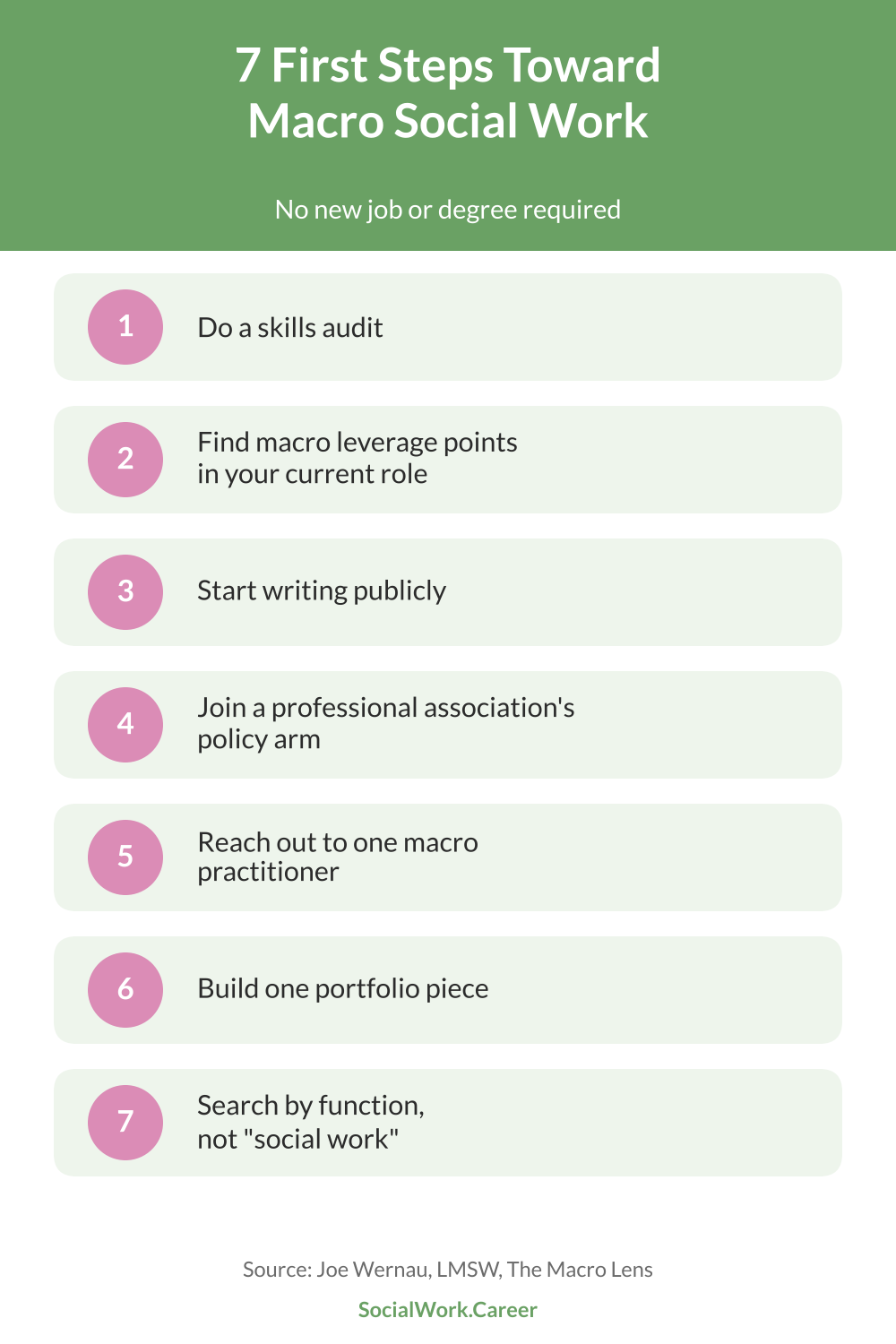
These are my top seven, in roughly the order I’d recommend approaching them.
- Do a skills audit. List every significant task from your current role, field placements, or volunteer work. For each one, ask what the bigger systems-level goal was, what broader population it touched, and what outcome it produced. This becomes the raw material for everything else on this list.
- Audit your current role for macro leverage points you’re already standing next to. Join a committee, task force, or evaluation project inside your own agency. Supervision structures, referral patterns, and agency policy are all sites where macro thinking applies right now, without changing jobs.
- Start writing publicly, even briefly. A LinkedIn post naming a structural pattern you’ve noticed in your caseload is a real contribution, not just visibility-building. It also trains you to translate clinical observation into systems language, which is the actual skill macro work requires.
- Get active in one professional association’s policy or advocacy arm. Showing up isn’t enough. Volunteer for a committee. Attend an advocacy day. Learn how the governance actually works from the inside.
- Reach out directly to one person already doing macro work whose path you find compelling. Ask for a 15-30 minute conversation. Most people remember how hard it was to find their own way in and are glad to talk. This is also how you start tapping into the hidden job market, since a large share of macro and policy roles get filled through referral before they’re ever posted.
- Build one piece of portfolio evidence. A policy brief, a community needs assessment, a letter of interest to a potential funder, or a full grant application are just a few potential artifacts. If there’s a lack of opportunity at your current job, you can always find a local nonprofit who would love the help. Five strong portfolio artifacts will do more for you than a long resume.
- Change how you search. Stop typing “social work” into job boards. Most of what you want is listed under titles like program coordinator, policy associate, or community engagement specialist, and a lot of it won’t mention a social work degree at all. Search by function and issue area instead of by credential.
The goal is cumulative motion, not a single decisive leap. None of these require quitting your job or going back to school. They require treating the skills you already have as transferable starting tomorrow, while systematically building a body of evidence and examples of your macro practice skills.
The Question Few Are Asking: Who Pays the Price of Clinical Drift?
Q: Is there a question about macro practice or clinical drift that you wish more people were asking, something critically important that isn’t getting enough attention right now?
The question I wish more people were asking is: What is the structural price of clinical drift, and who is actually paying it?
More specifically, I wish more people asked themselves and our professional institutions how the marginalization of, and lack of public awareness around, macro practice impacts trust between vulnerable populations and the profession itself.
Social work doesn’t enter vulnerable communities with a clean slate. For generations, social workers have been the visible face of child removals, involuntary commitments, and surveillance dressed up as support. Even when our profession was not overtly used as a mechanism of societal control, we often still imposed the values of a predominantly white, middle-class profession onto vulnerable communities without their consent.
This is not just a historical issue. Modern social work remains complicit in the coercion and control of vulnerable populations, most clearly exemplified by the child welfare system. Despite ongoing reform efforts, families of color continue to face significantly disparate involvement rates and outcomes nationwide. Moreover, the system still largely imposes mainstream values onto involved families, framing attempts to defend one’s cultural values as willful noncompliance.
All of that context doesn’t disappear just because today’s practitioners have better intentions or explicit commitments to cultural humility. When a community historically encounters social work through coercive or surveillance roles, “trust the process” is not a reasonable ask. Avoidance, in these circumstances, isn’t dysfunction. It’s a rational response to a pattern they’ve already lived through. Yet many of our societal systems, from child welfare to the criminal justice system, actively punish these individuals for their entirely valid response to generational systemic harm.
Here’s what makes this urgent rather than just unfortunate: the erosion of trust isn’t a side effect of clinical drift. It’s an accelerant driving it. When communities stop trusting social work as a vehicle for real change, the people from those communities who carry the most essential knowledge, the ones who’ve actually lived inside these systems, stop seeing the profession as a viable pathway toward challenging harmful systems and creating meaningful change. They go into peer support, grassroots organizing, or somewhere else entirely, anywhere their knowledge gets treated as expertise rather than supplementary testimony. We push away the very knowledge necessary to effect positive change for those communities, and the profession loses exactly the perspective it needs to rebuild that trust in the first place. Each cycle compounds the effects of the next.
We talk plenty about increasing representation in social work, more diverse students, more diverse hires. That conversation matters, but words alone are not enough. Policy briefs from our national organizations mean little if we are not willing to actively lobby for those policies at the state and national level. Diversifying the faces in the room while the institution still only recognizes certain kinds of knowledge as legitimate is little more than a publicity stunt. Unpaid community advisory boards whose findings and recommendations are filtered through organization leadership tokenize and extract value from the trauma of others, regardless of intention.
The harder and more urgent question is whether people with direct experience of these systems are shaping what the profession believes good practice even looks like. Trust will not return through better messaging. It returns when those closest to the harm hold real authority to rebuild the profession itself.
“Trust will not return through better messaging.”
Where to Find Joe Wernau and The Macro Lens
Q: You’ve built The Macro Lens as a free platform with articles, frameworks, and tools to make macro practice more accessible. Where can social workers who want to go deeper find you and your work?
The central hub for everything is themacrolens.com. That’s where the long-form articles, practice frameworks, and tools live, and it’s where I publish first before anything goes anywhere else. It is also the home of my Macro Social Work Resources Hub, which is a curated list of more than 55 free macro practice tools and guides, organized into 9 categories. I am committed to keeping all of these tools, guides, and articles entirely free and open access, as the founding principle behind the platform is reducing barriers between practitioners and the tools needed to effect positive change.
From the website, everything else branches out. I cross-post to Medium, Substack, LinkedIn, and Facebook, but if you only have time for one additional platform, my LinkedIn profile offers the most unique value. I post infographics and shorter, more visual content there that doesn’t exist anywhere else. It won’t replace the depth of the long-form articles, but it’s a good fit if you want to engage with the ideas in smaller pieces. Feel free to send me a connection request or message.
The Macro Lens Newsletter is the best way to make sure you don’t miss new content, and you can subscribe for free directly on the website. I keep this list deliberately light. Subscribers get three emails a month, the newsletter plus two new articles, and that’s the full extent of it. No daily check-ins, no sales pitches, nothing that exists just to keep your attention. Every email has actual substance behind it. I’m exploring additional options for people who want more frequent updates down the road, but the core newsletter will stay capped at three meaningful emails per month for anyone who’d rather not add more noise to their inbox.
For the academic side of this work, that’s where you’ll find material that isn’t on the website at all. The full empirical evidence behind my theoretical frameworks like the epistemic erosion spiral and the credentialing apparatus are published as working papers, and you can find them through my ORCID profile or directly on SSRN. If you want the complete citations, the methodology, and the full argument behind the concepts I write about for a general audience, that’s where to look.
Finally, if there are any macro social work-related topics, guides, or tools you are actively looking for, or you have specific questions or concerns, my inbox is always open. You can reach me directly at joe@themacrolens.com or by messaging me on LinkedIn.
Joe Wernau, LMSW, earned his BSW (2022) and MSW (2023) at Grand View University. He works full time as a school social worker and founded The Macro Lens to keep macro practice resources free and open to all.
Frequently Asked Questions About Clinical Drift in Social Work
What is clinical drift in social work?
Clinical drift is the structural shift of social work education, licensure, and labor markets toward clinical and therapeutic roles, at the expense of macro practice such as policy, community organizing, and administration. Specht and Courtney raised the warning decades ago; Joe Wernau argues the pattern has only compounded since.
Can a clinical social worker transition to macro practice?
Yes. Wernau stresses that clinical skills like rapport building, case planning, and client advocacy map directly onto coalition building, program design, and policy advocacy. Most transitions start inside a current role through committees, workgroups, and public writing. For more on building a macro career, see 7 Career Tips for Macro Social Workers.
What job titles should macro social workers search for?
Search by function and issue area rather than “social work.” Titles like program coordinator, policy associate, and community engagement specialist surface roles that rarely mention the MSW. 3 Secrets Every Macro Social Worker Must Know covers this job search strategy in depth.
What is the epistemic erosion spiral?
It’s Wernau’s framework for how clinical drift becomes self-reinforcing: a narrowed professional identity erodes community trust, which filters people with lived experience out of the profession, which weakens macro practice and justifies further clinical investment.
Why do ASWB exam pass rates matter for macro practice?
The 2022 ASWB data showed first-time Black test takers passed the clinical exam at 45.0%, compared with 83.9% for white test takers. Because licensure shapes compensation and leadership, these gaps affect whose knowledge shapes the profession. If you’re preparing for licensure, the LMSW Exam Guide walks through proven study strategies.
Explore more career guidance: Visit the Social Work Career Hub for job search tools, salary data, and expert interviews from across the profession.
Interview conducted by Dorlee Michaeli, MBA, LCSW.



Leave a Reply