Understanding Play Therapy: An Expert Interview
Have you wondered what play therapy is and/or how you may incorporate it into your practice? This post will provide an introduction to play therapy, as well as give you an Inside Out Feelings Activity that you may conduct with your child/client to help him/her better understand and manage emotions.
Today’s guest expert is Jennifer Taylor, a Licensed Clinical Social Worker (LCSW) and Registered Play Therapist (RPT) specializing in individual, group , and family therapy with a speciality in Play Therapy.
Jennifer has 15 years of experience as a social worker and is currently working as a private practitioner at Jennifer Taylor Play Therapy Services, and an adjunct instructor at the University of Memphis and the University of West Florida, teaching graduate level play therapy courses.
So without further ado, Jennifer, what led you to become a play therapist?
I attended a conference on Psychological First Aid for children and one of the presenters was a Registered Play Therapist (RPT). It was the first time I had heard of that credential, but the things that she did and talked about (both practical tips and also ways of just interacting with children) were so helpful and really suited my personality.
After that, I learned that my area did not have anyone with an RPT credential because there were not any local trainings. Luckily, my husband got stationed in San Diego with the Navy and they have a huge play therapy base there so I was able to get really good training.
I completed the majority of the training required through a certificate program at the University of California San Diego extension and then did an intensive supervision at the University of North Texas.
What is play therapy?
Play therapy is a type of mental health counseling that allows children to use a specially designed playroom to facilitate expression of emotions and feelings. In play therapy, children can take control of the therapy experience by choosing to play and/or talk.
Play therapy is a developmentally sensitive way to help children who are not yet ready for the traditional counseling experiences that are designed for adults.
How do you describe play therapy to the kids with whom you work?
I would say something like, “Hi, My name is Jennifer. I work with kids who are having some trouble at home or at school so that they can feel better and get along better with people. I have a special room set up where you can choose to talk or play in most of the ways you would like. (and then introduce the playroom).”
It usually doesn’t take much convincing after seeing the playroom, but if a child is anxious, I would explain that their parent will be nearby if we need them.
I then allow the child a chance to “hang out” without demanding or expecting anything during the first visit. This allows the child to build trust in the therapy process and get comfortable at their own pace.
How do you usually begin to work with a child?
Play therapy can be directive or non-directive so it might depend on the particular therapist and their theoretical framework.
I typically start off with non-directive (child centered play therapy.) So, the child gets to choose what they would like to do and the therapist follows the child’s lead. The relationship between the therapist and the child is valued over specific interventions or techniques.
There are very few rules and those are imposed only to protect the safety of the child, therapist and the space/toys. However, there are also some really good structured or directive interventions that can be helpful, especially with older children.
Can you give us an example of how you are able to use play therapy to help a child resolve a problem or heal from a past stressful experience through play?
I am reluctant to provide specific case examples, but can say this: I worked with a child that witnessed a very bloody crime in the home and this child was able to use paint to “play out” the images of that scene so that it became less scary.
Although the child did not talk about the event very much, after about 6 sessions of play therapy and the self-directed painting, the child was showing almost none of the previous symptoms (avoidance of the victim or the house, nightmares, withdrawn and anxious behaviors).
Another child witnessed very serious acts of domestic violence between parents and was having behaviors that included violence towards the parent that was the victim in the adult relationship, as well as separation anxiety towards that same parent.
Through non-directive play, the child was able to use the toys to demonstrate the specific acts of aggression, as well as the family dynamics and conflicted feelings towards each parent (conflicted loyalties, positive/negative feelings about each parent). This play allowed for the rebuilding of the relationship with the parent and a renewed sense of safety for the child.
As far as how this happens…again it begins with creating an atmosphere of safety so that the child feels free to express their thoughts and feelings in a way that is comfortable for them.
It means giving the child an opportunity to use words (or not) and showing a genuine concern and interest in developing a relationship with the child rather than just trying to reduce specific behaviors or symptoms.
Once that is established, the therapist is able to help the child give words and meaning to their experiences in a way that helps the child to normalize and validate their feelings and find more appropriate coping skills.
Could you share a play therapy activity that you sometimes use?
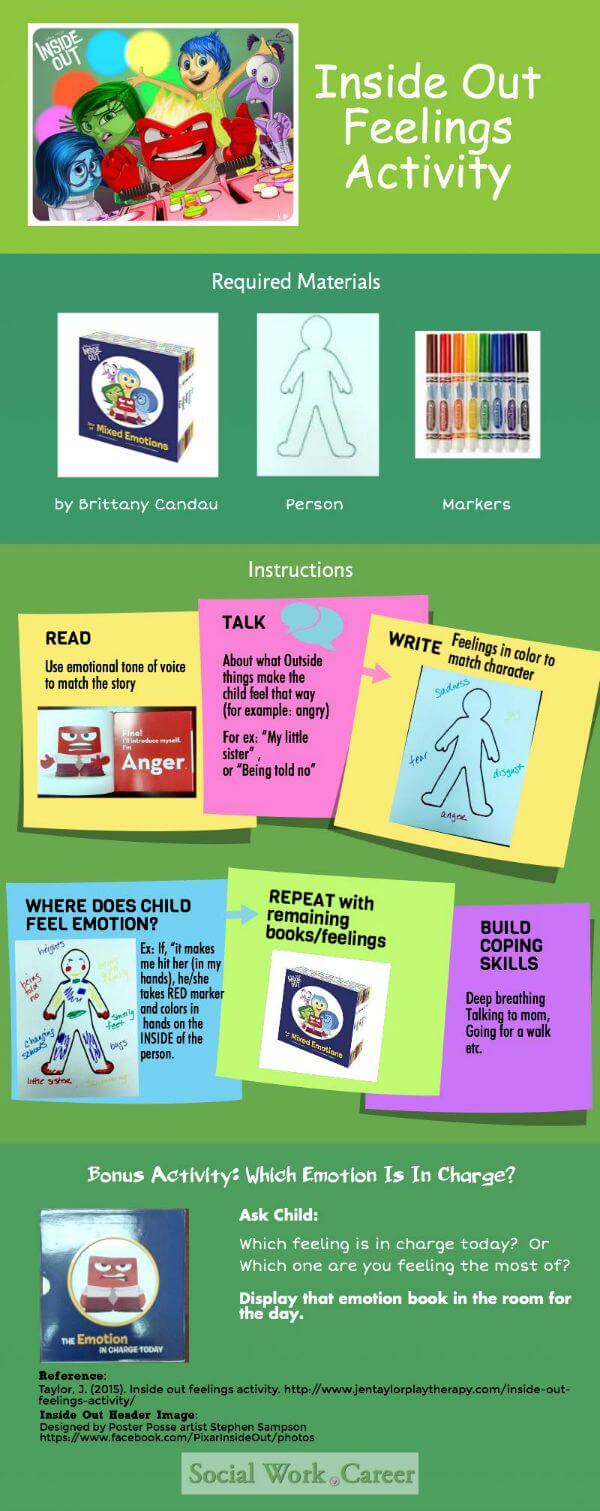
In this 4 minute video, I describe an “Inside Out Feelings” Activity in which you help a child explore and label feelings. It’s best for children ages 5-8, but I have also used it with some older children with good success.
For a written description of the activity, see the above infographic or Inside Out Feelings Activity.
What are some of the key assessment tools or questions you use with the child and/or parent during the first few sessions (to gauge where the child is at developmentally and emotionally and what he/she needs)?
I use standard psychosocial intakes and do a mental status exam just like you would with adults. Some of the more child specific questions I ask have to do with school (grades, conduct, bullying), sleep habits, screen time, discipline techniques, family meals, and social media.
For children that are not school age, I use the ASQ-3 (Ages and Stages Questionnaire) and I sometimes use the MCHAT to rule in/out autism. Most of the assessment comes from interacting with the child but is not through a standardized instrument.
For all children, I use the CATS (Child and Adolescent Trauma Screening) to determine the exposure and risk for PTSD.
For teenagers, I use the PHQ-9 to screen and monitor depression.
What do you enjoy most about your work with children?
I truly enjoy the process of seeing children mature and work out their problems from session to session.
While I believe wholeheartedly in the science and theory behind child centered play therapy, being a witness to the process of how a child makes changes from one session to the next is a special experience.
And what do you find most challenging about your work with children?
For me, working with children and their parents is the easy part.
The most challenging aspect of working with children is that, unfortunately, there are so many children today who have witnessed horrific things or are dealing with issues that are so severe and complex.
It becomes hard to set personal boundaries on the number of clients to see in a day or week because the need is so great. And yet, without those boundaries, I become a much less effective therapist.
Jennifer’s Play Therapy Room
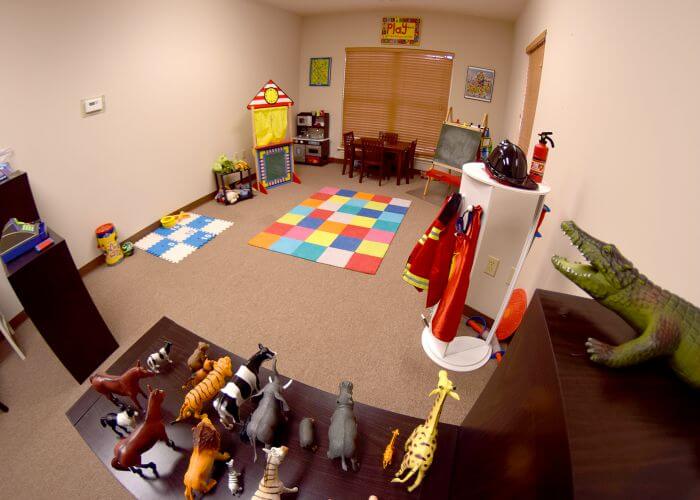
Setting Up Your Play Therapy Room
What toys/play equipment do you recommend every play therapist have?
You want to try to get a few things from each of these categories:
- Expressive (Art/paint/markers/paper, musical instruments, scarves/dress up)
- Aggressive (Handcuffs, dinosaurs, sharks/rope, knife)
- Real Life (Doctor kit, kitchen, dollhouse)
- Also a favorite for all is Sand/Sandbox (if your space allows for it)
Essential Play Therapy Resources
Which are your favorite 3 books/videos/podcasts for play therapy?
Far and away, the most highly recommended book is ““The Art of the Relationship” by Gary Landreth as this is widely considered a basic starting point for anyone interested in providing play therapy.
Second, I love “The Boy Who Was Raised as a Dog” by Bruce Perry. Although not specifically about play therapy, it is an excellent resource for dealing with children who have experienced trauma.
There is also a great, short youtube commercial produced by the Association for Play Therapy called “Introducing Andrew” that explains the value of play therapy in a fun and entertaining way.
How to Become a Play Therapist: 9 Essential Tips
Lastly, what are your top tips for mental health professionals interested in becoming play therapists?
- Join the Association for Play Therapy so that you get the magazines and the journals. They are a great resource and the membership is not expensive.
- Get good quality training (there are excellent resources through University programs and also approved providers that offer conferences).
- Seek out supervision -don’t just think that you can go to a couple of conferences and then be a good play therapist. You really need to get good supervision from someone who can help you through the process.
- Start selecting toys to build your play therapy tool kit. Don’t just collect a bunch of stuff, but look for toys that will facilitate creative/emotional expression, symbolize real-life or help act out aggression.
Go to consignment sales, yard sales and Goodwill stores. Used toys are better than new toys most of the time. Stay away from electronics and easily recognizable cartoons.
- Read! Start with the two books that I recommended, but also read articles, journals, books, and anything else about children and play therapy. Learning is a process that never stops and play therapy is no exception.
- Start with your own family. Always make your own children (or those in your family) the priority. Don’t spend all of your time working with other people’s children and neglect the ones closest to you. My first and last play therapy appointment of each day is with my three beautiful children.
 Jennifer and her three children (1 girl and twin boys)
 - Find time to enjoy playing yourself. Do things that you love and enjoy. Go outside. Get a hobby. Relax. Make sure that you are a good model of enjoying life and being personally accountable for your own well-being.
- Connect with other play therapists. There are so many resources available on YouTube, Pinterest, and Facebook. Google for resources and connect with other professionals in person or online because I learn so much from their experiences.
- Finally, trust the process. Sometimes it can feel like you are not getting anywhere or that it’s “just play” and “not really therapy.” But in the end, I believe that the play IS the therapy and if you trust the process and truly follow the child’s lead, you will start to have more faith in the power of play therapy and witness that it is the best intervention for children.
Thanks so much, Jennifer, for giving us this lovely introduction to play therapy!
What questions or thoughts do you have about play therapy?
Like this post? Please share it!
Disclosure: This post contains affiliate links. This means Social Work Career may receive a small commission if you make a purchase. Regardless, I only recommend or include recommendations for products or services I believe will be good for my readers.
Related Resources for Clinical Social Workers
Expand your therapeutic skills and career knowledge:
Evidence-Based Therapy Approaches
Dialectical Behavior Therapy: A Mindfulness-Based Behavioral Therapy
Comprehensive interview with DBT expert Dr. Laura K. Schenck explaining the four core skills modules, wise mind concept, and why DBT is particularly effective for borderline personality disorder and emotion regulation challenges. Includes visual infographics of key concepts.
Building Your Career
Complete Guide to Starting Your Private Practice
In-depth interviews with Tamara G. Suttle, M.Ed., LPC and Michael Langlois, LICSW covering everything from building essential clinical skills before opening doors to getting your first clients, marketing strategies (websites, blogging, social media), managing the business side, and finding your niche.
10 Must-Know Private Practice Start-Up Tips
Visual infographic distilling expert advice on successfully launching your practice: start networking NOW, create self-care plans, establish systems early, invest in quality websites, blog to get known, and remember it’s a marathon not a sprint.
Professional Development
Online Toolkit for New Social Workers
Curated collection of 10 essential posts for students and new practitioners: getting strong recommendation letters, acing interviews, passing the LMSW exam, developing clinical and macro skills, leveraging social media for career growth, and building online authority.
Looking for more clinical practice resources? Browse our complete Clinical Practice category for interviews with experts, therapeutic approaches, and professional development guidance.
About the interviewer:
Dorlee Michaeli, MBA, LCSW specializes in EMDR therapy for high-achieving professionals struggling with imposter syndrome. She provides consultation for complex cases involving perfectionism and workplace anxiety. Learn more.
Last updated: January 1, 2026



Thanks Dorlee and Jennifer for this informative post on play therapy!
Jennifer, How do you ask parents about their disciplinary methods? (some may not feel comfortable in sharing this kind of information)
Hi Samantha,
It was my pleasure to interview Jennifer 🙂
I love the question you raised; I’ll send Jennifer a quick email so that she may respond at her earliest convenience.
Hi Samantha,
That is a great question. It might sound surprising but most of the parents that I see are pretty up front about their discipline techniques. Usually, if they are talking about a particular behavior, I would empathize with the frustration, “That behavior is really frustrating” and then just ask, “What did you do after that happened?” or “How have you tried to manage that in the past?”
This was a fascinating read!
Thanks, Lee
I’m so glad you enjoyed the interview with Jennifer!